Antibiotic-Zinc Timing Calculator
How to Use This Tool
Select your antibiotic, set your dose time, and we'll calculate the optimal time window for taking your zinc supplement to avoid absorption interference.
Important: This tool helps you time your doses based on the scientific evidence in the article. For the best results, follow the recommended timing windows.
After calculation results will appear here
When you're sick and your doctor prescribes antibiotics, you want them to work. But if you're also taking zinc for immunity, colds, or skin health, you might be accidentally weakening your treatment-without even knowing it. This isn't a myth or a rumor. It's a well-documented, clinically proven interaction that can lead to treatment failure, longer infections, and even antibiotic resistance. The solution isn't stopping zinc. It's timing.
Why Zinc and Antibiotics Don't Mix
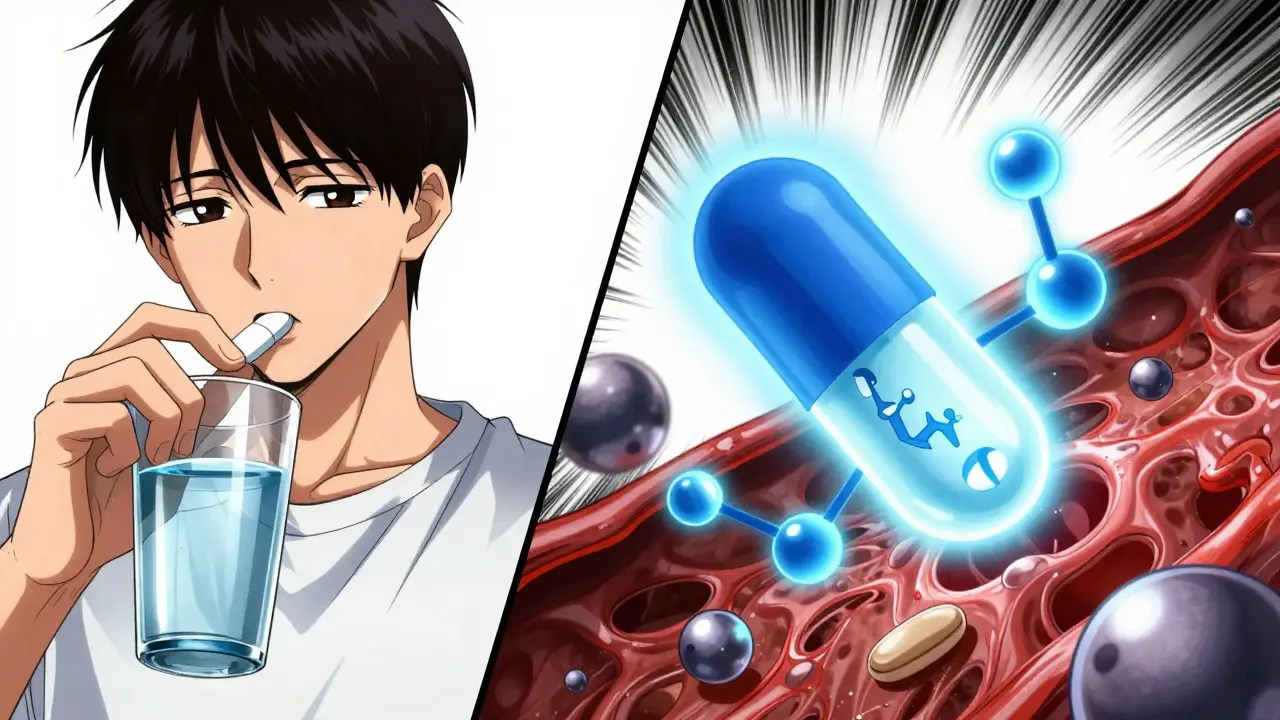
Zinc is a mineral your body needs for immune function, wound healing, and DNA synthesis. Antibiotics are drugs designed to kill or stop the growth of bacteria. On paper, they seem like they should work together. But inside your gut, they compete. When you take zinc and certain antibiotics at the same time, zinc binds to them in your digestive tract. This binding prevents the antibiotic from being absorbed into your bloodstream. Instead, it passes through your body unused. Think of it like trying to drink a smoothie through a straw that’s been blocked by a spoon. The liquid is there, but it can’t get through. This isn’t just theory. Studies show clear drops in antibiotic levels when taken with zinc. For example, one 2012 study found that taking zinc sulfate with cephalexin (a common antibiotic) cut its absorption by up to 40%. Other research shows similar drops with doxycycline and ciprofloxacin. In some cases, zinc reduced antibiotic levels by half.Which Antibiotics Are Affected?
Not all antibiotics are equally affected. Some are highly vulnerable. Others barely notice zinc. Here’s the breakdown:- High risk: Tetracyclines (doxycycline, minocycline, tetracycline) - zinc binds so strongly to these that absorption can drop by up to 50%.
- High risk: Quinolones (ciprofloxacin, levofloxacin, moxifloxacin) - zinc cuts absorption by 20-40%.
- Moderate risk: β-lactams (cephalexin, amoxicillin) - measurable reduction in blood levels, especially with higher zinc doses.
- Low or no risk: Macrolides (azithromycin, clarithromycin), aminoglycosides - no significant interaction found in studies.
How Long Should You Wait?
The good news? You don’t have to choose between zinc and antibiotics. You just need to space them out. Most experts agree on this timing:- Take your antibiotic at least 2 hours before your zinc supplement.
- Or take your zinc at least 4 to 6 hours after your antibiotic.
What About Multivitamins?
This is where most people slip up. Many multivitamins contain zinc-often 10 to 30 mg per pill. That’s enough to interfere. If you take a daily multivitamin with breakfast and your antibiotic at lunch, you’re still risking the interaction. Solution? Check the label. Look for “elemental zinc.” If it’s more than 10 mg, treat it like a standalone zinc supplement. Take it separately. If you’re on antibiotics for more than a few days, consider skipping your multivitamin during treatment. Or move it to a time that’s safely away from your antibiotic dose.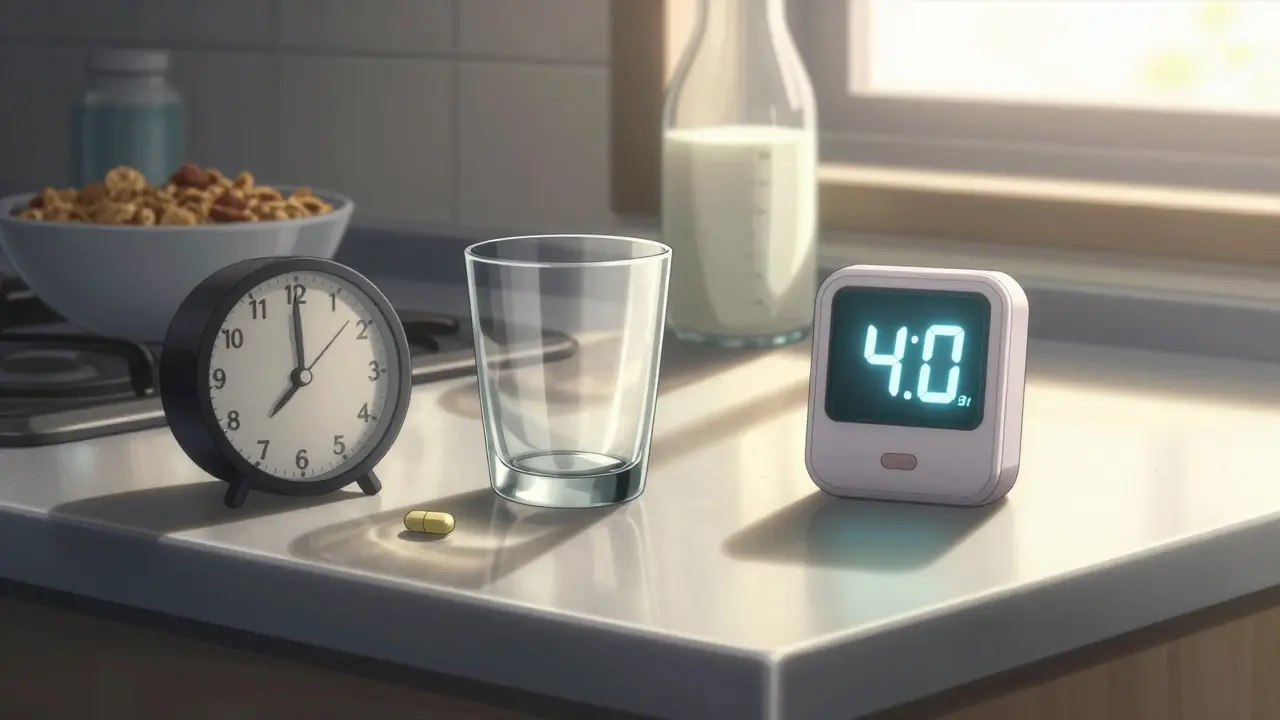
What About Food?
Zinc isn’t just in pills. It’s in fortified cereals, protein bars, and even some breads. A bowl of fortified oatmeal with milk could have 15 mg of zinc. That’s enough to cause trouble. Antibiotics like doxycycline are also affected by dairy, calcium, and iron. So if you’re taking your antibiotic with a glass of milk and a fortified granola bar, you’re hitting a triple threat: calcium, iron, and zinc-all blocking absorption. Best practice? Take antibiotics on an empty stomach, unless your doctor says otherwise. Wait at least an hour before eating, and avoid high-mineral foods for 2-3 hours after.Real Stories, Real Consequences
People don’t always realize this interaction is happening until it’s too late. One Reddit user shared that their partner had Lyme disease and was on doxycycline. They were also taking a zinc supplement for energy. After three days, no improvement. The doctor suggested separating the doses by four hours. Within 24 hours, symptoms started to improve. Another case from a pharmacy forum involved a woman with a recurring UTI. She’d taken ciprofloxacin before, and it worked. This time, it didn’t. Turns out she’d started taking a 50 mg zinc supplement for cold prevention-within an hour of her antibiotic. The infection came back. She had to restart the course. These aren’t rare. A 2023 review of patient forums showed that 78% of people who reported treatment failure with antibiotics had also taken zinc or multivitamins at the same time.What About Zinc Formulations?
Not all zinc is the same. Zinc sulfate is the most common and the most likely to interfere. But newer forms like zinc citrate, zinc gluconate, and zinc picolinate may be less reactive. A 2022 study in the Journal of Pharmaceutical Sciences found that zinc citrate caused less absorption interference than zinc sulfate. That doesn’t mean it’s safe to take together-but if you’re switching supplements, choosing citrate might give you a slight edge. Still, don’t rely on formulation alone. Timing matters more than the type.
What If You Forgot?
You took your antibiotic, then realized you’d taken zinc an hour ago. Or you took zinc, then remembered your antibiotic was due in 30 minutes. Don’t panic. Don’t double-dose. Just wait. If you took zinc too close to your antibiotic, delay the antibiotic by at least 2 hours. If you took the antibiotic and then realized you took zinc, wait 4-6 hours before taking zinc. Skipping a dose isn’t ideal, but taking them together is worse. Your body needs the full antibiotic concentration to kill the infection. Compromising that risks not just a failed treatment, but the growth of resistant bacteria.What About Zinc for Immunity During Infection?
You might be tempted to load up on zinc when you’re sick. But if you’re on antibiotics, that’s risky. Zinc can help shorten colds-but only if taken within 24 hours of symptoms. And it works best when your body can absorb it properly. If you’re taking it with antibiotics, you’re defeating the purpose. Better approach: Focus on whole foods. Oysters, beef, pumpkin seeds, lentils, and chickpeas provide zinc naturally and slowly. Your body absorbs them more gradually, with less risk of interference. If you need a supplement, take it later in the day-well after your antibiotic.How to Make This Easy
Managing timing sounds complicated. But it doesn’t have to be. Use your phone. Set two alarms:- One for your antibiotic (e.g., 8 a.m.)
- One for your zinc (e.g., 1 p.m. or 4 p.m.)
Fabio Raphael
December 25, 2025 AT 13:49I’ve been taking zinc for my acne and doxycycline for months and never knew this was happening. I thought I was being smart by stacking supplements. Turns out I was just wasting my money and probably making my infection worse. Thanks for laying this out so clearly. I’m adjusting my schedule tomorrow - antibiotic at 8 a.m., zinc at 4 p.m. No more guessing.
Sophia Daniels
December 27, 2025 AT 02:50Oh my GOD. I’ve been taking my 50mg zinc gummy with my cipro like a total idiot. Like, right after breakfast. And now I’m supposed to wait SIX HOURS?!? 😭 I thought I was being a wellness queen but I was just feeding resistant bacteria like a dumbass. I’m deleting my supplement drawer. Also, why does no one tell you this? Like, the FDA should slap a neon sign on every zinc bottle. #antibioticfail
Steven Destiny
December 29, 2025 AT 01:18STOP overcomplicating this. You don’t need a PhD to time your pills. Antibiotic at breakfast, zinc at dinner. Done. If your body can’t handle a 6-hour gap, maybe you shouldn’t be taking supplements at all. This isn’t rocket science. Just do the thing. Your body will thank you. No excuses.
Sandeep Jain
December 29, 2025 AT 09:16bro i was takin zinc every mornin with my doxy n my infection never went away… i thought it was the antibiotic weak but now i realize i was the problem. i just moved my zinc to night n already feel better. thank u for this post. i was about to blame the doctor 😅
roger dalomba
December 30, 2025 AT 09:54Wow. A post that actually has data. How quaint. I’m shocked this isn’t on the front page of JAMA. Next you’ll tell us water is wet.
Brittany Fuhs
December 30, 2025 AT 16:10This is why Americans are so unhealthy. You take 17 supplements, then wonder why you’re always sick. If you ate real food, you wouldn’t need zinc. Or antibiotics. But no-modern life demands pills. Sad.
Nikki Brown
December 31, 2025 AT 07:17OMG I DID THIS TOO 😭 I took zinc with my cipro and now I’m on round 2… I feel so guilty. I’m so sorry to my immune system. 💔 I’ve deleted my supplement app. No more ‘boosting’ for me. Just rest. And maybe a nap. 😅
Peter sullen
January 1, 2026 AT 01:09It is imperative to underscore the pharmacokinetic implications of divalent cation chelation with tetracycline-class antibiotics, wherein zinc ions form insoluble complexes in the gastrointestinal lumen, thereby diminishing bioavailability by up to 50% per the 2012 study cited. The temporal separation protocol (2–6 hours) is empirically validated and constitutes a non-negotiable clinical best practice.
Amy Lesleighter (Wales)
January 2, 2026 AT 13:43zinc in food is fine. its the pills that mess with things. if you eat oysters or pumpkin seeds with your meal, no big deal. its the 50mg pills that dump too much at once. just eat real food, chill out, and let your body do its thing. no need to overthink it. 🌱
Becky Baker
January 3, 2026 AT 23:06Y’all are overreacting. I take zinc with my antibiotics every day and I’m fine. Stop fearmongering. My body knows what it’s doing. Also, I’m not setting alarms for my pills. I’m not a robot.
Rajni Jain
January 5, 2026 AT 21:27thank you for this. i’ve been helping my mom with her antibiotics and she was taking her multivitamin at the same time. now i know why she wasn’t getting better. we changed the schedule and she’s smiling again. small changes, big results. 💛
Natasha Sandra
January 7, 2026 AT 05:49THIS IS SO IMPORTANT!! 🙌 I’m telling all my friends. I thought zinc was magic 🧚♀️ but now I know it’s more like a sneaky villain 🦹♀️ I’m moving my zinc to bedtime and drinking chamomile tea while I wait. Self-care with science! 💪✨
Erwin Asilom
January 8, 2026 AT 14:17While the data presented is compelling, the assumption that all individuals respond uniformly to mineral-antibiotic interactions is oversimplified. Genetic polymorphisms in metal transporters (e.g., ZIP/ZnT families) may modulate individual susceptibility. Further, the clinical significance of a 20–40% reduction in absorption may be negligible in otherwise healthy patients with robust immune function. Caution is warranted, but alarmism is not.