
Medication Synchronization Eligibility Checker
This tool helps you determine if you qualify for medication synchronization (med sync) - a system where your pharmacy aligns all maintenance prescriptions to a single monthly pick-up date. By simplifying your refill schedule, med sync prevents therapy gaps that can lead to health complications.
Your Medication Profile
Why This Matters
Medication synchronization aligns all your maintenance prescriptions to a single monthly pick-up date. This prevents therapy gaps that occur when medications run out at different times.
This system works best for patients taking 3 or more daily maintenance medications, especially for chronic conditions like hypertension, diabetes, and high cholesterol.
PRN medications (like albuterol inhalers or acute pain meds) stay on their own schedule as they're not meant for daily use.
Your Eligibility
Check your eligibility
Next Steps
Call your pharmacy and ask:
- "Do you offer medication synchronization?"
- "Can you check if all my maintenance meds can be synced?"
- "What's the best day for me to pick up?"
- "Can you talk to my doctor about switching to 90-day scripts?"
Imagine taking six different pills every day for high blood pressure, diabetes, cholesterol, arthritis, thyroid issues, and depression. Now imagine each one has a different refill date - some every 30 days, others every 45, some only every 90. One runs out on a Tuesday, another on a Friday. You forget. You’re busy. The pharmacy is closed. Suddenly, you’re skipping doses. That’s not a mistake. That’s a therapy gap - and it’s more common than you think.
Medication non-adherence isn’t just about forgetting. It’s about complexity. Nearly two-thirds of Americans don’t take their meds as prescribed. And the cost? Over $300 billion a year in avoidable hospital visits, emergency trips, and worsening conditions. But there’s a simple fix that’s been working for decades: medication synchronization.
What Is Medication Synchronization?
Medication synchronization - or "med sync" - is when your pharmacy aligns all your maintenance prescriptions to one monthly pick-up date. Instead of juggling multiple refill windows, you walk in once a month and get everything you need at once. No more scrambling. No more missed doses. No more gaps in therapy.
This isn’t new. It started in 1995 in a small pharmacy in Long Beach, California. A pharmacist noticed patients were dropping off their meds because they couldn’t keep track of when each one was due. He started grouping them together. It worked. Today, over 78% of independent pharmacies and 65% of chain pharmacies offer it. The American Society of Health-System Pharmacists (ASHP) defines it simply: "The process of aligning a patient’s medication fills so they can all be conveniently picked up on the same day."
It’s not magic. It’s logistics. And it’s designed for people managing chronic conditions - the kind that require daily, long-term meds. If you’re on three or more maintenance medications, this system was made for you.
How It Actually Works
Here’s how it happens in real life:
- You’re identified. Your pharmacist looks at your profile. If you’re on multiple chronic meds - like metformin, lisinopril, atorvastatin, levothyroxine - you’re a candidate.
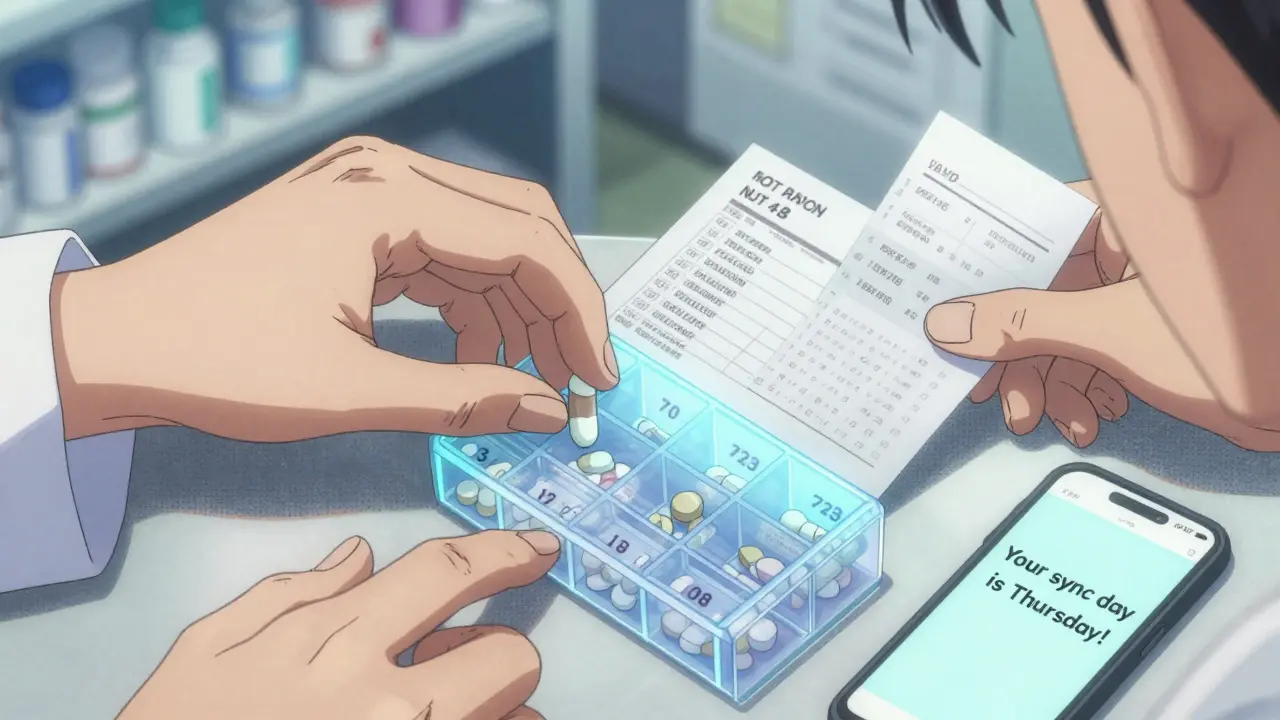
- You talk it through. Your pharmacist sits down with you (or calls you). They ask: "What day works best for you to come in?" Maybe it’s the first Thursday. Maybe it’s the 15th. You pick.
- They reconcile your meds. Not everything goes in. PRN meds - like albuterol inhalers, pain pills, or antibiotics - stay on their own schedule. Only maintenance drugs sync up.
- They adjust the timing. If your blood pressure med runs out on the 10th but your cholesterol med runs out on the 25th, the pharmacist might give you a short fill of the cholesterol med now so it lines up with the 10th. This is called a "one-time short fill." It’s legal. It’s documented. And it’s the key to making the system work.
- You get your anchor date. From now on, every month on that day, your prescriptions are ready. No calls. No reminders. Just walk in, grab your bag, and go.
That’s it. No apps. No complicated tech. Just a pharmacist who remembers your schedule - and cares enough to fix it.
Why It Works Better Than Traditional Refills
Traditional refill systems are broken. You get a 30-day script. You fill it. You forget when the next one’s due. You wait until you’re out. Then you call. Then you wait for approval. Then you drive. Then you wait in line. Rinse and repeat - six times a month.
Med sync flips that. One trip. One stop. One date. The numbers don’t lie:
- Patients using med sync reduce pharmacy visits from 12.4 per year to just 4.2.
- 78% report improved medication adherence.
- 40% fewer missed doses among elderly patients and caregivers.
- 87% satisfaction rate among users.
It’s not just about convenience. It’s about safety. Missing a dose of blood pressure medicine can spike your risk of stroke. Skipping diabetes meds can land you in the ER. Med sync prevents those moments before they happen.
Who Benefits the Most?
Med sync isn’t for everyone. But it’s life-changing for these groups:
- Elderly patients - Especially those who drive less or have memory issues. One caregiver told me, "My mom used to forget which meds she took. Now she just grabs her bag on the 12th. She hasn’t missed a dose in a year."
- People on three or more chronic meds - The more meds you take, the bigger the risk of mismanagement. Med sync cuts the chaos.
- Busy professionals - If you can’t get to the pharmacy during business hours, having one day to pick everything up saves hours.
- Patients with cognitive or mobility challenges - Fewer trips mean less stress, less risk of falls, less mental load.
It’s also a win for caregivers. If you’re managing meds for a parent or spouse, med sync turns a daily chore into a monthly task. That’s huge.
What Doesn’t Work in Med Sync?
Not every prescription fits. Here’s what stays out:
- As-needed inhalers (like albuterol)
- Antibiotics (short courses)
- Acute pain meds (like oxycodone for post-surgery)
- Medications with unstable dosing (e.g., warfarin if INR levels fluctuate)
These are kept on their own refill schedule because they’re not meant to be taken daily. Trying to sync them would cause confusion - or worse, harm.
Also, if your doctor writes a 30-day script with no refills, med sync can’t start. You need a 90-day prescription with multiple refills. That’s why pharmacists often reach out to your doctor to request a longer script. It’s part of the process.
Common Hurdles - And How to Solve Them
It’s not perfect. Here are the real problems people face - and how to fix them:
1. Insurance Won’t Cover Early Refills
Some Medicare Part D plans won’t let you refill a med until 75% of the supply is gone. That breaks the sync. Solution? Your pharmacist can request a "one-time exception" or use a "partial fill" to bridge the gap. Documenting it as "for adherence purposes" often clears it.
2. Your Doctor Doesn’t Know About It
Many doctors still write 30-day scripts by default. Ask your pharmacist to contact your provider. Many now use EHR systems like Epic that flag patients for 90-day prescriptions during annual visits.
3. You Get Less Medication at First
It’s confusing when you expect a 90-day supply but only get 45 days. That’s the short fill - it’s temporary. The pharmacist will explain: "This gets you to the anchor date. Next month, you’ll get your full 90-day supply."
4. You Forget Your Date
Most pharmacies now send a text or call a few days before your sync day. Some even mail a reminder card. If yours doesn’t, ask. It’s part of the service.

What to Ask Your Pharmacist
If you think med sync could help you or a loved one, here’s what to say:
- "Do you offer medication synchronization?"
- "Can you check if all my maintenance meds can be synced?"
- "What’s the best day for me to pick up?"
- "Will you call me if there’s a problem with my prescriptions?"
- "Can you talk to my doctor about switching to 90-day scripts?"
Don’t assume they’ll bring it up. Ask. Most pharmacists want to help - they just need you to start the conversation.
The Bigger Picture: Why This Matters
Med sync isn’t just about refills. It’s about care. When a pharmacist calls you every month to review your meds, they’re not just checking inventory. They’re checking on you. They’re asking: "How are you feeling? Any side effects? Are you still taking your blood thinner?"
That’s clinical care. That’s prevention. That’s what value-based healthcare looks like.
By 2025, Medicare may start rewarding pharmacies that sync 40% or more of their chronic medication patients. Why? Because studies show it cuts hospitalizations by 12%. That’s 4.2 billion dollars saved annually - just by fixing a scheduling problem.
This isn’t a pharmacy gimmick. It’s a safety net. And if you’re on multiple medications, it’s one you should be using.
Next Steps: How to Get Started
Here’s your action plan:
- Make a list of all your maintenance medications (the ones you take every day).
- Call your pharmacy and ask: "Do you offer medication synchronization?"
- Ask them to review your scripts for 90-day refills.
- Choose a monthly pick-up date that works for you.
- Confirm they’ll call you before your sync day.
- Stick with it for three months. That’s how long it takes to become habit.
If you’re helping someone else - a parent, a sibling, a friend - do it for them. Call the pharmacy. Set it up. You’ll save more than time. You’ll save health.
Elizabeth Cannon
January 22, 2026 AT 17:25omg yes this is life changing i synced my moms meds last year and she actually remembers to take them now. no more pill organizers falling apart or her taking double doses. pharmacy called her last week just to check in. i cried. this is care.
siva lingam
January 23, 2026 AT 13:35so you’re telling me a pharmacy can fix america’s healthcare crisis by just… aligning dates? wow. next they’ll sync our taxes and our exes’ birthdays too.
Kevin Waters
January 23, 2026 AT 14:22Just wanted to add - if your pharmacy says they don’t offer med sync, ask for the clinical pharmacist. Most chain stores have them now, especially in CVS, Walgreens, and Rite Aid. They can usually override insurance restrictions if you explain it’s for adherence. I’ve helped three elderly neighbors get this set up. It’s not magic, it’s just someone paying attention. You deserve that.
Gina Beard
January 25, 2026 AT 03:31Convenience is not cure. We optimize schedules, not souls.
Izzy Hadala
January 26, 2026 AT 09:52While the logistical benefits of medication synchronization are empirically supported, one must consider the epistemological implications of decentralizing pharmaceutical oversight to retail pharmacists. The ASHP guidelines, while well-intentioned, may inadvertently erode the physician-patient therapeutic alliance by normalizing non-specialist intervention in polypharmacy management. Furthermore, the reliance on one-time short fills introduces pharmacokinetic variability that could compromise therapeutic efficacy in patients with narrow therapeutic indices, such as those on warfarin or digoxin. A more robust solution might involve integrated EHR-based predictive algorithms rather than manual synchronization protocols.
Shelby Marcel
January 27, 2026 AT 08:35wait so if my blood pressure med runs out on the 10th and my thyroid on the 25th they just give me extra pills to make it match? that’s wild. i thought pharmacies just followed what the script said. so they’re like… magic doctors now?
lorraine england
January 28, 2026 AT 09:03Look, I’m not saying this isn’t good - but if you’re on six meds and still can’t remember your refill dates, maybe the real problem isn’t the pharmacy schedule. Maybe it’s you not taking responsibility. I’ve seen people use this as an excuse to not even try to manage their own health. Just saying.
Jamie Hooper
January 29, 2026 AT 12:29so like… the pharmacy is now your mom? you know what i mean? like, you dont even have to think anymore. you just show up on the 12th and boom - meds. no stress. no thinking. no accountability. just a bag. i miss the days when we had to remember stuff. now we’re just… passive consumers of health. like robots. with pills.
Himanshu Singh
January 29, 2026 AT 22:32Bro this is beautiful. 🙏 One day, one bag, one peace of mind. My uncle in Delhi tried this last year - he was on 7 meds. Now he plays chess every Sunday without panic. Pharmacy guy even calls him on his birthday. That’s not business. That’s humanity. You don’t need AI when you have a human who remembers your name.
Don Foster
January 30, 2026 AT 23:5378 percent of pharmacies do this and you still need a blog post to explain it? This is the most basic thing in pharmacy practice. If you’re not using this you’re either lazy or you’re not paying attention. I’ve been syncing my meds since 2012. No one told me. I asked. That’s it. Stop acting like this is some revolutionary tech. It’s not. It’s just common sense. With better packaging.
Tiffany Wagner
February 1, 2026 AT 02:10i’ve been doing this for 2 years and honestly i forgot it was even a thing until i read this. it just… works. i get my bag on the 3rd every month. i don’t think about it. i just grab it. sometimes i forget what’s in it but i know i took it. that’s enough.
Marlon Mentolaroc
February 1, 2026 AT 07:54Let’s be real - this is just a cost-cutting measure disguised as care. Pharmacies save money on phone calls, staffing, and refill processing. They get you to take 90-day supplies so they get paid more upfront. And you? You’re just the happy customer who doesn’t realize you’re being managed like a cattle herd. Don’t mistake convenience for compassion.
Darren Links
February 1, 2026 AT 11:51So now the government’s gonna pay pharmacies to babysit Americans who can’t remember to take their pills? That’s not healthcare. That’s welfare with a prescription label. We used to be a nation that took responsibility. Now we want a calendar reminder and a bag of pills on a Thursday. What happened to us?