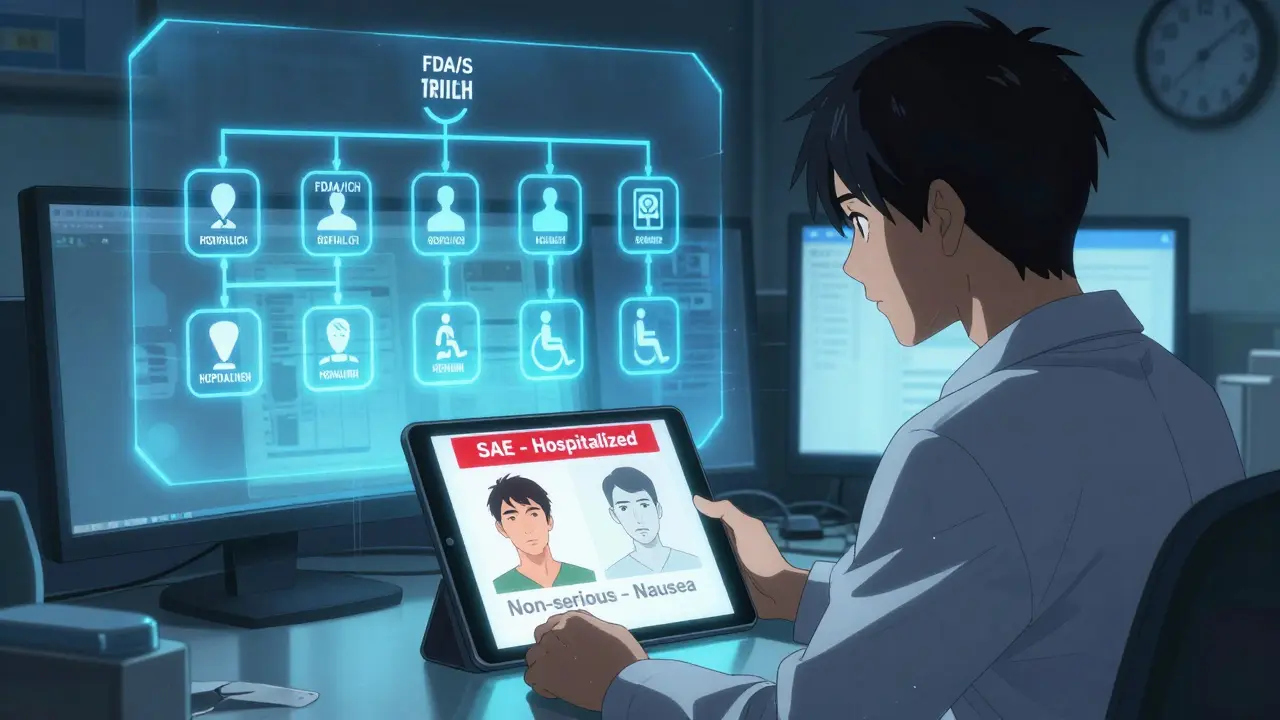
When you’re running a clinical trial, not every side effect needs to be reported right away. But if you mix up serious and non-serious adverse events, you could be wasting time, missing real dangers, or even putting patients at risk. The difference isn’t about how bad the symptom feels-it’s about what actually happened to the person.
What Makes an Adverse Event 'Serious'?
An adverse event is any unwanted medical occurrence during a trial, whether it’s linked to the drug or not. But only some of these count as serious. The FDA and global regulators define serious adverse events (SAEs) by outcomes, not how intense they feel. A pounding headache might be severe, but if it goes away with ibuprofen? It’s not serious. On the other hand, a mild rash that triggers anaphylaxis? That’s serious.
Here’s the official list of what makes an event serious:
- It caused death
- It was life-threatening (the patient was at immediate risk of dying)
- It required hospitalization or extended an existing hospital stay
- It led to permanent disability or significant loss of function
- It caused a birth defect
- It required medical intervention to prevent any of the above
That’s it. No more, no less. The ICH E2A guideline, adopted worldwide in the 1990s, still holds today. And the NIH’s 2018 guidelines, updated through 2023, reinforce this: seriousness is about outcome, not intensity. A patient with mild nausea who ends up in the ER because they became dehydrated? That’s serious. A patient with severe nausea who stays home and drinks ginger tea? Not serious.
Why the Confusion Happens
People mix up ‘severe’ and ‘serious’ all the time. A 2022 survey of 347 research sites found that 63.4% had inconsistent seriousness decisions across studies. In oncology trials, where patients often arrive already weak or sick, it’s even harder. Is that fever from the cancer? From the drug? From a cold? The confusion isn’t just human error-it’s built into the system.
At the University of California, San Francisco, over 40% of adverse event reports in 2022 needed clarification. One coordinator told me they once reported a patient’s ‘severe anxiety’ as a serious event because the patient was crying and couldn’t sleep. But anxiety alone, even if intense, doesn’t meet the criteria unless it led to self-harm, hospitalization, or permanent psychological damage. That report got flagged as non-serious. It took three days to fix.
And it’s not just small sites. The SWOG Cancer Research Network found that over 30% of their SAE reports in 2021 had to be corrected because the event didn’t meet the outcome criteria. That’s nearly 19 full-time hours every week spent fixing misclassified reports.
When and How to Report
Timing matters. If it’s a serious adverse event, you don’t wait for your next team meeting.
Investigators must report SAEs to the trial sponsor within 24 hours of learning about it-no exceptions. That’s required by 21 CFR 312.32. It doesn’t matter if you think the drug caused it. You report it anyway. The sponsor then decides if it’s unexpected or related. If it’s a life-threatening SAE, the sponsor must report it to the FDA within 7 days. For other serious events, it’s 15 days.
For non-serious events, you follow the protocol. Most sites collect them in Case Report Forms (CRFs) and report them monthly or quarterly. Some protocols don’t even require reporting mild events to the Institutional Review Board (IRB) at all. But if the event is moderate and requires treatment, it still goes into the safety database. Just not as an emergency.
And here’s the kicker: the IRB doesn’t need to see every non-serious event. Only those that are new, unexpected, or could impact patient safety. Most routine mild events are only reviewed during the annual continuing review. That’s by design-so the IRB can focus on what actually matters.

Tools and Training to Get It Right
There’s a reason the ICH E6(R2) guidelines require all staff to be trained on seriousness criteria before a trial starts. And most top institutions now require annual refreshers. Why? Because 98.7% of them know how often mistakes happen.
The NIH and FDA both recommend using a simple decision tree:
- Did the event cause death?
- Was it life-threatening?
- Did it require hospitalization or extend a stay?
- Did it cause permanent disability or birth defects?
If the answer is ‘yes’ to any of these, it’s serious. If not, it’s not. Simple. No guesswork.
Many sponsors now use the Common Terminology Criteria for Adverse Events (CTCAE) version 5.0 to grade severity (mild, moderate, severe), but they apply the seriousness criteria separately. That’s key. CTCAE tells you how bad it felt. The SAE criteria tell you if it changed the patient’s life.
And now, AI is helping. Since 2020, automated tools have grown 27.4% in use. Today’s AI systems correctly classify seriousness in 89.7% of cases-better than humans. But they’re not replacing people. They’re flagging potential errors. The final call still needs a trained reviewer.
The Cost of Getting It Wrong
This isn’t just about paperwork. It’s about money, time, and safety.
In 2022, the pharmaceutical industry spent $1.89 billion on adverse event reporting. Over 60% of that went to handling events that shouldn’t have been reported as serious. That’s billions spent chasing noise.
The FDA’s Sentinel Initiative has processed over 14 million reports since 2008. Only 18.3% met seriousness criteria. That means 82% of reports were noise. Imagine if those 11 million reports didn’t clog the system. Regulators could spot real signals faster. Patients could get safer drugs sooner.
And it’s getting worse. The European Medicines Agency found that nearly 29% of expedited reports in 2020 didn’t meet seriousness criteria. The same problem exists in the U.S. The FDA’s 2023 draft guidance is trying to fix it-proposing tiered reporting timelines and clearer definitions across therapies.

What’s Changing in 2025?
Global standards are finally aligning. The EU’s Clinical Trials Regulation, fully in force since 2022, harmonized seriousness definitions across all 27 member states. Cross-border reporting errors dropped by over a third.
Next up: ICH E2B(R4). This new electronic reporting format will go live in 2025. It’s designed to make data exchange faster, cleaner, and more consistent worldwide. No more faxed forms. No more handwritten notes.
And the FDA is testing AI-driven triage tools in 2024. Early results from MIT show these tools could cut processing time by almost half. That means faster reviews, fewer delays, and more focus on real safety signals.
But none of this matters if the person entering the data doesn’t know the difference between severity and seriousness.
Bottom Line
Don’t report based on how bad it feels. Report based on what happened. If a patient didn’t die, didn’t nearly die, didn’t get hospitalized, and didn’t lose function? It’s not serious. Even if it’s the worst headache they’ve ever had.
Train your team. Use the decision tree. Double-check before you click ‘submit.’ And remember: every time you report a non-serious event as serious, you’re not helping safety-you’re hiding the real dangers under a pile of noise.
Get this right, and you’re not just following rules. You’re making clinical trials safer-for patients, for researchers, and for everyone waiting for the next breakthrough.