More parents are turning to melatonin to help their kids fall asleep. It’s easy to see why: it’s sold over the counter, labeled as "natural," and often recommended by well-meaning friends or online forums. But here’s the truth - melatonin isn’t a bedtime snack. It’s a hormone, and giving it to a child without knowing the right dose, timing, or long-term effects can do more harm than good.
In the UK, melatonin is a prescription-only medicine. In the US, it’s sold like a vitamin. That difference alone should raise a red flag. If you’re considering melatonin for your child, you need to understand what’s really in that bottle, how much is safe, and whether it’s even the right solution.
What Melatonin Actually Does in a Child’s Body
Melatonin is made naturally by the pineal gland in the brain. It tells your body it’s time to sleep. In adults, levels rise in the evening and drop by morning. But in kids - especially those with autism, ADHD, or other neurodevelopmental conditions - this rhythm can be off. That’s why melatonin supplements are sometimes used: to help reset their internal clock.
But here’s the catch: giving a child extra melatonin doesn’t just nudge their sleep cycle. It floods their system. A 2024 review in PubMed Central found that doses above 1 mg can produce blood levels more than 100 times higher than what the body normally makes. That’s not a gentle nudge. That’s a sledgehammer.
And it’s not just about sleep. Melatonin affects other hormones too - including those tied to growth, puberty, and mood. Long-term use? We just don’t know enough. The American Academy of Pediatrics says we need more research. That’s not a green light. It’s a warning.
Dosage Confusion: Why There’s No One-Size-Fits-All
Look up melatonin dosing for kids and you’ll find wildly different advice. One source says 1 mg. Another says 5 mg. Another says 10 mg. What’s going on?
It’s because there’s no universal standard. The UK NHS prescribes a 2 mg slow-release tablet for children with diagnosed sleep disorders. In the US, gummies often contain 1 mg per piece - but some brands have as little as 0.5 mg or as much as 5 mg. A 2022 study in JAMA Network Open found that 71% of melatonin products didn’t match what was listed on the label. Some had 8 times more than stated. Others had none at all.
So how do you pick the right dose?
- Under age 3: Avoid unless directed by a pediatrician. Sleep issues at this age are often tied to feeding, teething, or routine - not a hormone imbalance.
- Ages 3 to 5: Start with 0.5 to 1 mg. Most kids respond to this low dose. Don’t jump to 3 mg unless your doctor says so.
- Ages 6 to 12: 1 to 3 mg is the typical range. Some children need as little as 0.5 mg. Others need up to 5 mg - but always start low.
- Teens (13-18): 1 to 5 mg. Higher doses (up to 10 mg) are sometimes used for neurodiverse teens, but only under specialist supervision.
Never assume more is better. A 2024 study showed that children given 0.3 mg - close to their natural levels - had better sleep than those given 5 mg. Higher doses can cause grogginess, nightmares, or even disrupt natural melatonin production.
When to Use Melatonin - and When Not To
Melatonin isn’t a fix for bad bedtime habits. If your child stays up playing video games, scrolls on a tablet, or has inconsistent bedtimes, melatonin won’t solve that. It might even make things worse by masking the real problem.
The American Academy of Sleep Medicine says this clearly: Behavioral changes should come first. That means:
- Fixed bedtime and wake-up time (even on weekends)
- No screens for at least 60 minutes before bed
- A calm, dark, cool bedroom
- Wind-down routines: reading, baths, quiet talk
- Avoiding caffeine (yes, even in soda or chocolate)
If you’ve tried all that for at least 2-4 weeks and your child still can’t fall asleep - then talk to your doctor about melatonin.
There’s one group where melatonin often helps: children with autism, ADHD, or other neurodevelopmental conditions. For them, sleep problems are common - and melatonin can be a game-changer. Studies show it can improve sleep onset by 30-60 minutes in these kids. But even here, it’s not a long-term crutch. The goal is to use it short-term while fixing the underlying sleep routine.
Timing Matters Just as Much as Dose
Giving melatonin at the wrong time can throw off the body’s clock even more. It’s not a sleep pill. It’s a time signal.
Most experts agree: give it 30 to 60 minutes before bedtime. Some suggest up to 90 minutes for kids with delayed sleep phase. But never give it right before bed - or worse, after they’re already lying awake for an hour.
Why? Melatonin takes time to peak in the bloodstream. If given too late, it delays sleep instead of helping it. If given too early, it might wear off before bed. Consistency is key. Same time, same dose, every night.
Red Flags: When Melatonin Could Be Dangerous
Not all kids should take melatonin. Avoid it if your child:
- Is under age 3 (unless under strict medical supervision)
- Has autoimmune disorders, seizure disorders, or diabetes
- Is taking medications like blood thinners, immunosuppressants, or antidepressants
- Has a history of night terrors or sleepwalking
Overdose symptoms are real - and scary. Vomiting, dizziness, rapid heartbeat, low blood pressure, and extreme drowsiness have been reported. One 2023 case study in Pediatrics described a 5-year-old who took 10 mg of melatonin (a whole bottle) and ended up in the ER with a racing heart and low blood pressure. He recovered, but it took 12 hours.
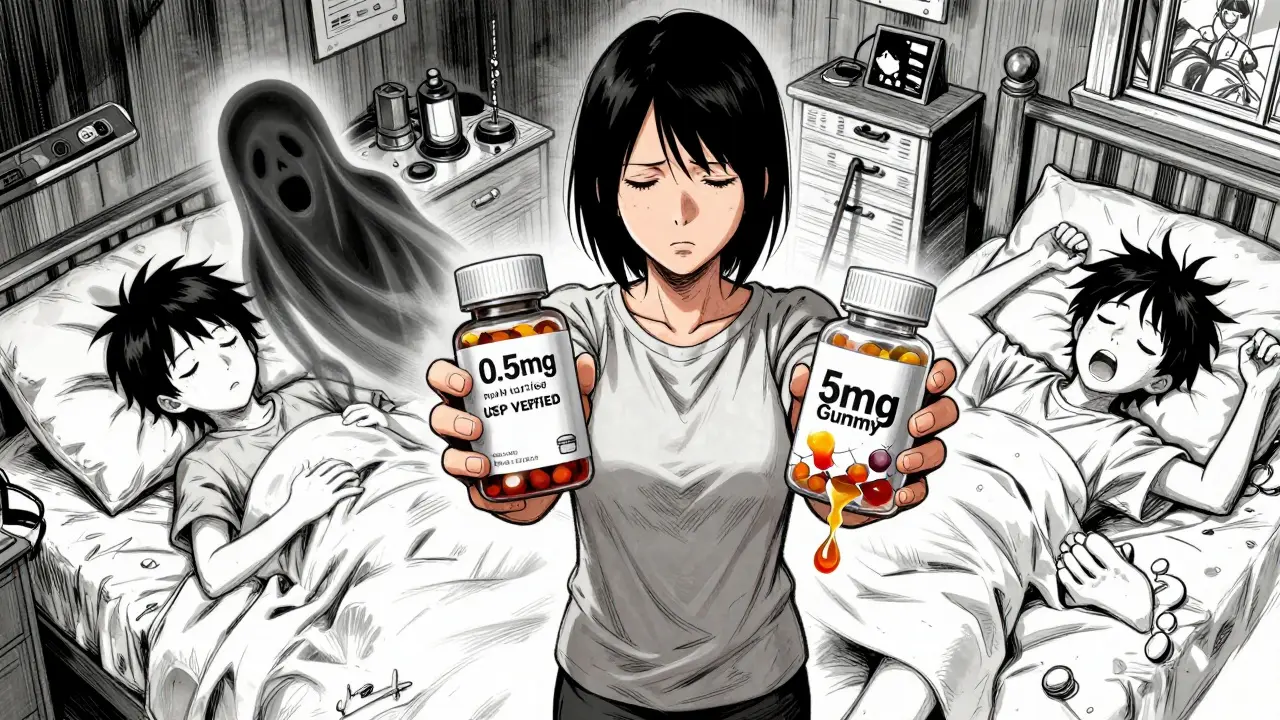
And here’s another hidden risk: unregulated products. In the US, melatonin isn’t tested by the FDA. Labels lie. A 2023 study found that 70% of melatonin supplements contained contaminants - including serotonin, a powerful mood-altering chemical. Even products with the USP Verified Mark (a voluntary quality check) aren’t foolproof.
What to Do Instead of Reaching for the Bottle
Before you buy melatonin, ask yourself:
- Has my child’s sleep schedule been consistent for at least 2 weeks?
- Are screens off 1 hour before bed?
- Is the bedroom dark, quiet, and cool?
- Have I ruled out anxiety, pain, or medical issues like sleep apnea?
If the answer is no to any of these, fix those first. Sleep hygiene works - even for kids with autism or ADHD. One 2022 study showed that a simple routine (bath, book, dim lights, no screens) improved sleep in 80% of neurodiverse children - without any supplements.
And if you’re still stuck? Talk to your pediatrician. They might refer you to a pediatric sleep specialist. These experts don’t just hand out melatonin. They look at sleep logs, light exposure, caffeine intake, and even school schedules. They tailor solutions - not prescriptions.
Final Thoughts: Less Is More
Melatonin isn’t evil. For some kids, it’s a helpful tool - short-term, low-dose, and under medical guidance.
But it’s not a magic bullet. And it’s not a substitute for good sleep habits. The rise in melatonin use among children - up 530% between 1999 and 2012 - isn’t because sleep problems got worse. It’s because parents are desperate. And in that desperation, they’re trusting a supplement with unknown long-term effects.
Here’s the bottom line: Start with 0.5 mg. Wait 3 nights. Talk to your doctor. Never give melatonin without a plan. Your child’s body is still growing. Don’t risk long-term disruption for a quick fix.
Can melatonin be used for toddlers under 3?
Generally, no. Children under 3 rarely need melatonin. Sleep issues at this age are usually due to teething, feeding patterns, or developmental changes. Most resolve on their own with consistent routines. If sleep problems persist, talk to your pediatrician before considering any supplement.
Is melatonin addictive for children?
Melatonin isn’t addictive in the way drugs like opioids or stimulants are. But the body can become dependent on it to trigger sleep, especially if used long-term without addressing underlying sleep habits. Stopping suddenly after months of use may cause temporary sleep disruption. That’s why it should be used as a short-term bridge, not a permanent solution.
What’s the safest form of melatonin for kids?
Slow-release tablets prescribed by a doctor are safest, especially in the UK where they’re regulated. In the US, if you must use an over-the-counter product, choose one with the USP Verified Mark - it means the dose was independently tested. Avoid gummies, liquids, or chewables with added sugar, artificial colors, or unlisted ingredients. Always check the label for exact milligram amounts.
Can melatonin affect a child’s growth or puberty?
There’s no strong evidence yet, but melatonin plays a role in regulating reproductive hormones. Long-term, high-dose use in children could theoretically interfere with puberty timing. That’s why experts recommend using the lowest effective dose for the shortest time possible - especially in pre-teens and teens.
How long should a child take melatonin?
For most children, melatonin should be used for no longer than 2-4 weeks at a time. If sleep doesn’t improve in that window, the problem isn’t melatonin deficiency - it’s something else. For children with autism or ADHD, longer use (up to several months) may be appropriate under specialist care, but even then, the goal is to wean off once sleep habits improve.
What should I do if my child accidentally takes too much melatonin?
Call your pediatrician or local poison control center immediately. Symptoms of overdose include vomiting, extreme drowsiness, rapid heartbeat, dizziness, and low blood pressure. Even if your child seems fine, internal effects can develop over hours. Don’t wait. Keep melatonin out of reach like you would any medication.
Tasha Lake
February 9, 2026 AT 19:30Melatonin isn't some benign herbal tea-it's a neuroendocrine modulator with affinity for MT1 and MT2 receptors in the suprachiasmatic nucleus. Giving kids supraphysiological doses (like 5mg gummies) floods the system, desensitizing receptors and potentially disrupting circadian entrainment. The 2024 PMC review showed blood levels spiking 100x above endogenous production-that’s not supplementation, that’s pharmacological intervention.
And don’t get me started on label inaccuracies. A JAMA Network Open study found 71% of OTC products deviated from labeled doses. Some had 8x more melatonin than stated. Others had zero. We’re essentially dosing kids with a lottery ticket.
For neurodivergent kids? Maybe. But only after behavioral sleep hygiene is locked in. Sleep latency improvement from consistent routines alone? Up to 80% in some cohorts. Melatonin should be a bridge, not a crutch.
Also-serotonin contamination in supplements? That’s not a bug, it’s a feature of unregulated markets. Imagine giving a 4-year-old a serotonin reuptake inhibitor because a label said '1mg melatonin.' We’re playing Russian roulette with developing HPA and HPG axes.
Sam Dickison
February 10, 2026 AT 08:14Look, I get it. My kid’s been up until 1am for three weeks straight. I’m desperate. But I didn’t realize melatonin was a hormone until I read this. Like, I thought it was just a vitamin. Turns out, it’s a signaling molecule that talks to the pituitary and affects gonadotropin release.
So now I’m terrified I’ve been messing with puberty timing. I gave my 8-year-old 3mg for a month because the bottle said 'safe for kids.'
Turns out, the AAP says we need more research. That’s not an endorsement. That’s a red flag with a smiley face.
I’m switching to blackout curtains, no screens after 7, and a consistent 8pm bedtime. If that doesn’t work? I’m calling the pediatric sleep clinic. No more guessing.
Karianne Jackson
February 11, 2026 AT 14:33MY KID TOOK A WHOLE BOTTLE OF MELATONIN AND I THOUGHT SHE WAS JUST SLEEPING TOO HARD.
SHE WENT TO THE ER.
HER HEART WAS RACING.
SHE HAD LOW BLOOD PRESSURE.
SHE WASN’T EVEN CONSCIOUS FOR 12 HOURS.
I’M STILL TERRIFIED.
DO NOT LET YOUR KIDS NEAR THIS STUFF.
IT’S NOT A SNACK.
Chelsea Cook
February 11, 2026 AT 19:24Oh honey, you think melatonin is the problem? Let me tell you about the 27 other things I tried before this. Co-sleeping? Nope. White noise machine? Nope. Warm milk? She threw it at the wall. Bedtime stories? She read them to me while scrolling TikTok.
Then we tried 0.5mg. One night. She slept 7.5 hours. For the first time in 11 months.
So no, I’m not some reckless parent. I’m a parent who’s been to three pediatricians, two sleep specialists, and a behavioral therapist. Melatonin was the *last* tool. Not the first.
And yes, I got it from a doctor. With a prescription. In a 2mg slow-release tablet. Not a gummy shaped like a unicorn.
Stop shaming moms. Start sharing real solutions.
John Sonnenberg
February 13, 2026 AT 13:58Let’s be real-this whole article is fearmongering disguised as science. Melatonin has been used for decades in Europe. In the U.S., it’s a supplement, so we’re supposed to panic? The FDA doesn’t regulate supplements because they’re not drugs. That’s not negligence, that’s policy.
And yes, some products are mislabeled. But so are multivitamins. So is protein powder. Do we ban them all?
My 10-year-old with ADHD sleeps 9 hours a night now because of 1mg melatonin. He used to get up at 2am and play video games. Now he’s calm. His grades improved. His therapist says he’s less anxious.
So no, I’m not giving my kid a sledgehammer. I’m giving him a key to a locked door. And I’m not apologizing for it.
Jessica Klaar
February 13, 2026 AT 18:02I’m a pediatric nurse and I’ve seen it all. Parents come in with melatonin bottles like they’re bringing candy. Some have 10mg doses for 4-year-olds. Others are giving it because their kid ‘won’t nap.’
But here’s what I’ve learned: 90% of sleep issues in kids under 12 are behavioral. Not hormonal. Not neurological. Just… routine.
I had one mom who said, ‘We don’t have a bedtime. He falls asleep on the couch watching YouTube.’ I said, ‘Let’s start with turning off the screen at 7:30, reading a book, lights out at 8.’ She did it for two weeks. No melatonin. Sleep improved by 70%.
So before you reach for the bottle, ask: Is this a hormone problem? Or is it a habit problem?
And if you’re still stuck? Call your pediatrician. Not Google. Not Reddit. A real human who knows your kid.
PAUL MCQUEEN
February 15, 2026 AT 06:38Interesting how the article spends 3000 words warning against melatonin but doesn’t mention that the real issue is screen time, poor parenting, and the fact that American kids are overstimulated 24/7.
Instead of fixing the environment, we pharmacologize the symptom. Classic.
Also, 530% increase since 1999? That’s not because kids sleep worse. It’s because parents are lazy and overwhelmed. And now we’ve turned a hormone into a parenting shortcut.
My kid sleeps fine because we have rules. No screens after 7. Bedtime at 8. No exceptions. Not because of melatonin. Because of discipline.
Maybe we should teach parenting before we teach pharmacology.
glenn mendoza
February 16, 2026 AT 00:33While the concerns raised in this comprehensive analysis are both clinically valid and ethically imperative, I would like to underscore the importance of differential diagnosis in pediatric sleep pathology.
It is not merely a question of dosage or formulation; rather, it is a matter of discerning whether sleep onset delay is attributable to circadian rhythm disorder, anxiety, sensory processing dysfunction, or comorbid neurodevelopmental conditions.
In my clinical practice, melatonin has served as a temporizing measure-never a definitive solution-when behavioral interventions have been insufficiently implemented or inconsistently maintained.
Furthermore, the absence of standardized dosing protocols across jurisdictions reflects a critical gap in translational pediatric pharmacology that requires urgent policy attention.
For families navigating these complexities, I urge a multidisciplinary approach: pediatrician, sleep specialist, behavioral therapist, and educational liaison. No supplement should be administered without this framework.
Monica Warnick
February 17, 2026 AT 17:11Okay but what about the kids who are on autism meds already? I have a 7-year-old on risperidone and clonidine and his sleep is still a nightmare. We tried everything. The sleep doc said melatonin was the only thing that might help. So we started with 0.5mg. He slept 8 hours straight. For the first time ever.
So no, I’m not reckless. I’m a mom who read the studies, talked to the specialists, and still had to make a hard choice.
And now I’m terrified because the label on the bottle says 5mg but I gave 0.5mg because I read this article and I’m paranoid.
Why is everything so complicated?
Jonah Mann
February 19, 2026 AT 02:53Ugh i just got back from the er. my 6 yr old took a whole bottle of melatonin. like 10mg. she was fine. just super sleepy. but the nurse said it coulda been worse. like she coulda had seizures or something.
so now im throwing out all the bottles. and i swear i never thought it was a drug. i thought it was like a vitamin. why is this even sold in gummy form? its not candy.
also. my kid still wakes up at 3am. so now what? no melatonin. no screens. no nothing. just… crying. i hate this.
MANI V
February 20, 2026 AT 01:51You people are pathetic. You give your children melatonin because you’re too lazy to set boundaries. You let them stay up late with phones and tablets. You don’t read to them. You don’t enforce routines. And now you want a chemical fix?
My son sleeps at 8pm every night because we don’t allow screens after dinner. We have lights out. We read. We talk. No drama. No supplements.
Stop blaming the medicine. Blame yourself.
And if your child has autism or ADHD? You still need discipline. Not a pill.
Parenting isn’t a pharmacology experiment.
Brett Pouser
February 21, 2026 AT 11:25I’m a dad of two neurodivergent kids. One with autism, one with ADHD. Melatonin was the only thing that gave us back our nights.
But I didn’t just grab it off a shelf. I went to a pediatric sleep clinic. They did a sleep log for 14 days. Tested light exposure. Checked for sleep apnea. Then prescribed 1mg slow-release.
And we still did the routines. Still no screens. Still consistent bedtime.
Melatonin didn’t replace discipline. It helped us *keep* discipline.
Because when your kid’s brain is wired differently, sometimes you need a little help to reset the clock.
But you still have to build the house. The supplement just gives you a hammer.
Andy Cortez
February 22, 2026 AT 01:38OMG this article is the most dramatic thing I’ve read all year.
So melatonin is a sledgehammer? A hormone? A chemical weapon?
What about all the kids who are sleeping better because of it?
My daughter used to cry for 90 minutes every night. We tried white noise. We tried weighted blankets. We tried chamomile tea (she spit it out). Then we tried 0.5mg. She fell asleep in 15 minutes.
Now she sleeps 9 hours.
So yeah. Maybe it’s not perfect.
But it’s better than tears.
And if you’re scared of labels? Buy the USP one. Read the bottle. Use the lowest dose.
Stop scaring parents. Start helping them.
Joseph Charles Colin
February 23, 2026 AT 01:35From a clinical pharmacology standpoint, the key issue isn’t melatonin per se-it’s the absence of pharmacokinetic data in pediatric populations. We have adult plasma half-life curves, but pediatric clearance rates vary by age, BMI, and CYP1A2 enzyme activity.
That’s why slow-release formulations are preferred: they mimic endogenous secretion patterns. Immediate-release gummies create artificial peaks and troughs, increasing risk of next-day sedation or circadian disruption.
Also: the 71% mislabeling rate in OTC products is a regulatory failure. The FDA classifies melatonin as a supplement, so manufacturers aren’t required to demonstrate bioequivalence or stability.
Until we have standardized, child-specific dosing guidelines backed by RCTs, clinicians should treat melatonin like any other endocrine agent: with caution, monitoring, and a clear exit strategy.