Protease Inhibitor Interaction Simulator
Estimated Plasma Concentration
100%
Therapeutic Level
Clinical Insight
Select options above to see how hyperforin affects medication efficacy.
Imagine taking a life-saving medication every single day, only to find out that a common herbal supplement from the health store is quietly erasing its effects. This isn't a hypothetical scenario; it's a dangerous reality for people taking Protease Inhibitors. When paired with St. John's Wort, these critical HIV medications can drop to levels where they simply stop working, potentially leading to viral rebound and drug resistance.
The core of the problem is that "natural" doesn't always mean "safe." Many people view herbal supplements as harmless additions to their routine, but St. John's Wort acts as a powerful chemical trigger in the body. For those on antiretroviral therapy, this specific combination can be the difference between a suppressed viral load and a total therapeutic collapse.
The Biology of the Crash: How It Actually Happens
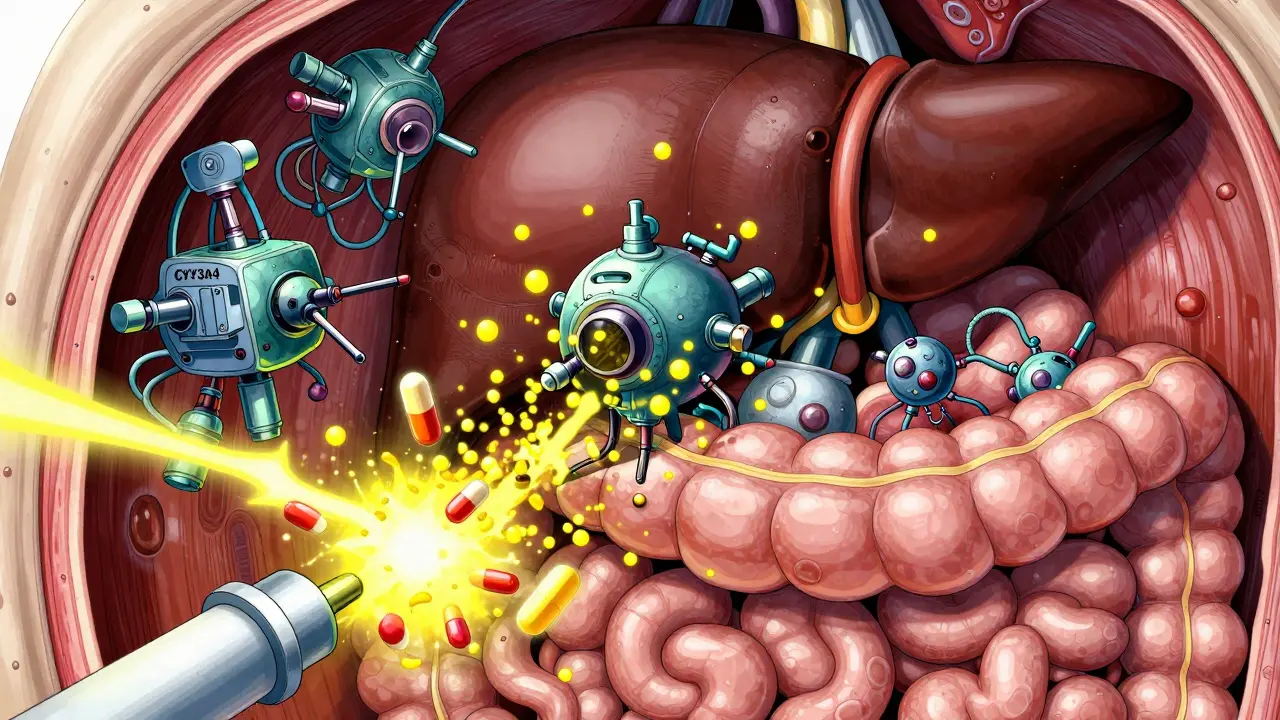
To understand why this happens, we need to look at how your body processes drugs. Most Protease Inhibitors are antiretroviral medications that block the enzyme HIV uses to create new copies of itself. To get into your bloodstream, these drugs must pass through the liver and intestinal wall, where they encounter a specific enzyme called CYP3A4.
Under normal conditions, CYP3A4 breaks down the medication at a predictable rate. However, St. John's Wort contains a potent active compound called hyperforin. Hyperforin is an "inducer," meaning it tells your body to produce way more CYP3A4 enzymes than usual. It also ramps up P-glycoprotein (P-gp), a transporter that literally pumps medication back out of the cells before it can work.
When you have an army of extra enzymes and pumps working overtime, the medication is destroyed and expelled far too quickly. It never reaches the concentration needed to stop the virus. This is why the University of Liverpool's HIV Drug Interactions database warns that this combination can lead to a total loss of virologic response.
Quantifying the Risk: The Numbers
This isn't just a slight dip in effectiveness; we're talking about a massive drop in drug concentration. In a well-known study published in Drug Safety, researchers found that taking 900 mg of St. John's Wort daily reduced the maximum plasma concentration (Cmax) of indinavir by a staggering 81%.
| Metric | Impact with Standard St. John's Wort | Clinical Result |
|---|---|---|
| Plasma Concentration (AUC) | Decreased by 40% to 80% | Sub-therapeutic levels |
| Lopinavir/Ritonavir Levels | Potential 57% decrease | High risk of viral escape |
| Indinavir Cmax | Up to 81% reduction | Rapid medication clearance |
When the concentration of a drug like lopinavir drops by over 50%, the virus isn't just "fighting back"-it's essentially evolving. This environment creates the perfect storm for the virus to develop resistance, meaning the medication might never work for that patient again, even after they stop taking the herbal supplement.
The "Washout" Trap: Why Stopping Isn't Instant
One of the most dangerous misconceptions is that the risk vanishes the moment you stop taking the supplement. If you stop St. John's Wort today, your liver doesn't instantly go back to normal. Because hyperforin changes the actual production of enzymes, those extra CYP3A4 enzymes stick around for a while.
Evidence shows that the inducing effect persists for at least 14 days after the last dose. This creates a two-fold risk: first, the medication remains too low for two weeks. Second, once the enzymes finally disappear, the levels of the protease inhibitor can suddenly spike because the "accelerator" is gone, potentially leading to toxicity or increased side effects.
Because of this, clinical guidelines suggest that if a patient stops St. John's Wort, they must be monitored closely, and their dose of lopinavir/ritonavir may actually need to be adjusted downward to prevent overexposure.

Is There a Safe Way to Use It?
For years, the FDA and other health bodies have issued absolute contraindications-essentially saying "never do this." However, recent science has added a nuance. The real culprit is hyperforin. Not all St. John's Wort extracts are created equal.
New research suggests that "low-hyperforin" formulations-those containing 1 mg or less of hyperforin per day-don't trigger the same enzyme explosion. A 2023 study showed that these low-dose versions only reduced lopinavir levels by about 12.3%, which is generally acceptable. This is a huge shift in how doctors view the risk, moving from a total ban to a risk-stratified approach.
The catch? The supplement market is notoriously under-regulated. Only about 37% of products actually disclose their hyperforin content. Unless the label explicitly states the hyperforin level, you have to assume it's the standard, high-risk version.
Practical Steps for Patients and Providers
Preventing therapeutic failure requires a proactive approach. Because many patients don't consider herbal teas or supplements as "drugs," they often forget to mention them during doctor visits. This silence is where the danger lies.
If you are managing HIV or caring for someone who is, follow these rules of thumb:
- Audit all supplements: Check every bottle for Hypericum perforatum.
- Ask specifically: Don't just ask "Are you taking any meds?" Ask "Are you taking St. John's Wort or any mood-boosting herbs?"
- Verify the hyperforin: If a patient insists on using a formulation, verify that the total daily dose of hyperforin is ≤1 mg.
- Plan the transition: If stopping the supplement, expect a 14-day window where drug levels will fluctuate. Check viral loads during this period.
For those needing treatment for depression or anxiety, there are many alternative medications that don't mess with the CYP3A4 pathway. Switching to a safer antidepressant is a much lower risk than gambling with the effectiveness of a protease inhibitor regimen.
Will St. John's Wort make my HIV medication stop working completely?
It can. By inducing the CYP3A4 enzyme, St. John's Wort can lower the concentration of protease inhibitors by 40% to 80%. This often drops the drug level below the "therapeutic window," which means the virus is no longer suppressed, leading to what doctors call therapeutic failure.
Can I just take a lower dose of St. John's Wort to avoid the interaction?
Not necessarily. The risk depends on the concentration of hyperforin, not just the overall milligram dose of the herb. Only formulations explicitly labeled as having 1 mg or less of hyperforin per day are considered potentially safe, and even then, they should be used under medical supervision.
What happens if I stop taking St. John's Wort immediately?
The "inducing" effect on your liver lasts for about two weeks after your last dose. During this time, your medication levels will slowly climb back up. Because of this, some patients may experience an increase in drug side effects as the protease inhibitor levels return to normal.
Does this affect all HIV medications?
While this deep dive focuses on protease inhibitors, St. John's Wort also interacts dangerously with non-nucleoside reverse transcriptase inhibitors (NNRTIs). In general, any medication metabolized by the CYP3A4 enzyme is at risk when combined with this herb.
Why isn't this interaction listed on every supplement bottle?
Supplement regulation is different from pharmaceutical regulation. While more companies are adding warnings (up from 22% in 2000 to 68% today), it is not legally mandated in the same way a drug label is, meaning the burden of safety often falls on the patient and the pharmacist.