
Probiotic Timing Calculator
How to Take Probiotics
To maximize effectiveness, probiotics should be taken separately from antibiotics. Antibiotics can kill beneficial bacteria in probiotic supplements.
Select your timing:
Your risk status:
Your Probiotic Timing Analysis
Recommended strains:
• Lactobacillus rhamnosus GG (reduces diarrhea by 50%)
• Saccharomyces boulardii (protects against C. diff)
Always choose products with at least 5-10 billion CFUs per dose and third-party testing.
When you’re on antibiotics, you’re not just fighting an infection-you’re also shaking up your gut. Antibiotics don’t care if the bacteria they kill are good or bad. They wipe out both, and that’s where the trouble starts. About one in five people on antibiotics end up with diarrhea, bloating, or cramps. For some, it’s mild. For others, it’s a full-blown case of Clostridioides difficile infection, which can land you in the hospital. That’s where probiotics come in-not as a magic cure, but as a practical tool to help your gut bounce back.
Why Your Gut Gets Messed Up on Antibiotics
Your gut is home to more than 100 trillion bacteria. These microbes help digest food, make vitamins, train your immune system, and keep harmful bugs in check. When you take antibiotics, especially broad-spectrum ones like amoxicillin or ciprofloxacin, you’re basically throwing a grenade into that ecosystem. The good bacteria take a hit, and the bad ones-like C. diff-take over. That’s when diarrhea hits. In fact, studies show that among people at high risk for C. diff, probiotics can cut the chance of infection from 11.6% down to just 3.1%. That’s not small. That’s life-changing for someone who’s been through it.Which Probiotics Actually Work?
Not all probiotics are created equal. Some strains have solid evidence. Others? Not so much. The two most studied and recommended strains for antibiotic-related diarrhea are Lactobacillus rhamnosus GG and Saccharomyces boulardii.- L. rhamnosus GG (found in Culturelle and other brands) has been shown to reduce antibiotic-associated diarrhea by about 50% in multiple trials.
- S. boulardii, a yeast (not a bacteria), is especially good at fighting C. diff. It doesn’t get killed by antibiotics, which makes it a smart choice to take alongside them.
How to Take Them (Timing Matters)
Taking a probiotic at the same time as your antibiotic? That’s a mistake. Antibiotics can kill the live microbes in the supplement before they even reach your gut. The sweet spot? Take your probiotic 2 to 3 hours after your antibiotic dose. That gives the antibiotic time to do its job without wiping out the probiotics. Most experts recommend starting the probiotic on day one of your antibiotic treatment and continuing for at least a week after you finish the course. Some people even go two weeks, especially if they’ve had diarrhea before. Daily dosing is important-skip days, and you lose the benefit. Dosing varies, but most effective products contain 5 to 10 billion CFUs (colony-forming units) per dose. Check the label. If it doesn’t say how many live cultures are in each capsule, move on. Many cheap supplements don’t even contain what they claim. Independent testing found that 30% of probiotic products on the market had far fewer live bacteria than advertised.What You Might Feel at First
When you start taking probiotics, your gut might throw a little tantrum. You could get more gas, bloating, or even mild constipation. That’s normal. It’s your gut adjusting. Most people say these symptoms fade within a few days. If they don’t, or if you feel worse, stop and talk to your doctor. Some people with IBS or sensitive guts report that probiotics made their symptoms worse. That doesn’t mean probiotics don’t work-it means your body might react differently. Start with a low dose. If you’re unsure, ask your pharmacist or doctor for a gentle starter product.
The Big Caveat: Safety First
Probiotics are generally safe for healthy people. But they’re not risk-free. There have been documented cases of people developing bloodstream infections from probiotics-especially those with weakened immune systems, people who’ve had recent surgery, or those in intensive care. Lactobacillus and Saccharomyces boulardii have both been linked to rare but serious infections like sepsis and endocarditis. If you’re immunocompromised, have a central line, or are recovering from major surgery, don’t take probiotics without talking to your doctor. What’s safe for most people can be dangerous for you. The same goes for pregnant women, newborns, and people with short bowel syndrome. Don’t assume “natural” means “safe.”The Market Is a Wild West
In the U.S., probiotics are sold as dietary supplements, not medicines. That means the FDA doesn’t require companies to prove they work or even that they contain what’s on the label. A 2022 ConsumerLab test found that 15% of products contained microbes not listed on the bottle. Some had mold. Others had no live cultures at all. You’re paying for hope, not a guarantee. That’s why sticking to well-known brands with third-party testing (like USP, NSF, or ConsumerLab certified) matters. Look for those seals on the bottle. Brands like Culturelle (L. rhamnosus GG), Florastor (S. boulardii), and Align (B. infantis) have been studied in clinical trials and are more likely to deliver what they promise.Real People, Real Results
On Amazon, Culturelle has over 12,500 reviews with a 4.2-star rating. A common theme in the five-star reviews: “I took this with my antibiotics and didn’t get diarrhea.” In the one-star reviews? “Nothing changed” or “Made my bloating worse.” That’s the reality. It works for many, not everyone. Reddit threads are full of people sharing their timing tricks: “I take mine after dinner, 3 hours after my antibiotic.” “I started on day one and kept going for two weeks after.” “I switched from a capsule to a powder because my stomach couldn’t handle the pill.” Real people, real adjustments. There’s no one-size-fits-all.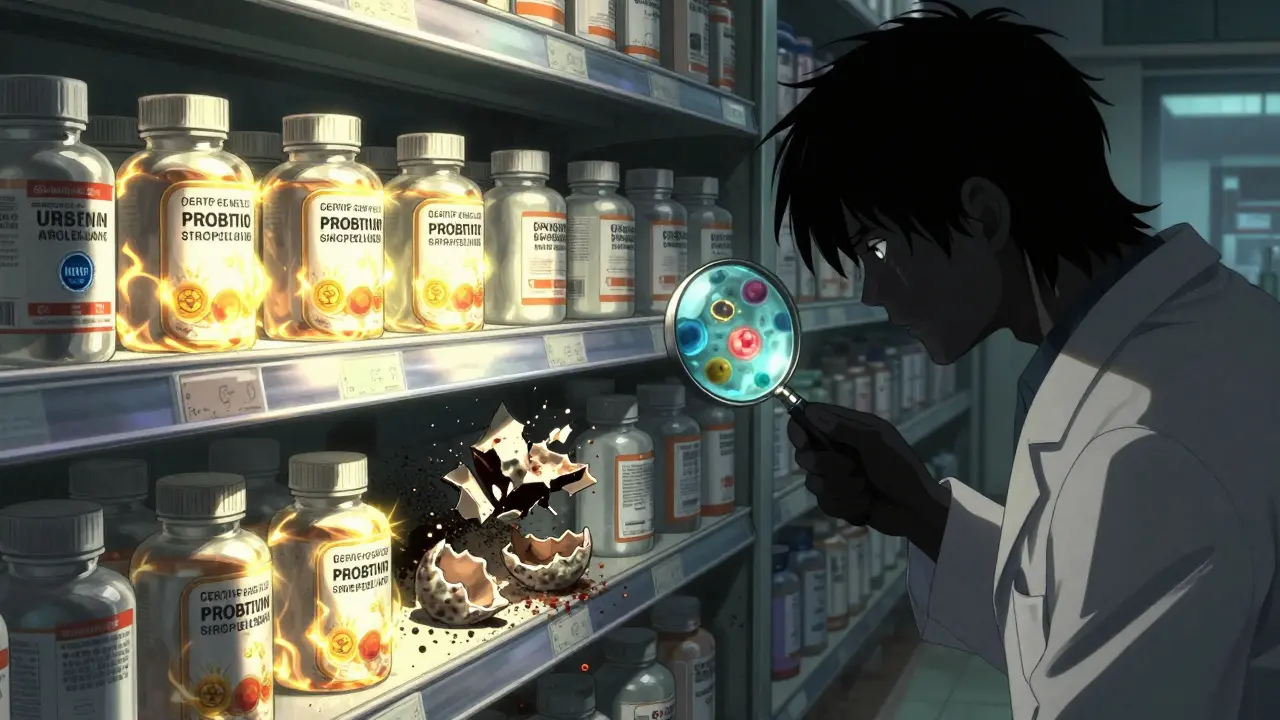
What About Food? Yogurt, Kefir, Sauerkraut?
Yes, fermented foods contain probiotics. But the amounts are unpredictable. A spoonful of yogurt might have a few billion live cultures-or none, if it’s been pasteurized after fermentation. Plus, most of these foods don’t contain the specific strains proven to help with antibiotics. They’re great for general gut health, but if you’re trying to prevent diarrhea while on antibiotics, supplements are more reliable.What’s Next?
Scientists are now looking at personalized probiotics-matching strains to specific antibiotics and patient profiles. Early research suggests that some probiotics might actually delay gut recovery after antibiotics, which is a shocking twist. We’re moving beyond “all probiotics are good” to “which probiotic, for whom, and when?” The NIH has invested $12.5 million in new studies to figure this out. In the meantime, the best advice is simple: use a proven strain, take it correctly, and don’t skip the conversation with your doctor.Who Should Avoid Probiotics?
You should not take probiotics if you:- Have a weakened immune system (HIV, chemotherapy, organ transplant)
- Are critically ill or in the ICU
- Have a central IV line
- Have had recent major surgery
- Are severely malnourished
- Have short bowel syndrome
Amy Insalaco
January 30, 2026 AT 03:29Let’s be real-probiotics are a placebo with a side of microbiome theater. The entire premise assumes gut flora is a delicate garden that needs tending, when in fact, the human microbiome is a war zone that thrives on chaos. Studies showing 50% reduction in diarrhea? Publication bias, small samples, and industry-funded trials. The real effect size is negligible, and the commercialization of L. rhamnosus GG is a masterclass in capitalizing on health anxiety. You don’t need a supplement-you need to stop treating your gut like a potted plant.
kate jones
January 30, 2026 AT 05:29While the contrarian perspective is understandable, the clinical evidence for L. rhamnosus GG and S. boulardii is robust across multiple meta-analyses, including Cochrane reviews. The key is adherence to timing-2–3 hours post-antibiotic-and using products with verified CFU counts. Many failures stem from inconsistent dosing or low-quality formulations, not the probiotics themselves. For immunocompetent individuals, the risk-benefit profile is overwhelmingly favorable. Third-party certification (USP, NSF) is non-negotiable.
Natasha Plebani
January 31, 2026 AT 17:39What does it mean to ‘bounce back’? Is the gut a machine that needs recalibration, or is it an emergent ecosystem that reconfigures itself autonomously? We project our need for control onto microbial communities, treating them like servants rather than symbionts. Probiotics may suppress symptoms, but do they restore ecological function-or merely mask dysbiosis with temporary colonization? The NIH’s $12.5M investment suggests we’re still in the dark ages of microbial ecology. Maybe the real intervention isn’t supplementation, but antibiotic stewardship and dietary fiber.
Rob Webber
February 2, 2026 AT 10:22This entire article is a corporate shill for Culturelle and Florastor. Big Pharma doesn’t want you healing naturally-they want you buying pills. Antibiotics are poison, sure, but probiotics are just another scam to keep you dependent. I took amoxicillin last year and didn’t touch any supplement. Got zero diarrhea. Your gut doesn’t need help-it needs to be left alone. Stop buying into this wellness cult.
Yanaton Whittaker
February 3, 2026 AT 21:49USA made the best probiotics, period. Other countries? Their supplements are full of fillers and fake strains. If you’re not taking American-made, you’re risking your health. Culturelle? Made in the USA. Florastor? USA. Don’t fall for imported junk. We lead the world in science-use American products. 🇺🇸
Kathleen Riley
February 4, 2026 AT 04:30It is imperative to underscore the ontological distinction between probiotic supplementation and the innate homeostatic mechanisms of the human gastrointestinal tract. The reductionist framing of gut flora as a binary ecosystem of ‘good’ and ‘bad’ bacteria is epistemologically flawed and anthropocentrically biased. The microbiota functions as a dynamic, non-linear network, and the imposition of exogenous strains constitutes an interventionist paradigm that may, in fact, impede endogenous resilience.
Beth Cooper
February 5, 2026 AT 11:19Probiotics are a distraction. The real problem? Antibiotics are overprescribed. Why are we treating every sinus infection like it’s the plague? And why are we letting corporations sell us ‘gut repair’ when the solution is to stop destroying our microbiome in the first place? Also, did you know the FDA doesn’t regulate these? That’s right-your $30 bottle might be sugar and chalk. I think Big Pharma is using this to distract us from the real issue: they’re overmedicating us. 🤫
Lily Steele
February 7, 2026 AT 04:52I took Culturelle with my antibiotics and didn’t get sick. Took it 2 hours after my pill, every day. Kept going for two weeks after. Simple. No drama. I’m not a scientist, but it worked for me. If you’re worried, talk to your pharmacist-they know which brands actually have live bugs. Don’t overthink it.
Gaurav Meena
February 8, 2026 AT 10:12As someone from India where yogurt is part of daily life, I can say food-based probiotics have been our tradition for centuries. But you're right-when on strong antibiotics, supplements are more reliable. I recommend starting with low dose and increasing slowly. Also, drink plenty of water and eat bananas. They help the good bugs settle. 😊
Katie and Nathan Milburn
February 9, 2026 AT 20:18Interesting that the article cites Amazon reviews as evidence. The same logic could be applied to homeopathy. If 12,500 people say it worked, does that make it science? Or just confirmation bias? The placebo effect is powerful, especially when paired with expensive packaging and a reassuring brand name. I remain skeptical of any intervention marketed as ‘natural’ that requires daily dosing for ‘optimal results.’
Beth Beltway
February 11, 2026 AT 03:02Let’s cut through the fluff. You’re telling people to take probiotics, but you didn’t mention that 30% of products contain less than 10% of the CFUs claimed. You’re enabling consumer fraud. And you call S. boulardii ‘safe’? It’s a yeast that’s been linked to fungemia in immunocompromised patients. You’re not helping-you’re enabling negligence. This isn’t advice. It’s a liability.
Claire Wiltshire
February 11, 2026 AT 05:38For those concerned about quality, I recommend seeking products with the USP Verified Mark or NSF Certified for Sport. These certifications require third-party testing for potency, purity, and label accuracy. Additionally, refrigerated probiotics often have higher viability, though some strains like S. boulardii are shelf-stable. Always check the expiration date-live cultures degrade over time. If the label doesn’t list strain designation and CFU count, it’s not worth your money.
Darren Gormley
February 11, 2026 AT 14:33Probiotics are the new crypto. Everyone’s buying into the hype, but nobody knows how it actually works. The science is messy, the regulation is nonexistent, and the market is a casino. I’ve seen people spend $50/month on probiotics while ignoring their sugar intake and sleep. The real fix? Less antibiotics, more fiber, less stress. But that’s not sexy. So we buy pills. 🤷♂️
Mike Rose
February 13, 2026 AT 01:28probiotics are just fancy yogurt pills. who even cares. i took antibiotics and ate pizza. no diarea. problem solved.