Polypharmacy Risk Assessment Tool
This tool helps you assess your risk of medication-related problems based on the number of medications you take and specific high-risk drugs. According to the article, taking 5 or more medications significantly increases health risks.
Enter your medication information and click "Assess Risk" to see your results.
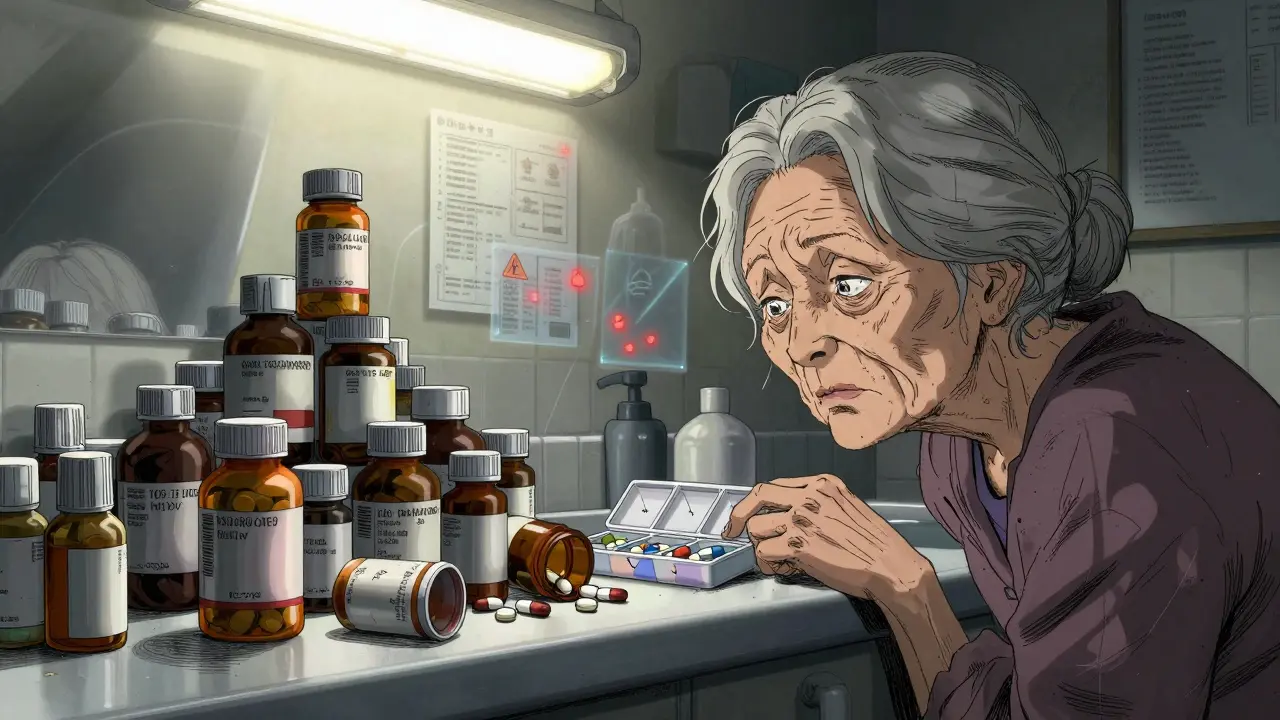
When you take one or two medications, it’s usually straightforward. But when the pill organizer starts filling up-five, seven, ten pills a day-that’s when things get dangerous. This isn’t just about forgetting which pill you took. It’s about how your body reacts when too many drugs are fighting for space in your system. That’s polypharmacy, and it’s silently increasing risks for millions of older adults across the U.S.
What Exactly Is Polypharmacy?
Polypharmacy isn’t just a fancy word for taking a lot of pills. It’s the regular use of five or more medications at the same time. The number five isn’t magic-it’s a red flag. Studies show that once you hit five medications, your risk of harmful side effects jumps sharply. And it’s not just seniors. While nearly 40% of Americans over 65 are taking five or more drugs, younger people with multiple chronic conditions are catching up fast.
Some polypharmacy is necessary. For example, someone recovering from a heart attack might need a beta blocker, a statin, an aspirin, and an ACE inhibitor. That’s four drugs working together to save lives. But too often, medications are added without reviewing what’s already being taken. A new prescription for acid reflux leads to another for constipation, then another for dizziness caused by the constipation pill. This is called a medication cascade, and it accounts for 30-40% of unnecessary prescriptions in older adults.
How Multiple Medications Trigger Side Effects
Your body doesn’t handle drugs like a pharmacy shelf. It’s a complex system where each medication interacts with your liver, kidneys, brain, and heart. When you add more drugs, those interactions multiply. Here’s what happens:
- Drug interactions: One medication can change how another is absorbed, broken down, or eliminated. For example, common antibiotics can make blood thinners dangerously strong. A 2018 study found that half of people taking five or more medications experience at least one dangerous interaction.
- Overloaded organs: Your liver and kidneys filter out drugs. As we age, they slow down. That means drugs stick around longer, building up to toxic levels. A drug that was safe at age 60 can become harmful at 75.
- Overlapping side effects: Two different drugs might both cause dizziness. Together, they double the risk of falling. Falls are the leading cause of injury-related death in older adults, and polypharmacy increases that risk by 1.5 to 2 times.
It’s not just falls. People on multiple medications report confusion, fatigue, memory loss, nausea, and loss of appetite. A 2018 study in the Journal of the American Geriatrics Society found that 68% of seniors on five or more drugs said their quality of life had declined. Many stopped going out, stopped cooking, stopped driving-all because they felt too unwell.
The Hidden Costs: Money, Time, and Health
The financial burden is staggering. People taking five to nine medications spend an average of $317 per month on drugs. Those on one to four pay $78. For fixed-income seniors, that’s a choice between medicine and food. One patient, Robert, 68, told UCI Health: “I had to skip my heart pill one day to afford my insulin.”
And it’s not just out-of-pocket costs. Hospital bills pile up. Polypharmacy patients have 32% more emergency room visits and 24% more hospital admissions than those on fewer drugs. Hospital stays are 2-19% longer on average. In 2022, avoidable costs from polypharmacy hit $300 billion in the U.S. alone.
Even worse, many patients stop taking their meds because they’re too confusing. A 2021 study found that people on 10 or more medications were over three times more likely to skip doses. Reasons? Cost (65%), complexity (58%), and side effects (47%).

Who’s Most at Risk?
Older adults are the most visible group, but they’re not the only ones. Women over 65 are more likely than men to be on five or more drugs-57% compared to 44%. That’s partly because women live longer and often have more chronic conditions. But it’s also because they’re more likely to be prescribed sedatives, antidepressants, and painkillers.
People with three or more chronic conditions are also at high risk. Think diabetes, heart disease, arthritis, and depression. Each condition brings its own meds. Add in over-the-counter drugs, vitamins, and supplements, and you’ve got a prescription pile that no one can manage alone.
And here’s the truth no one talks about: many of these drugs were never meant to be taken long-term. Benzodiazepines for anxiety? Anticholinergics for overactive bladder? NSAIDs for chronic pain? These are often prescribed for months or years, even though guidelines say they should be short-term.
Deprescribing: The Right Way to Cut Back
The solution isn’t to stop all meds. It’s to stop the ones that don’t belong. This is called deprescribing-the careful, step-by-step removal of unnecessary or harmful drugs.
It’s not a quick fix. It takes 3 to 6 months. Here’s how it works:
- Full medication review: Every pill-even aspirin, melatonin, or herbal supplements-is listed. Doctors and pharmacists compare them against known risky combinations.
- Use the Beers Criteria: This is a list of medications that are risky for older adults. Things like sleeping pills, certain antihistamines, and some painkillers are flagged.
- Start with the weakest link: Which drug is most likely causing side effects? Which one has no clear benefit anymore? That’s the first to go.
- Monitor closely: After removing a drug, the patient is watched for 2-4 weeks. Did the dizziness go away? Did energy improve? Did blood pressure stay stable?
One patient, 78, was on 12 medications. She was falling, confused, and too tired to leave her house. After a 4-month deprescribing plan, three unnecessary pills were removed. Within weeks, she was walking without a cane again. “I felt like myself for the first time in years,” she said.

Why Don’t More Doctors Do This?
It’s not because they don’t care. It’s because they’re overwhelmed. Only 35% of primary care doctors say they feel confident managing complex medication regimens. Most haven’t been trained in deprescribing. Medical schools teach how to prescribe, not how to stop.
Also, patients often resist. “I’ve been taking this for 10 years,” they say. “What if I get worse?” That fear is real. But studies show that when deprescribing is done right-with clear communication and slow tapering-patients feel better, not worse.
Tools are emerging. In 2022, the FDA approved a decision-support tool called MedWise. It scans a patient’s full medication list and flags dangerous combinations. Practices using it saw a 37% drop in high-risk drug pairings.
What You Can Do
If you or a loved one is on five or more medications, here’s what to do:
- Make a complete list of every pill, patch, capsule, and supplement. Include doses and times.
- Bring it to your next doctor’s visit. Ask: “Which of these are still necessary? Which might be causing side effects?”
- Ask about the Beers Criteria. Ask if any drugs can be stopped or replaced with safer options.
- Track side effects. Write down dizziness, confusion, fatigue, or falls. These are clues.
- Don’t be afraid to say no. If a new drug is prescribed, ask: “Is this absolutely needed? What happens if I don’t take it?”
Medication isn’t always the answer. Sometimes, physical therapy, diet changes, or better sleep can replace a pill. But you won’t find that out unless you ask.
The Bigger Picture
Polypharmacy isn’t just a medical issue. It’s a system failure. We’ve built a healthcare model that rewards adding treatments, not removing them. Insurance pays for prescriptions, not time spent reviewing them. Doctors get paid for new visits, not for spending 40 minutes talking about a pill organizer.
But change is coming. Medicare now requires medication reviews for people on eight or more drugs. The NIH is funding $15 million to build better deprescribing protocols. And more patients are speaking up.
The goal isn’t to take fewer pills. It’s to take the right ones. And sometimes, the best medicine is the one you stop taking.
What is considered polypharmacy?
Polypharmacy is generally defined as taking five or more medications regularly. This includes prescription drugs, over-the-counter medicines, vitamins, and supplements. While the number five is a practical warning sign, the real issue is whether each medication is still necessary, safe, and effective for the individual.
Can polypharmacy cause falls in older adults?
Yes. Taking five or more medications doubles the risk of falls in older adults. Drugs that cause dizziness, low blood pressure, or confusion-like sedatives, blood pressure pills, and anticholinergics-are common culprits. Falls are the leading cause of injury and death in seniors, and polypharmacy is one of the most preventable reasons.
Is it safe to stop taking medications on my own?
No. Never stop or change doses without talking to your doctor. Some medications, like antidepressants or blood pressure pills, can cause dangerous withdrawal effects if stopped suddenly. Deprescribing must be done slowly and under medical supervision.
What medications are most often unnecessary in older adults?
The American Geriatrics Society’s Beers Criteria lists high-risk drugs for seniors. These include benzodiazepines (like lorazepam), long-term NSAIDs (like ibuprofen), anticholinergics (like diphenhydramine), and certain diabetes drugs that can cause low blood sugar. Many of these were prescribed years ago and no longer serve a purpose.
How long does deprescribing take?
Deprescribing usually takes 3 to 6 months. It’s a slow process because each medication must be removed one at a time, with careful monitoring for side effects or worsening symptoms. Rushing it can cause serious problems. Patience and follow-up are key.