
Cholesterol Drug Decision Tool
Your Situation
Answer these questions to see which cholesterol medication may be best for you.
Your Personalized Recommendation
When it comes to lowering cholesterol, two major drug classes dominate the conversation: statins and PCSK9 inhibitors. Both work to reduce LDL - the "bad" cholesterol - but they do it in completely different ways, with different risks, benefits, and real-world challenges. If you’ve been told your cholesterol is too high and your doctor is talking about switching you from a statin to a PCSK9 inhibitor, or vice versa, you’re not alone. Millions of Americans face this decision every year. And the right choice isn’t just about numbers on a lab report - it’s about how you feel, what you can afford, and what you’re willing to stick with long term.
How Statins Work - and Why They’re Still the Go-To
Statins have been the backbone of cholesterol treatment since the late 1980s. Drugs like atorvastatin (Lipitor), rosuvastatin (Crestor), and simvastatin (Zocor) block an enzyme in your liver called HMG-CoA reductase. That enzyme is responsible for making cholesterol. When you slow it down, your liver pulls more LDL out of your bloodstream to use for its own needs. The result? LDL levels drop by 30% to 50%, depending on the dose and the person.
What makes statins so popular isn’t just their effectiveness - it’s their track record. Over 40 million Americans take them. Decades of data show they cut heart attacks, strokes, and deaths from heart disease. They’re cheap, too. Generic statins cost as little as $4 to $10 a month. Most people take one pill a day. No needles. No special training. Just pop it and forget it.
But here’s the catch: about 5% to 10% of people can’t tolerate statins. The most common complaint? Muscle pain. Not just a twinge - persistent soreness, weakness, or cramps that don’t go away. Some report memory fog or trouble sleeping. In rare cases, liver enzymes rise, or a serious condition called rhabdomyolysis (muscle breakdown) occurs. These side effects aren’t common, but they’re real enough that many patients stop taking statins - even if their doctor says they should keep going.
How PCSK9 Inhibitors Work - A Different Kind of Power
PCSK9 inhibitors - like alirocumab (Praluent) and evolocumab (Repatha) - don’t touch cholesterol production at all. Instead, they target a protein called PCSK9, which normally tells your liver to destroy LDL receptors. When you block PCSK9, your liver keeps more of those receptors alive. More receptors mean more LDL pulled out of your blood. The result? LDL drops by 50% to 61%, often more than even the strongest statins.
These drugs are injectable. You give yourself a shot under the skin every two weeks or once a month. It’s not a needle like insulin - it’s a small, pre-filled pen. Most people learn how to use it in one or two tries. But that doesn’t mean it’s easy. Some people hate the idea of self-injecting. Others feel anxious about it. And if you’re not comfortable with needles, this isn’t going to work for you.
What’s more, PCSK9 inhibitors are expensive. Before insurance, they cost $5,000 to $14,000 a year. Even with coverage, copays can hit $300 a month. Insurance companies almost always require proof that you tried and failed on statins - or that you’re intolerant to them. That means a lot of paperwork, delays, and frustration.
Side Effects: Statins vs PCSK9 Inhibitors
Statins and PCSK9 inhibitors have almost no overlapping side effects. That’s why they’re often used together.
Statins are linked to:
- Muscle pain or weakness (reported by 32% of negative reviewers on Drugs.com)
- Increased blood sugar (slight risk of developing type 2 diabetes)
- Memory issues (rare, but frequently reported anecdotally)
- Minor liver enzyme elevations (usually harmless)
- Higher risk of hemorrhagic stroke in certain people (22% increase per UCLA research)
PCSK9 inhibitors, on the other hand, are mostly clean. In over 36 clinical trials, the most common side effects were:
- Injection site reactions - redness, swelling, or itching (affects about 10% of users)
- Nasal congestion or sore throat
- Flu-like symptoms (rare)
Here’s the kicker: no significant increase in muscle pain. No memory complaints. No rise in diabetes. And crucially, no increased risk of hemorrhagic stroke. In fact, some experts believe PCSK9 inhibitors might be safer for people with a history of brain bleeds or those at higher risk.

Outcomes: Who Benefits Most?
Both drugs reduce heart attacks and strokes - but not equally.
The FOURIER trial showed that adding evolocumab to statin therapy in people with existing heart disease cut major cardiovascular events by 27% over two years. The ODYSSEY trial saw similar results with alirocumab. These aren’t small wins. They’re life-saving.
But here’s the real-world picture: statins help millions. PCSK9 inhibitors help thousands. Why? Because they’re reserved for people who really need them:
- Those with familial hypercholesterolemia (inherited high cholesterol)
- People with established heart disease who still have LDL above 70 mg/dL despite maximum statin therapy
- Patients who can’t take statins due to side effects
One patient story from the FH Foundation tells it all: a 42-year-old with inherited high cholesterol had an LDL of 286 mg/dL on high-dose rosuvastatin. After adding alirocumab, his LDL dropped to 58 mg/dL. That’s the kind of change that stops heart attacks before they start.
For most people, though, a high-intensity statin plus ezetimibe (a second-line pill) is enough. It’s cheaper. It’s proven. And it gets LDL down to safe levels for most.
Cost and Access: The Hidden Barrier
Let’s be blunt: cost is the biggest reason most people never get PCSK9 inhibitors.
Generic statins: $4-$10/month.
PCSK9 inhibitors: $400-$1,200/month after insurance - if you get approved.
Eighty-seven percent of U.S. insurers require you to try and fail on at least two statins before they’ll even consider covering a PCSK9 inhibitor. That means:
- Documenting muscle pain or liver issues
- Providing lab results showing LDL still above target
- Waiting weeks or months for prior authorization
Many patients give up. Others switch to less effective alternatives like bempedoic acid (Nexletol), which is cheaper but not as powerful. And while the price of PCSK9 inhibitors has dropped since 2020, they’re still 3.2 times more expensive than statin-plus-ezetimibe regimens.
Manufacturers have stepped up with support programs - Amgen’s Repatha SupportPlus and Sanofi’s Praluent Support help with insurance appeals, copay cards, and injection training. Ninety-two percent of users say these services made a difference. But they’re not a fix for systemic access problems.
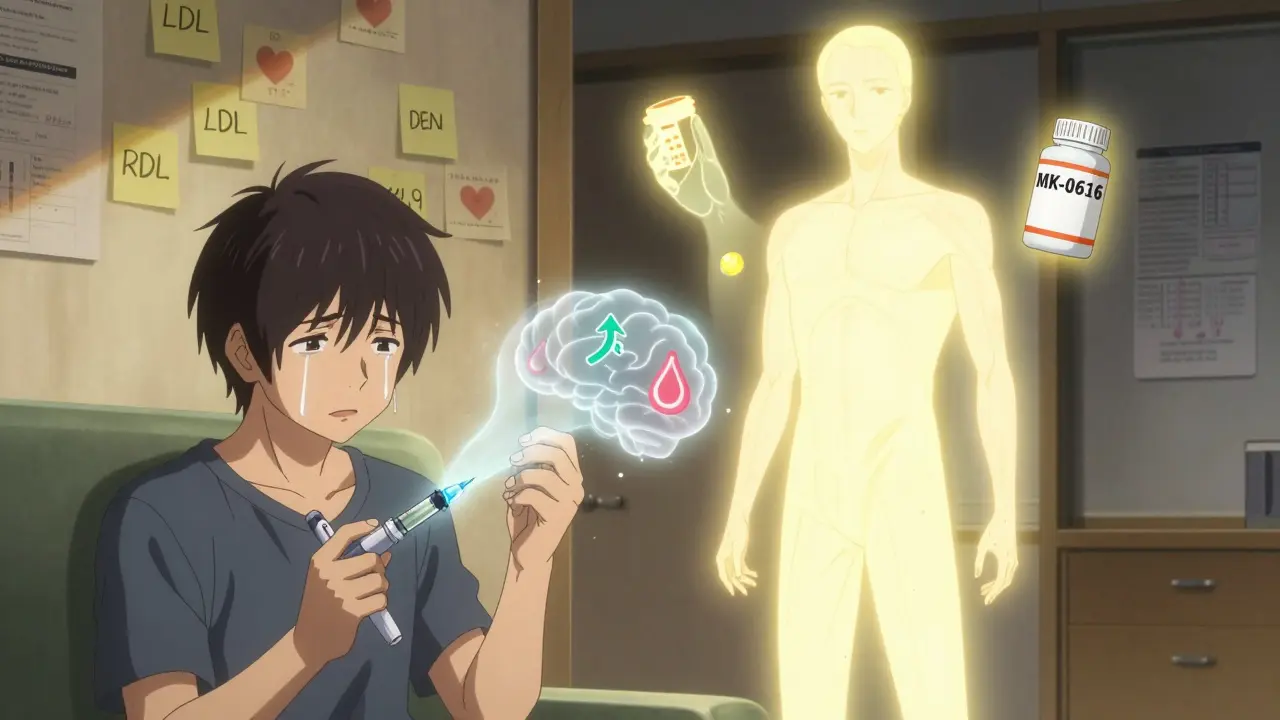
What About the Future?
The next wave of cholesterol drugs is already here. Inclisiran (Leqvio), approved in 2021, is a PCSK9 inhibitor you get as a shot only twice a year. That’s a game-changer for people who hate monthly injections.
Even more exciting? Oral PCSK9 inhibitors. Merck’s MK-0616, currently in Phase II trials, reduced LDL by 60% in early 2024 data - without a needle. If approved, it could bring the power of PCSK9 inhibition to millions who can’t or won’t use injections.
And the science keeps evolving. Researchers now believe statins help not just by lowering cholesterol, but by reducing inflammation in artery walls. That’s why they may still be better for long-term plaque stabilization - even if PCSK9 inhibitors lower LDL more.
So Which One Should You Choose?
There’s no universal answer. But here’s how to think about it:
- If you’re on a statin, feel fine, and your LDL is below 70 mg/dL - stick with it. It works. It’s cheap. It’s proven.
- If you’re on a statin and still have high LDL - talk to your doctor about adding ezetimibe first. It’s low-cost and adds another 15-20% LDL reduction.
- If you can’t tolerate statins - muscle pain, liver issues, or worse - PCSK9 inhibitors are a lifeline. They work without touching your muscles.
- If you have inherited high cholesterol or a history of heart attack/stroke - PCSK9 inhibitors may be your best shot at hitting aggressive LDL targets (under 55 mg/dL).
- If cost is a major barrier - ask about patient assistance programs. Don’t give up before you’ve tried.
Bottom line: Statins are the foundation. PCSK9 inhibitors are the upgrade - for those who need it.
Are PCSK9 inhibitors better than statins?
PCSK9 inhibitors lower LDL more - often 50-61% vs. statins’ 30-50%. They also avoid muscle pain and don’t raise stroke risk like statins can. But they’re not better for everyone. Statins have decades of data showing they save lives, cost far less, and are easy to take. PCSK9 inhibitors are reserved for people who can’t tolerate statins or still have dangerously high cholesterol despite maximum statin therapy.
Do PCSK9 inhibitors cause muscle pain?
No. Unlike statins, PCSK9 inhibitors do not cause muscle pain or weakness. That’s one of their biggest advantages. In clinical trials and real-world use, patients who switched from statins to PCSK9 inhibitors often report their muscle symptoms disappeared completely. This makes them ideal for people with statin intolerance.
Can you take PCSK9 inhibitors and statins together?
Yes - and many patients do. In fact, combining a PCSK9 inhibitor with a statin can reduce LDL by up to 75%. This is common for people with very high-risk conditions like heart disease or familial hypercholesterolemia. The two drugs work differently, so they don’t interfere with each other. The main downside is cost - combining them doubles the price.
Why are PCSK9 inhibitors so expensive?
PCSK9 inhibitors are biologic drugs made from living cells - not simple chemicals like statins. They require complex manufacturing, storage, and delivery systems. When they launched in 2015, prices were set high to recoup R&D costs. Since then, prices have dropped significantly due to competition and pressure from insurers, but they’re still far more expensive than generic statins. Patient assistance programs and copay cards can reduce out-of-pocket costs to under $50/month for many.
Do I need a blood test before starting a PCSK9 inhibitor?
Not usually. Unlike statins, which require baseline liver enzyme tests and occasional monitoring, PCSK9 inhibitors don’t affect the liver or muscles. Your doctor will check your LDL before and after starting to measure effectiveness, but routine blood work isn’t needed. The main focus is on injection technique and managing insurance paperwork.
Is there a pill version of PCSK9 inhibitors?
Not yet, but one is coming. Merck’s MK-0616, an oral PCSK9 inhibitor, showed 60% LDL reduction in early 2024 trials. If approved, it could be available by 2027-2028. This would eliminate the need for injections and could dramatically expand access. Until then, injections remain the only option.
Next Steps: What to Do If You’re Considering a Switch
If you’re thinking about switching from statins to a PCSK9 inhibitor - or vice versa - here’s what to do:
- Get your latest LDL number. Know your target (usually under 70 mg/dL if you have heart disease).
- Track your side effects. Write down muscle pain, fatigue, memory issues - and when they started.
- Ask your doctor if you qualify for a PCSK9 inhibitor. Do you have heart disease? Familial hypercholesterolemia? Did you fail on two statins?
- Call your insurance. Ask what’s required for prior authorization. Do they need lab results? A letter from your doctor?
- Check patient assistance programs. Amgen and Sanofi offer copay cards that can cut your monthly cost to $0-$50.
- Try the injection once. Many clinics offer a practice session with a nurse. It’s less scary than it looks.
There’s no rush. But if you’ve been struggling with statin side effects or stubbornly high cholesterol, the right alternative might be closer than you think.
Mike Hammer
February 13, 2026 AT 15:41Sarah Barrett
February 13, 2026 AT 19:39Daniel Dover
February 14, 2026 AT 23:26Mandeep Singh
February 15, 2026 AT 12:47Josiah Demara
February 16, 2026 AT 08:01Kaye Alcaraz
February 17, 2026 AT 10:14Erica Banatao Darilag
February 17, 2026 AT 19:42Charlotte Dacre
February 19, 2026 AT 08:16Esha Pathak
February 20, 2026 AT 12:45Chiruvella Pardha Krishna
February 21, 2026 AT 10:16Joe Grushkin
February 22, 2026 AT 01:39Virginia Kimball
February 22, 2026 AT 10:53Kapil Verma
February 24, 2026 AT 02:20Michael Page
February 25, 2026 AT 17:13Betty Kirby
February 26, 2026 AT 04:46