When someone is diagnosed with multiple myeloma, the focus often turns to chemotherapy, stem cell transplants, or targeted drugs that kill cancer cells. But for most patients, the real daily struggle isn’t the cancer itself - it’s the bone disease that comes with it. Over 80% of people with multiple myeloma develop severe bone damage, and for many, the pain, fractures, and hospitalizations caused by bone destruction are worse than the cancer symptoms. This isn’t just a side effect - it’s a core part of the disease, and new treatments are finally starting to change that.
How Myeloma Turns Your Bones into Swiss Cheese
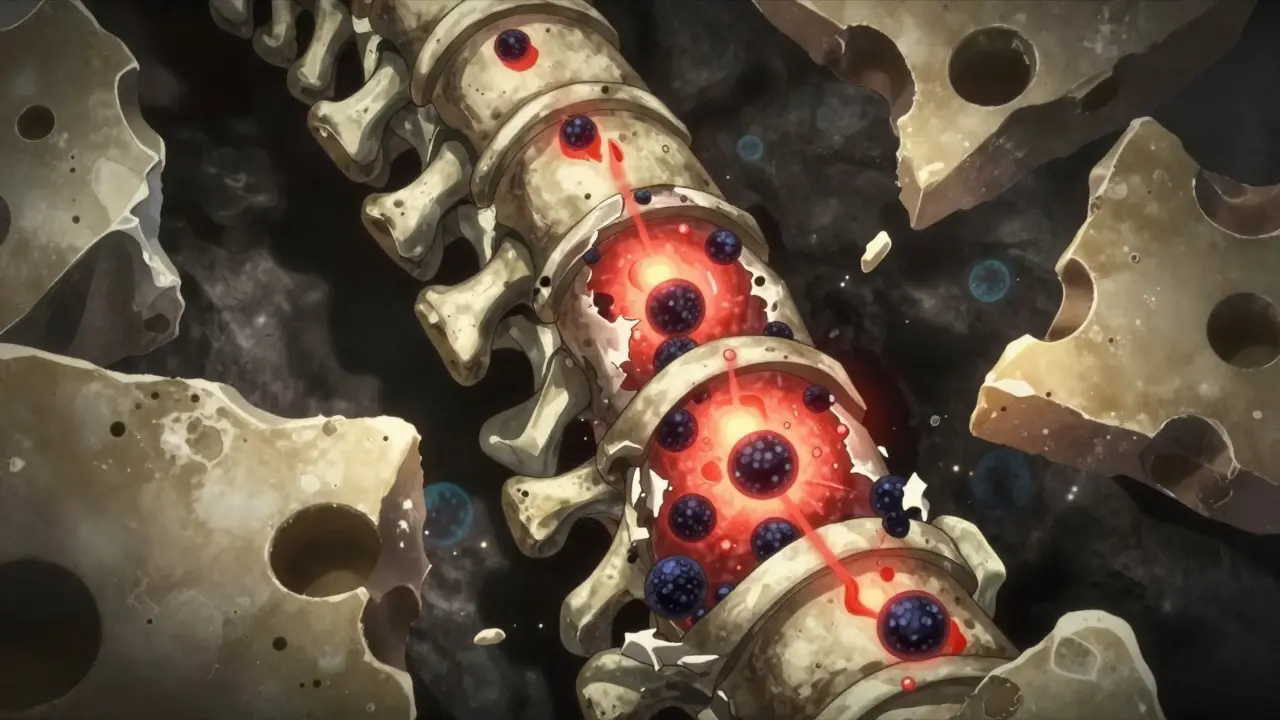
Your bones aren’t static. They’re alive, constantly being broken down and rebuilt in a balanced process called remodeling. Osteoclasts chew up old bone; osteoblasts build new bone. In multiple myeloma, this balance shatters. Myeloma cells move into the bone marrow and send out chemical signals that turn osteoclasts into overactive demolition crews while shutting down osteoblasts completely. The result? Holes in your bones - called osteolytic lesions - that look like they’ve been punched out by a drill. These aren’t just visible on X-rays; they weaken your spine, ribs, hips, and skull, making everyday movements dangerous.
It’s not random. The destruction happens right next to the cancer cells. Studies using bone biopsies show that the worst damage is always clustered where myeloma cells are most active. This isn’t coincidence - it’s a cycle. Bone breakdown releases growth factors that feed the myeloma cells, helping them multiply. More myeloma cells mean more signals to destroy more bone. It’s a vicious loop: bone damage helps cancer grow, and cancer growth causes more bone damage.
Three major pathways drive this destruction. First, the RANK/RANKL/OPG system. Myeloma cells boost RANKL (a signal that activates bone-eating cells) and suppress OPG (the natural brake on that signal). In patients, this ratio is 3 to 5 times higher than in healthy people. Second, myeloma cells release DKK1 and sclerostin - proteins that block the Wnt pathway, which is essential for bone building. Patients with DKK1 levels above 48.3 pmol/L have over three times more bone lesions than those with lower levels. Third, osteocytes (the most common bone cells) get hijacked. They start pumping out more sclerostin and activating Notch pathways, further tipping the balance toward destruction.
Current Treatments: Stopping the Damage, But Not Healing It
For decades, the only tools doctors had were drugs that slow bone loss - not rebuild it. Bisphosphonates like zoledronic acid and pamidronate have been the standard since the early 2000s. They work by sticking to bone surfaces and killing overactive osteoclasts. Monthly IV infusions reduce fractures and other bone complications by 15-18% compared to no treatment. But they come with serious downsides: kidney damage, jaw bone death (osteonecrosis of the jaw), and acute flu-like reactions in over 30% of patients.
Denosumab, a monthly shot that blocks RANKL directly, became the next big option. It’s more effective than bisphosphonates at preventing fractures and doesn’t harm the kidneys. In a 2021 Mayo Clinic survey, 74% of patients preferred it over IV therapy because it’s easier to get. But it costs $1,800 per dose - over 10 times more than generic zoledronic acid. And like bisphosphonates, it only stops bone loss. It doesn’t fix what’s already broken.
That’s the big problem. Even with the best current drugs, bones don’t heal. Lesions stay. Pain lingers. Patients still get spinal cord compressions and pathological fractures. A 2022 survey of 1,247 myeloma patients found bone complications led to hospitalization in over 32% of cases - second only to infections. And on patient forums like Reddit, 68% say they still have bone pain despite treatment. We’ve gotten better at slowing destruction, but we haven’t figured out how to rebuild.
The New Generation of Drugs: Building Bone Again
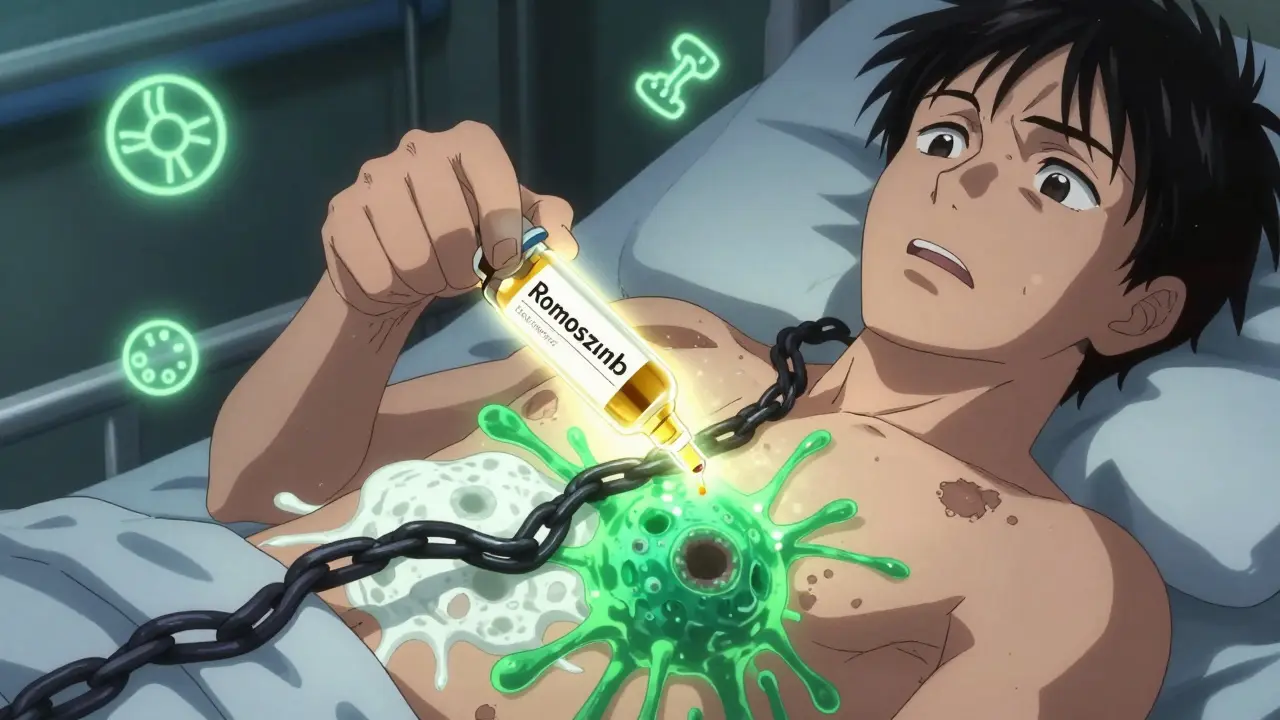
For the first time, drugs are being developed that don’t just stop bone loss - they actually rebuild it. These are called bone-forming agents, and they’re turning the old model upside down.
One of the most promising is romosozumab. It’s a monoclonal antibody that blocks sclerostin - the protein myeloma cells use to shut down bone building. In a 2021 phase II trial with 49 patients, romosozumab increased bone density in the spine by 53% over 12 months. Patients also reported a 35% improvement in pain scores. This isn’t just a lab result - it’s a life change. The FDA has fast-tracked it, and a phase III trial called BONE-HEAL is now enrolling 450 patients across the U.S. and Europe.
Another candidate is DKK-1 inhibitors, like DKN-01. In a 2020 trial with 32 patients, this drug cut bone resorption markers by 38%. It’s not just about density - it’s about restoring the natural bone-building environment. Early data suggests it works best when combined with existing bone drugs.
Then there’s gamma-secretase inhibitors, like nirogacestat. These target the Notch pathway, which myeloma cells use to trick osteocytes into helping destroy bone. In animal models, these drugs cut osteolytic lesions by 62%. Human trials are still early, but the results are promising enough that major pharma companies are investing heavily.
Even drugs that failed in other areas are finding new life here. Odanacatib, originally developed for osteoporosis, showed a 31% drop in bone resorption before being shelved due to stroke risk. Researchers are now testing lower doses specifically for myeloma, where the risk-benefit ratio may be acceptable.
Who Benefits Most? The Real Challenge
Not all myeloma bone disease is the same. Some patients have a few small lesions. Others have their spine crumbling. The new drugs aren’t magic bullets - they work best in specific situations. Experts like Dr. Irene Ghobrial from Harvard say we need to stop treating bone disease as a one-size-fits-all problem. The key is identifying who will respond.
Right now, we’re looking at biomarkers. High DKK1? High sclerostin? Those patients are likely to respond best to the new bone-forming drugs. A 2023 study showed patients with sclerostin levels above 28.7 pmol/L had significantly more bone damage - and also showed the biggest gains in trials with romosozumab. We’re moving toward personalized bone therapy: test the markers, match the drug.
But there’s a catch. Dr. Kenneth Anderson from Dana-Farber warns that while these drugs improve bone markers and pain scores, we still don’t know if they extend life. No phase III trial has yet proven a survival benefit. That’s because bone disease is one piece of a complex puzzle. A patient might heal their spine, but if the myeloma keeps growing elsewhere, the gain is temporary. The future isn’t just bone drugs - it’s combinations. Bone-forming agents + anti-myeloma drugs + immunotherapy.

What’s on the Horizon?
The next wave of treatments is already in the pipeline. Bispecific antibodies are being designed to hit both myeloma cells and bone-signaling molecules at once. RNA therapies like Alnylam’s ALN-DKK1 can silence DKK1 production at the genetic level - early preclinical models show 65% reduction. And researchers are testing wearable bone monitors that track turnover in real time, letting doctors adjust therapy before damage occurs.
Regulators are catching up. The FDA now requires bone health endpoints in all new myeloma trials. The EMA demands MRONJ risk plans for every new bone drug. And guidelines from the European Hematology Association now urge doctors to start bone-targeting therapy at diagnosis - not after a fracture.
Cost remains a barrier. Denosumab is expensive. Romosozumab will likely cost even more. In the U.S., 78% of patients get denosumab. In Europe, it’s only 42%. In Asia, bisphosphonates still dominate at 89%. Without affordable access, these breakthroughs won’t help the majority.
What Patients Should Know
If you or a loved one has multiple myeloma, here’s what to ask your doctor:
- Have I had a full bone scan - not just an X-ray, but a whole-body low-dose CT or PET-CT?
- What’s my sclerostin or DKK1 level? Can we test it?
- Am I on the best bone drug for my situation - and is there a better option coming?
- Have I had a dental checkup since starting treatment? MRONJ risk is real.
- Am I getting enough calcium and vitamin D? New drugs like romosozumab can cause low calcium.
Don’t accept pain as normal. Bone damage isn’t inevitable - it’s treatable. And for the first time, healing is possible.
Can multiple myeloma bone disease be reversed?
Previously, bone damage from myeloma was considered permanent. Current drugs like bisphosphonates and denosumab can stop further destruction but don’t rebuild bone. However, new agents like romosozumab - which blocks sclerostin - have shown in clinical trials that they can increase bone mineral density by over 50% in the spine within a year. This suggests that bone healing is possible, not just prevention. The BONE-HEAL phase III trial is now testing this in 450 patients.
Why do myeloma patients get fractures so easily?
Myeloma cells in the bone marrow release signals that activate osteoclasts (bone-breakers) and block osteoblasts (bone-builders). This creates holes in bones called osteolytic lesions - areas where the bone is completely gone. These lesions weaken the structure so much that even minor stress, like bending over or coughing, can cause a fracture. About 28-38% of patients experience a pathological fracture, often in the spine, ribs, or hips.
Is denosumab better than zoledronic acid?
Denosumab is slightly more effective at preventing skeletal-related events like fractures and spinal cord compression, according to phase III trials. It also doesn’t harm the kidneys, making it safer for patients with reduced kidney function. However, it’s given as a monthly shot, while zoledronic acid is an IV infusion. Denosumab costs about $1,800 per dose, while generic zoledronic acid is around $150. Many patients prefer denosumab for convenience, but cost and access limit its use in many countries.
What are the side effects of new bone-building drugs?
New agents like romosozumab can cause low calcium levels (hypocalcemia) in up to 12.3% of patients, so calcium and vitamin D supplements are required. Gamma-secretase inhibitors often cause skin rashes (in 68% of trial patients). DKK1 inhibitors may lead to mild flu-like symptoms. Unlike bisphosphonates, these drugs don’t cause jaw bone death (MRONJ) or kidney damage - but long-term safety data is still being collected. All new bone-targeting drugs require careful monitoring.
Can I stop taking bone drugs if my myeloma goes into remission?
No. Even if the cancer is under control, bone disease can continue to progress. The bone marrow environment remains altered, and osteoclast activity often stays high. International guidelines recommend continuing bone-modifying agents as long as the patient is receiving active myeloma treatment. For those in long-term remission, doctors may reassess, but stopping too early risks new fractures. The goal is to protect bones until they’re fully healed - which may take years.
Hariom Sharma
February 22, 2026 AT 03:29Nina Catherine
February 22, 2026 AT 09:07Taylor Mead
February 23, 2026 AT 17:50Ashley Paashuis
February 25, 2026 AT 13:39Oana Iordachescu
February 26, 2026 AT 14:32Davis teo
February 27, 2026 AT 11:48Michaela Jorstad
February 28, 2026 AT 22:20Danielle Gerrish
March 2, 2026 AT 11:52Liam Crean
March 2, 2026 AT 15:45