When you fill a prescription for a generic drug, you probably assume more competitors mean lower prices. That makes sense - more companies making the same pill should drive prices down, right? But in real-world pharmaceutical markets, that logic often breaks down. The number of generic competitors doesn’t always line up with how cheap your medicine becomes. In fact, sometimes having more competitors doesn’t help at all - and in rare cases, it can even make prices go up.
Why More Generics Don’t Always Mean Lower Prices
The FDA says generics now make up 90.3% of all prescriptions filled in the U.S., but they only account for 23.4% of total drug spending. That sounds great - until you dig into the numbers. A single generic competitor typically cuts the price of a brand-name drug by 30-39%. Two generics? Prices drop about 54%. But here’s the catch: it takes six or more competitors to bring prices down by 95%. And in many markets, that never happens.
Take China, for example. A 2023 study of 27 originator drugs found that 15 of them still held over 70% of the market eight quarters after the first generic entered. Why? Because most drugs only had one or two generic rivals. Even when generics are approved, they don’t always show up on pharmacy shelves. The reason? High barriers to entry. Complex drug formulations - like extended-release pills, inhalers, or injectables - require expensive testing to prove they’re identical to the brand. Only the biggest generic manufacturers can afford that. Smaller companies walk away. So even if 10 companies get approval, only two or three actually sell the drug. That’s not competition. That’s a cartel in disguise.
The Paradox of Generic Competition
Here’s where things get weird. Sometimes, when generics enter the market, the original brand doesn’t lower its price - it raises it. A study of Chinese drug markets found that 70.4% of originator drugs had only one or two generic competitors. And in some cases, brand prices went up by 0.62% on average after generics appeared. Why? Because patients and doctors still trust the brand. If you’ve been taking Lipitor for years, you might not want to switch to a generic you’ve never heard of - even if it’s FDA-approved. The brand exploits that loyalty. It lowers production costs but keeps prices high, betting that loyal customers won’t switch. This isn’t theory. It’s happening right now.
And it’s not just about perception. Some brands slash prices just enough to scare off new competitors. They don’t want a full-blown price war. They want to stay profitable without losing too much market share. That’s why, in many cases, the first generic gets 80% of the market during its 180-day exclusivity period. The rest? They sit on the sidelines. Why risk millions in development costs when the first mover already owns the market?
How PBMs and Authorized Generics Twist the Rules
Pharmacy Benefit Managers - or PBMs - control 90% of drug purchases in the U.S. They don’t care how many companies make a drug. They care about the lowest price they can squeeze out of a deal. So even if 10 generics are available, the PBM might only pick one or two. That kills competition before it even starts. The others? They’re stuck with unsold inventory.
Then there’s the authorized generic - a version of the brand-name drug made by the original company but sold under a generic label. Sounds like a win for consumers, right? Not always. If the brand owns the authorized generic, it lowers its own wholesale price by 8-12%. But if another company makes the authorized generic? The brand’s price jumps 22% higher. Why? Because now the brand can pretend it’s still the only option. It’s a clever loophole: the brand lets someone else undercut it, then raises its own price to make up the difference. The patient pays more. The brand wins. The generic? Just a pawn.
Patents, Pay-for-Delay, and Regulatory Minefields
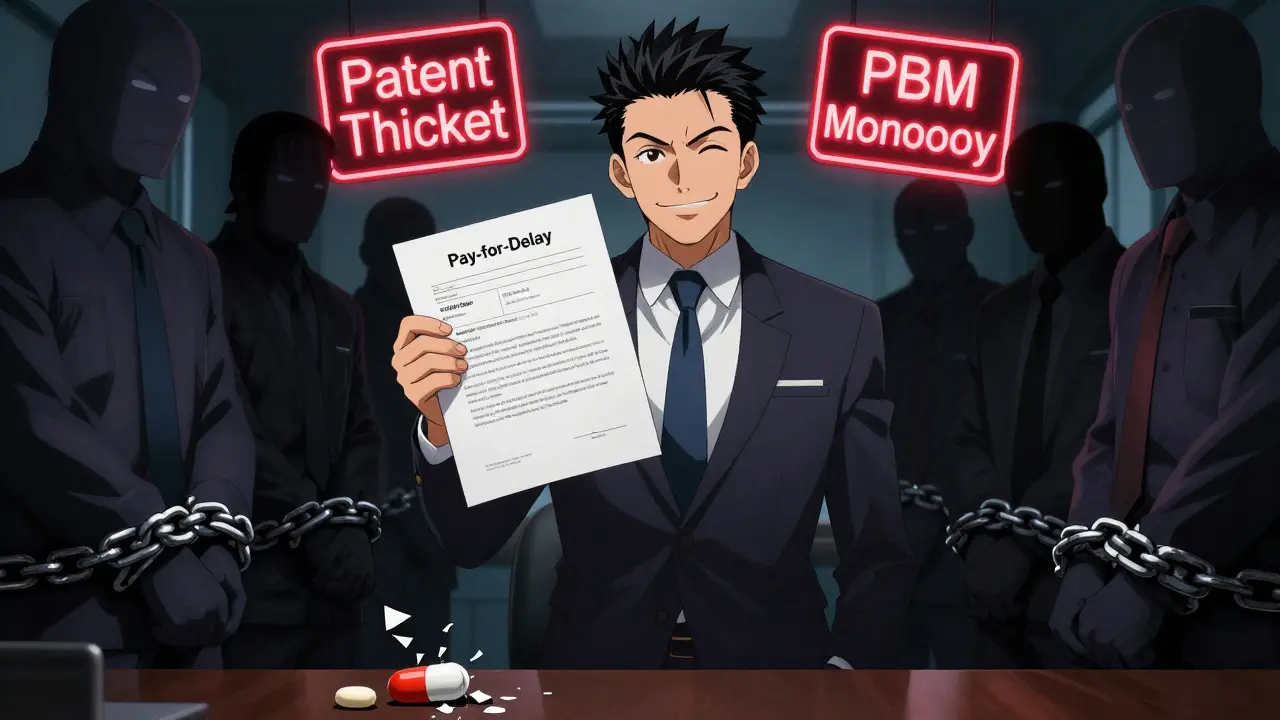
Big pharma doesn’t just rely on brand loyalty. They build legal walls. A single drug can have dozens of patents - not just on the active ingredient, but on the pill shape, coating, packaging, even the manufacturing process. Generic companies have to fight each one in court. Some settle. The brand pays the generic to delay entry. This is called pay-for-delay. The FTC has documented dozens of these deals. They’re legal. And they keep prices high.
Even without pay-for-delay, the regulatory path is brutal. To get approval, a generic maker must prove every single quality attribute matches the brand. For a simple tablet, that’s manageable. For a complex inhaler? You need a $50 million study. That’s why only five or six companies worldwide can make certain generics. The rest can’t afford to try.
Supply Chains and Shortages - The Hidden Cost of Weak Competition
You might think more competitors = safer supply. But that’s only true if those competitors actually exist. The FDA found that drugs with three or more manufacturers had 67% fewer shortages between 2018 and 2022. Why? Because if one factory shuts down, another can pick up the slack. But when only one or two companies make a drug, a single equipment failure or inspection failure can cause a nationwide shortage. That’s not a supply chain issue. It’s a competition issue. And it’s getting worse.
Take the Inflation Reduction Act of 2022. It lets Medicare negotiate prices for some brand-name drugs. Sounds good - until you realize it kills the incentive for generics to enter those markets. If the brand’s price is capped at $10, and the generic can only sell for $8, there’s barely any profit. Why spend $20 million to get approval if you’ll make $500,000 a year? That’s not a market. That’s a graveyard for generics. The FDA warned this could lead to fewer manufacturers, more shortages, and higher prices in the long run.
Therapeutic Classes Don’t Play by the Same Rules
Not all drugs are created equal. A generic statin for high cholesterol faces a different market than a generic cancer drug. In China, imatinib and dasatinib - used for leukemia - showed the biggest price gaps between brand and generic. Why? Because patients and doctors are terrified of switching. One wrong dose can be fatal. So even if a generic is 80% cheaper, hospitals stick with the brand. The price stays high. The competition? Nonexistent.
Meanwhile, in Portugal, statins are priced under strict government caps. You’d think that would force prices down. But it didn’t. Instead, all the generic companies started pricing at the cap. Why? Because if you undercut your rival, they’ll just undercut you next. So they all stay at the ceiling. It’s called mutual forbearance. No one wins. Patients pay more than they should.
What’s Really Driving the Market?
It’s not just about how many companies make the drug. It’s about who controls the system.
- PBMs decide which generics get sold - not patients or doctors.
- Patent thickets block new entrants with legal noise.
- Complex formulations lock out small manufacturers.
- Regulatory caps can freeze prices instead of lowering them.
- Brand loyalty lets originators raise prices after generics arrive.
And none of this is accidental. It’s the result of policies designed decades ago that never caught up with reality. The Hatch-Waxman Act of 1984 was meant to speed up generics. It did. But it didn’t plan for pay-for-delay, PBMs, or complex drugs. Today, the system is broken - not because generics are too expensive, but because the rules let the wrong players win.
The Future Isn’t Just About More Generics
The next big shift isn’t more pills. It’s biologics - complex drugs made from living cells. These aren’t like aspirin. You can’t copy them. You have to build them from scratch. That’s why biosimilars cost more to develop. And why their price drops are smaller - maybe 15-30%, not 90%. The FDA says we’re entering a new era. But if we keep treating biosimilars like old-school generics, we’ll repeat the same mistakes.
What needs to change? Simpler approval paths for complex drugs. Stricter limits on patent abuse. Real transparency in PBM deals. And a shift away from price caps that just freeze competition. More competitors don’t guarantee lower prices. But better rules? They can.
Why do some generic drugs cost more than others?
The price of a generic drug depends on how many manufacturers actually sell it, not how many are approved. If only one or two companies make a drug, they can keep prices high. Complex drugs - like inhalers or injectables - cost more to produce, so fewer companies make them, and prices stay elevated. Also, if a brand sells its own authorized generic, it can manipulate pricing to protect its profits.
Do generics always work as well as brand-name drugs?
Yes - legally and scientifically, generics must meet the same standards as brand-name drugs. The FDA requires them to have the same active ingredient, strength, dosage form, and absorption rate. But perception matters. Some doctors and patients still prefer brands, especially for critical drugs like heart medications or cancer treatments. That’s not because generics are less effective - it’s because of trust, not science.
Why don’t more companies make generic drugs?
Making generics isn’t cheap. For simple pills, it’s profitable. But for complex drugs - like those with timed-release coatings or injectable forms - development costs can hit $50 million. Only the largest manufacturers can afford that. Smaller companies walk away. Plus, patent lawsuits and pay-for-delay deals discourage new entrants. Even if a company gets approval, a PBM might not buy it. Without buyers, there’s no profit.
Can Medicare’s price negotiation hurt generic competition?
Yes. When Medicare sets a maximum fair price for a brand-name drug, it reduces the profit margin for generics. If a brand’s price is capped at $10, a generic might only sell for $8. That leaves little room for profit after manufacturing, regulatory, and legal costs. Many manufacturers will avoid those markets entirely. The FDA warns this could lead to fewer generics, more shortages, and higher prices in the long term.
What’s the difference between authorized generics and regular generics?
An authorized generic is made by the original brand-name company but sold under a generic label - often during the first 180 days of exclusivity. A regular generic is made by a different company. The key difference? If the brand owns the authorized generic, it can lower its own wholesale price to stay competitive. But if another company makes the authorized generic, the brand often raises its price by 22% to protect its profits. That’s why ownership matters.
Market competition in generics isn’t broken because of too many players. It’s broken because the rules let the wrong ones win. Real competition means more than approvals - it means real choices, real pricing pressure, and real access. Until we fix the system, patients will keep paying more than they should - even when the pills are identical.
Joe Grushkin
February 16, 2026 AT 04:08Michael Page
February 17, 2026 AT 19:22Mandeep Singh
February 19, 2026 AT 03:18Daniel Dover
February 20, 2026 AT 05:28Chiruvella Pardha Krishna
February 20, 2026 AT 12:18Virginia Kimball
February 21, 2026 AT 12:57Kapil Verma
February 23, 2026 AT 00:09Betty Kirby
February 24, 2026 AT 02:23Josiah Demara
February 26, 2026 AT 00:54Kaye Alcaraz
February 26, 2026 AT 14:40Sarah Barrett
February 27, 2026 AT 12:19Erica Banatao Darilag
February 28, 2026 AT 07:27Charlotte Dacre
February 28, 2026 AT 10:39Esha Pathak
March 2, 2026 AT 04:13Mike Hammer
March 3, 2026 AT 08:44