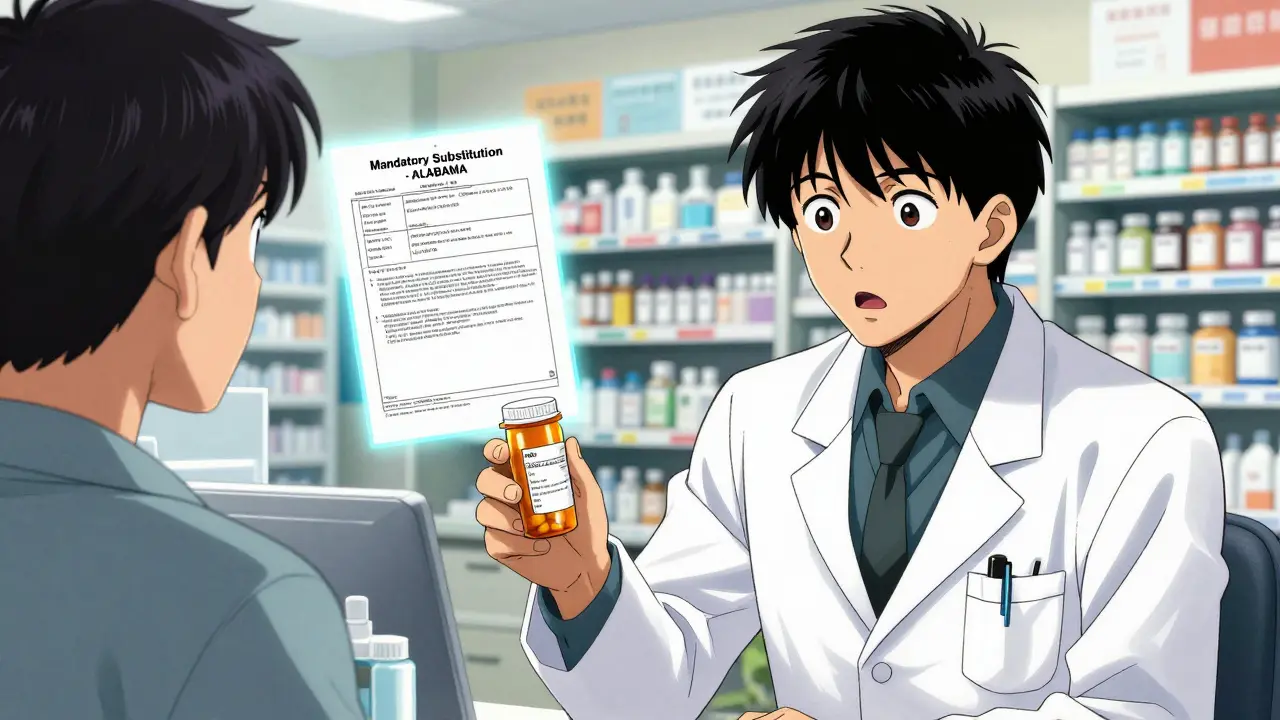
When you pick up a prescription, you might assume the pharmacist will always give you the cheapest version of your medicine. But that’s not true everywhere. In some states, pharmacists must swap your brand-name drug for a generic. In others, they can only do it if you say yes. These differences aren’t just paperwork-they change how much you pay, whether you stick with your treatment, and even how safe your meds are.
What’s the real difference between mandatory and permissive substitution?
Mandatory substitution means the law forces pharmacists to switch you to a generic drug whenever it’s available and approved by the FDA. Unless your doctor writes "Dispense as Written" or "Brand Medically Necessary," the pharmacist has no choice. Permissive substitution means the pharmacist can swap the drug, but they don’t have to. They decide based on their judgment, your preferences, or even how busy the pharmacy is. This isn’t a federal rule. It’s decided state by state. The federal government set up the system back in 1984 with the Hatch-Waxman Act, which made it easier for generic drugs to get approved. But it left the actual substitution rules to each state. That’s why you can walk into a pharmacy in Alabama and get a generic automatically, but in New York, you might need to sign a form first.Which states require substitution? Which let pharmacists choose?
As of 2020, 19 states and Washington, D.C., have mandatory substitution laws. That includes Alabama, Alaska, Arizona, Arkansas, Colorado, Connecticut, Delaware, Idaho, Indiana, Kentucky, Louisiana, Maine, Maryland, Massachusetts, Mississippi, Montana, New Hampshire, North Dakota, and West Virginia. In these places, if a generic is available and your doctor didn’t block it, you get the cheaper version by default. The other 31 states use permissive substitution. That means pharmacists have the option-but no obligation-to switch. In places like California, Florida, Illinois, Michigan, New York, and Texas, the pharmacist might still swap your drug, but only if they think it’s safe and you’re okay with it. The difference isn’t just about who decides. It’s about what happens next.How patient consent rules change everything
Here’s where things get surprising: even in mandatory substitution states, if the law requires you to give explicit consent before the switch, generic use drops hard. A 2011 study on simvastatin-a common cholesterol drug-showed this clearly. In states with mandatory substitution and no patient consent needed, 98.1% of prescriptions were filled with generics six months after the brand went off patent. In states that required you to sign off on the swap, only 32.1% of prescriptions used the generic. That’s a 66-point gap from one simple rule. Why? Because patients don’t always understand what’s happening. If you’re handed a pill that looks different and told, "This is a substitute," you might say no-even if it’s just as safe. Pharmacists, knowing this, often avoid the swap altogether to prevent arguments or confusion. States that skip the consent step get far more generic use. That means lower costs and better adherence. But it also means patients might not know they’re getting a different drug. That’s the trade-off.What about notification? Do you even know you were switched?
Thirty-one states and D.C. require pharmacists to notify you about substitution-even if you didn’t have to give consent. That notice might come on the prescription label, in a handout, or through a verbal warning. The idea is transparency: you should know what you’re taking. But in states without this rule, you might never realize your brand-name pill was swapped. That’s not always bad-generics are FDA-approved to work the same way. But for people on narrow therapeutic index drugs-like warfarin, lithium, or thyroid meds-small differences matter. A slight change in absorption can cause serious side effects. Pharmacists in mandatory states without notification requirements are nearly twice as likely to skip substituting these high-risk drugs, according to the same JAMA study. Why? Because they’re scared of getting it wrong. The law says they can swap, but without clear guidance or patient awareness, they play it safe.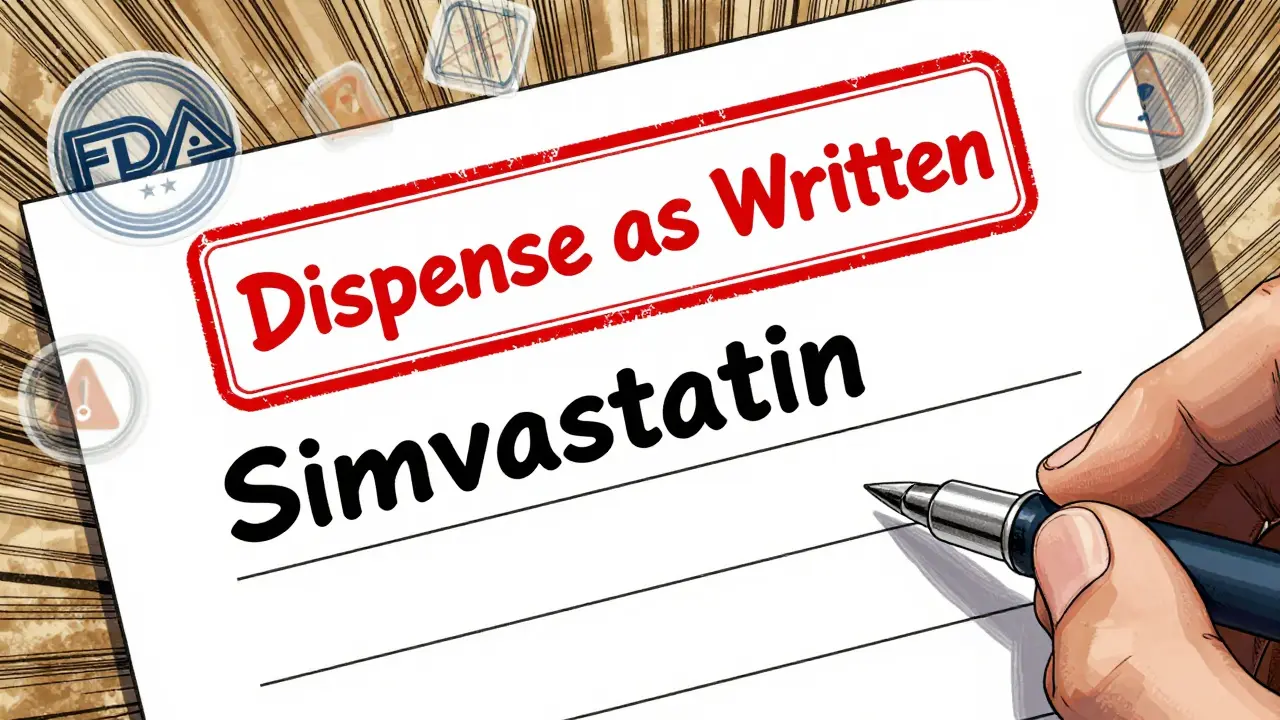
Liability: Who gets sued if something goes wrong?
Twenty-four states don’t give pharmacists legal protection if a patient has a bad reaction after a generic substitution. That means if you end up in the hospital after switching meds, the pharmacist could be held responsible-even if they followed the law. This creates a huge disincentive. Pharmacists in those states are more likely to avoid substitution altogether, even when it’s allowed. Why risk a lawsuit over a $20 savings? In contrast, states with clear liability protections-like those that say pharmacists aren’t liable if they follow FDA and state rules-see higher substitution rates. The law isn’t just about what pharmacists can do. It’s about whether they feel safe doing it.Biologics and biosimilars: A whole new level of complexity
The rules get even trickier with biologic drugs-things like Humira, Enbrel, or insulin analogs. These aren’t simple pills. They’re complex proteins made in living cells. Their generics are called biosimilars, and they’re harder to copy exactly. Forty-five states have stricter rules for biosimilar substitution than for regular generics. Most require the doctor to approve the switch in writing. Some require special recordkeeping. A few won’t allow substitution at all unless the biosimilar is officially labeled "interchangeable" by the FDA-and even then, many states add extra steps. Why? Because switching biologics can trigger immune reactions. Some patients develop antibodies that make the drug stop working-or cause dangerous side effects. So states are cautious. But that caution comes at a cost. Biologics make up just 2% of prescriptions but 42% of total drug spending in Medicare Part D. If substitution rules were more like those for regular generics, billions could be saved.How prescriptions are written matters more than you think
In some states, prescriptions have to be printed on two-line forms. The top line is for the drug name. The bottom line? That’s where the doctor signs to say whether substitution is allowed. If they don’t sign the bottom line, substitution is automatic. Other states don’t use this system. Instead, doctors have to write exact phrases like "Do Not Substitute," "Dispense as Written," or "Brand Medically Necessary" to block the switch. If they forget, the pharmacist can swap the drug-no questions asked. This creates a real risk. A busy doctor might not know the local rules. A handwritten note might be missed. A patient might not realize their doctor didn’t block substitution. That’s why some states now require prescribers to justify why they’re blocking a generic. It’s not just about saving money-it’s about reducing errors.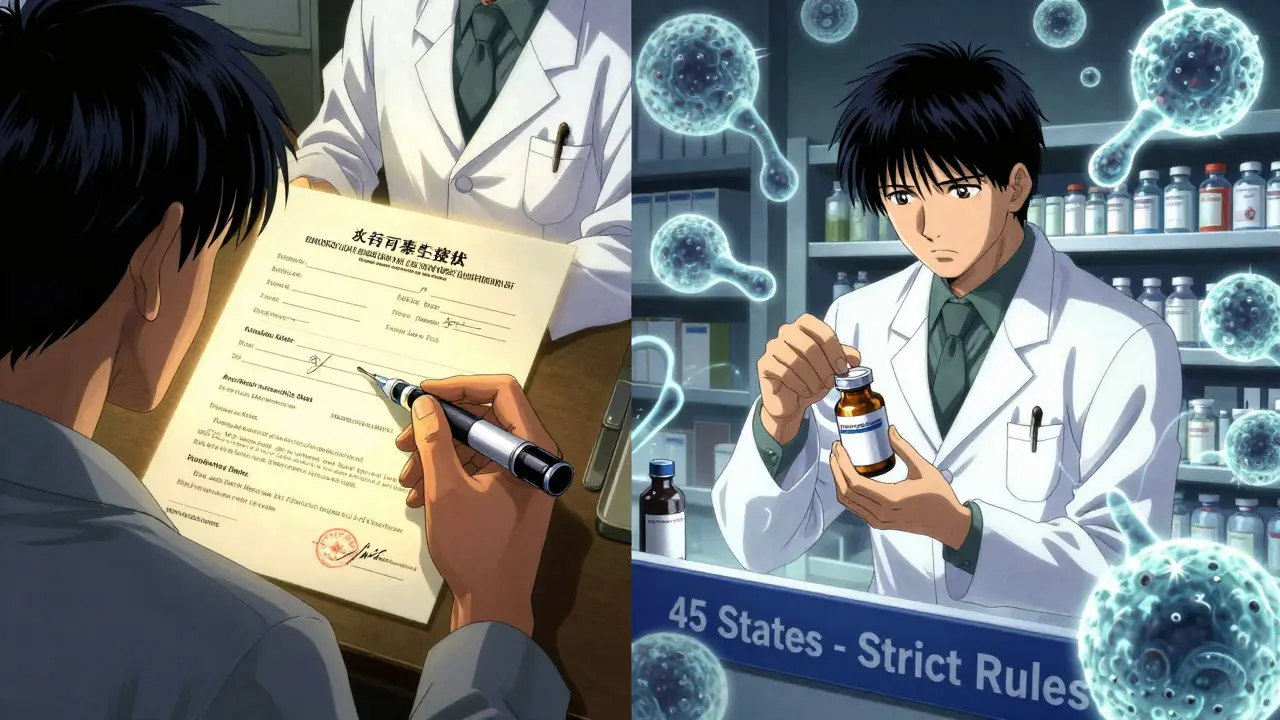
What does this mean for you?
If you’re on a generic drug and it’s working fine, you probably don’t need to worry. But if you’re switching meds, or your prescription keeps changing, here’s what to do:- Check your state’s substitution law. A quick search for "[your state] pharmacy generic substitution law" will tell you if it’s mandatory or permissive.
- Ask your pharmacist: "Was this drug switched?" They’re required to tell you in 31 states.
- If you’re on a high-risk drug (blood thinners, seizure meds, thyroid meds), ask your doctor to write "Dispense as Written" on the prescription.
- If you get a different-looking pill and weren’t told why, call your pharmacy. You have a right to know.
Why does this matter beyond your prescription?
These laws aren’t just about individual choices. They’re about the entire healthcare system. In mandatory substitution states, generic use is nearly 20% higher than in permissive ones. For a drug like simvastatin, that’s millions of dollars saved in Medicaid alone. The Congressional Budget Office estimated that a 1% increase in generic use saves Medicare Part D $160 million a year. Multiply that across all drugs, and you’re talking billions. But savings aren’t the only goal. Better adherence matters too. People are more likely to keep taking their meds if they’re cheaper. And generics work just as well-when they’re allowed to be used. The real challenge? Balancing cost, safety, and patient control. Some states lean hard on cost savings. Others prioritize caution. Neither is wrong. But the variation makes it harder for patients, pharmacists, and doctors to keep up.What’s changing?
The number of mandatory substitution states has grown-from 14 in 2014 to 19 in 2020. That trend suggests more states are choosing cost savings over patient consent requirements. But as biosimilars become more common, we’re seeing the opposite: more restrictions, not fewer. The future will likely split into two paths: simpler rules for small-molecule generics, and tighter controls for biologics. The goal? Make generics the default for cheap, safe drugs. Keep extra steps for complex, expensive ones. Until then, the system stays messy. Your pharmacist might be legally required to switch your pills-or they might need your signature. Your doctor might not even know which rules apply. That’s why knowing your state’s law isn’t just helpful-it’s essential.Can a pharmacist substitute my brand-name drug without telling me?
In 19 states and D.C., pharmacists must substitute generics if your doctor didn’t block it, and they’re not required to notify you unless your state has a separate notification law. In 31 states, they must tell you-either verbally, in writing, or on the label-before swapping. Always check your state’s rules. If you’re unsure, ask.
Do I have to give consent to get a generic drug?
Only in 7 states and D.C. You’ll need to sign a form or give verbal approval. In the other 43 states, consent isn’t required. But even in states without consent rules, pharmacists often ask anyway to avoid confusion. If you’re asked to sign something, read it carefully. You have the right to say no.
Why does my doctor write "Do Not Substitute" on my prescription?
Your doctor writes that phrase to block generic substitution. This is common for drugs with narrow therapeutic indexes-like warfarin, levothyroxine, or certain seizure medications-where even small differences in how the drug is absorbed can cause side effects. It’s also used if you’ve had a bad reaction to a generic before. The pharmacist must follow this instruction.
Are biosimilars treated the same as regular generics?
No. Only 9 states treat biosimilars the same as small-molecule generics. In 45 states, stricter rules apply: you may need doctor approval, special labeling, or detailed records. Biosimilars are more complex than regular generics, and regulators are cautious about switching patients between them and the original biologic due to potential immune reactions.
Can I be charged more if I refuse a generic substitution?
No. You cannot be charged more for refusing a generic. If you choose the brand-name drug, you pay the difference between the brand and the generic price. Some insurance plans may require you to pay the full brand price if you refuse a generic, but that’s a plan rule-not a pharmacy or state law. Always check your insurance policy.
What if I get a different-looking pill and I’m not sure it’s the right one?
Call your pharmacy immediately. Pharmacists are required to provide information about substitutions. If you were switched without being told, that’s a violation in states with notification laws. Even if you’re in a state without notification rules, you still have the right to ask why your medication looks different. Don’t take it if you’re unsure.
Aditya Kumar
December 15, 2025 AT 16:01Ugh, another post about pharmacy paperwork. I just want my pills to work and not cost a fortune. Why does this have to be so complicated?
Colleen Bigelow
December 17, 2025 AT 11:47THIS is why America is falling apart. Big Pharma and the government are teaming up to poison us with cheap knockoffs while pretending they're the same. They don't tell you the generics are made in China with unregulated chemicals. I've seen the videos. My neighbor's cousin got hospitalized after switching. They're hiding the truth from you. Wake up.
Billy Poling
December 19, 2025 AT 11:39It is imperative to recognize that the variance in state-level pharmaceutical substitution statutes represents a profound regulatory fragmentation that undermines the coherence of national healthcare delivery systems. The absence of federal uniformity introduces substantial administrative burdens upon pharmacists who operate across state lines, and further complicates the ability of patients to maintain therapeutic continuity when relocating. Moreover, the legal liability disparities, particularly in jurisdictions lacking statutory immunity provisions, create a chilling effect that disproportionately impacts rural and under-resourced pharmacies, thereby exacerbating health inequities. The current patchwork system is not merely inefficient-it is structurally unsound and ethically indefensible.
Kim Hines
December 20, 2025 AT 00:03I didn’t realize some states don’t even tell you when they switch your meds. That’s wild. I’d want to know if my pill looked different.
Joanna Ebizie
December 20, 2025 AT 02:51People still don’t get it. If your doctor didn’t say ‘do not substitute,’ you’re not being cheated-you’re being saved money. Stop acting like generics are some kind of scam. They’re FDA-approved, same active ingredients. Your ‘brand’ pill is just a fancy label.
Mike Smith
December 20, 2025 AT 23:25Understanding these laws is one of the most important things you can do for your health. Pharmacists are your allies-not your adversaries. Ask questions. Know your rights. If you're on a high-risk medication, make sure your doctor writes 'Dispense as Written.' It's a small step that could prevent a big problem. You deserve to be informed, and you have the power to demand clarity.
Ron Williams
December 22, 2025 AT 10:40As someone who moved from Texas to Oregon, I noticed the difference immediately. In Texas, I had to sign a form every time. In Oregon, they just handed me the generic and said 'your co-pay's lower now.' I didn't mind. The pills worked the same. Maybe we should stop treating patients like kids who can't handle the truth.
Kitty Price
December 23, 2025 AT 22:16Just read the label. If it says 'generic' and the dosage is the same, you're good. 🙌 I switched my blood pressure med to generic and saved $80/month. No side effects. No drama. Just smart choices.
Randolph Rickman
December 25, 2025 AT 14:58Let’s be real-this isn’t about generics vs brand. It’s about whether we trust the system. The FDA approves generics. The science is solid. The real issue is that patients are scared because they’re not educated. We need public campaigns, not more laws. Teach people what they’re taking. Empower them. Then let the system work.
sue spark
December 25, 2025 AT 23:43I get why some states make you sign stuff but honestly why do we even need consent if the drug is the same I mean if it works why stop it
SHAMSHEER SHAIKH
December 27, 2025 AT 06:19As a pharmacist in Mumbai, I have witnessed the global paradox: in the United States, patients fear generic substitution, while in India, the same generics are hailed as miracles of accessibility. The FDA’s rigorous bioequivalence standards are among the most stringent in the world-yet, in many American states, patients are conditioned to distrust them. This is not a pharmacological issue-it is a cultural one, rooted in marketing, misinformation, and a systemic failure to communicate scientific truth. The solution is not more legal barriers, but transparent education: every prescription should come with a one-page, plain-language explanation of generic equivalence, translated into common languages, and posted visibly in every pharmacy. Let the science speak-and let patients choose, informed, not afraid.