Malignant Hyperthermia Treatment Calculator
Malignant hyperthermia is a life-threatening reaction to anesthesia. Survival depends on immediate treatment with dantrolene. This calculator shows how treatment timing affects survival chances.
What Is Malignant Hyperthermia?
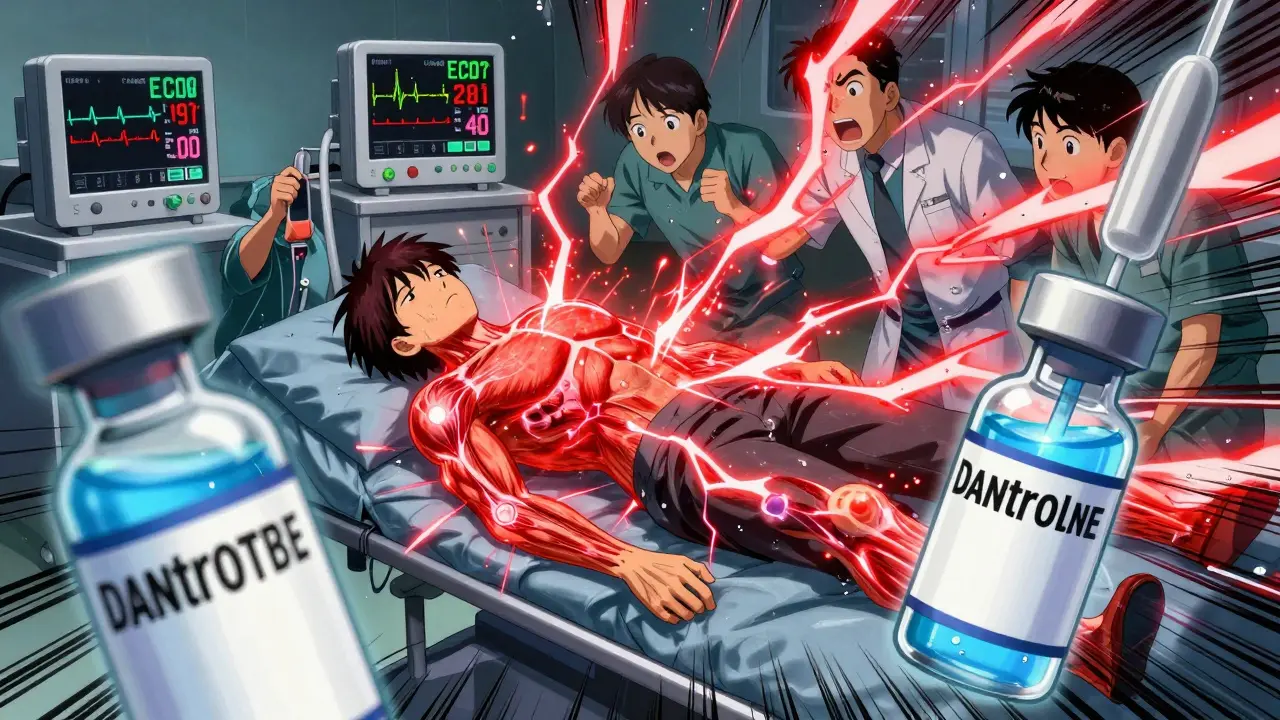
Malignant hyperthermia is a rare but deadly reaction that can happen during general anesthesia. It’s not an allergy-it’s a genetic condition triggered by specific drugs used to put you to sleep or relax your muscles. When someone with this hidden gene mutation gets exposed to these anesthetics, their muscles go into a full-blown metabolic crisis. Their body starts producing heat like a furnace, their heart races, and their blood chemistry goes haywire. Without fast action, it can kill you in minutes.
This isn’t science fiction. It’s a real, documented risk that’s been studied since the 1960s. Back then, four young patients died during routine surgeries with no clear cause. Today, we know it’s linked to mutations in the RYR1 gene, which controls calcium flow in muscle cells. When this system glitches under anesthesia, calcium floods out uncontrollably. Muscles lock up, burn through oxygen, and generate extreme heat-sometimes raising body temperature to over 109°F (43°C).
What Anesthesia Drugs Trigger It?
Not all anesthetics cause this reaction. Only two classes are known triggers. The first is a group of inhaled gases ending in “-flurane”: sevoflurane, desflurane, and isoflurane. These are the most common gases used to keep you asleep during surgery. The second trigger is succinylcholine, a muscle relaxant often used to help insert the breathing tube.
Here’s the catch: if you’ve never had surgery before, you won’t know you’re at risk. Most people with the gene mutation live their whole lives without ever knowing. That’s why MH can strike anyone-even healthy kids getting their tonsils removed. The risk is highest in children under 18, especially during procedures like tonsillectomies. About 1 in 3,000 pediatric cases turns into MH, compared to 1 in 50,000 in adults.
How Do You Know It’s Happening?
The signs don’t wait. They show up fast-often within minutes of the anesthetic being given. The earliest warning is usually a sudden spike in end-tidal CO2 (EtCO2). This measures how much carbon dioxide you’re breathing out. In a normal patient, it stays around 35-45 mmHg. In MH, it shoots past 55 mmHg and keeps climbing. Anesthesiologists monitor this constantly, and a sudden rise is the first red flag.
Right after that, the heart rate spikes. A resting heart rate of 120 or higher in an adult under anesthesia is abnormal. Then comes muscle rigidity-especially in the jaw. This is called masseter muscle rigidity. If the surgeon can’t open the patient’s mouth after giving succinylcholine, that’s a major clue. Body temperature starts rising next. Within 30 minutes, it can jump from normal to over 104°F. Other signs include rapid breathing, dark brown urine (a sign of muscle breakdown), and dangerously high potassium levels in the blood.
One real case from a Reddit thread shared by an anesthesiologist described a 28-year-old man whose EtCO2 hit 78 mmHg and heart rate jumped to 142 just 32 minutes after anesthesia started. He had no family history. No prior issues. One moment he was stable. The next, he was in full MH crisis.
What Happens If It’s Not Treated?
Before 1970, malignant hyperthermia killed 80% of the people who had it. There was no antidote. Now, thanks to one drug, that number has dropped to 5%. That drug is dantrolene.
Without dantrolene, the body keeps burning energy, breaking down muscle tissue, and flooding the bloodstream with toxins. This leads to kidney failure from myoglobin (a muscle protein), dangerous heart rhythms from high potassium, and acidosis from lactic acid buildup. Multiple organs shut down. Death can come from cardiac arrest or respiratory failure.
Even if the patient survives, the damage can be lasting. Some people need weeks of dialysis. Others suffer permanent muscle weakness. The longer treatment is delayed, the worse the outcome. Studies show survival drops from nearly 100% if dantrolene is given within 20 minutes to just 50% if it’s delayed beyond 40 minutes.
How Is It Treated?
There’s only one proven treatment: dantrolene. It stops the calcium leak in muscle cells. The first dose is 2.5 mg per kilogram of body weight, given through an IV. If symptoms don’t improve within 5 to 10 minutes, you give another dose. You keep giving it until the muscle rigidity fades and the temperature drops. The maximum initial dose is 10 mg/kg-sometimes that means 10 vials or more.
But dantrolene isn’t enough on its own. The anesthesiologist must immediately stop all triggering gases and switch to 100% oxygen. They hyperventilate the patient to flush out CO2. Surgery is canceled. The patient is cooled down with ice packs on the neck, armpits, and groin. Cold IV fluids are rushed in. If the temperature keeps climbing, they may need to use a cardiopulmonary bypass machine to cool the blood directly.
Supportive care is critical too. Sodium bicarbonate corrects acidosis. Insulin and glucose lower dangerous potassium levels. Mannitol and furosemide protect the kidneys from muscle breakdown products. Every second counts.
Why Is Dantrolene So Hard to Get?
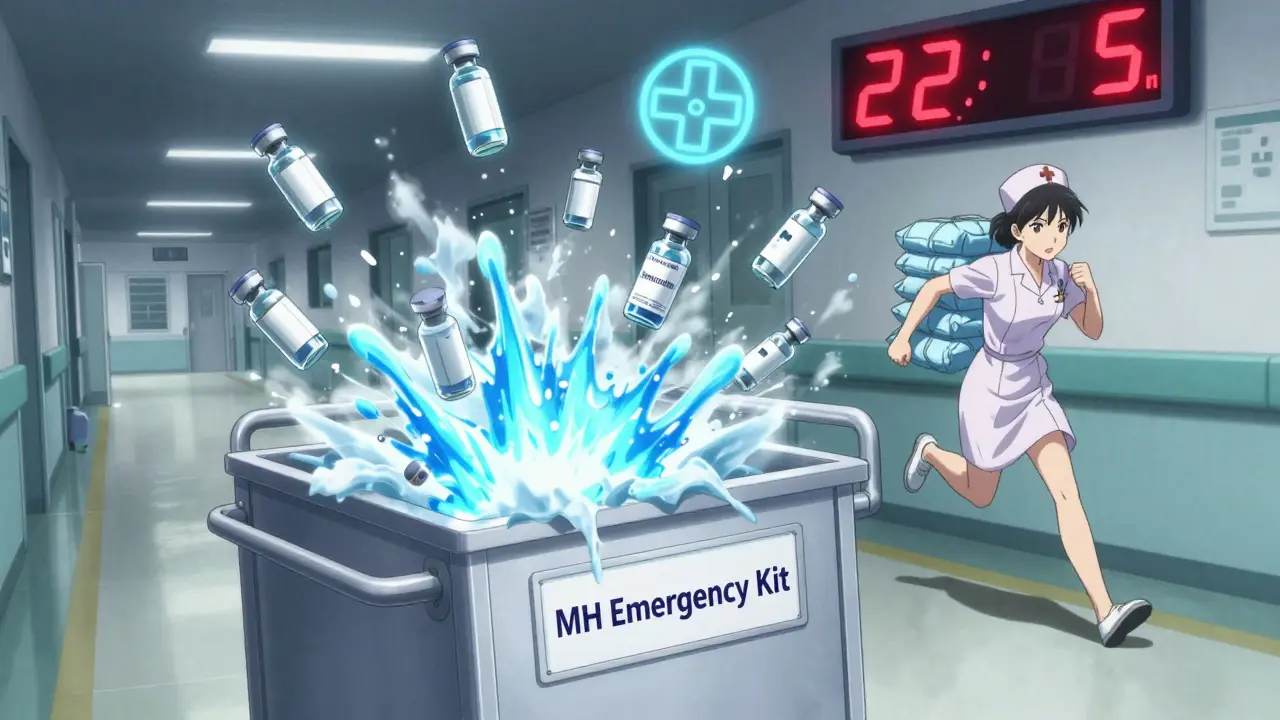
There are two versions: Dantrium and Ryanodex. Dantrium comes as a powder that takes 22 minutes to mix with water. Ryanodex, approved in 2014, is a ready-to-use liquid that reconstitutes in just one minute. That’s why Ryanodex is now the standard of care.
Each vial costs about $4,000. A single adult case can need 36 vials-totaling $144,000 in drug cost alone. That’s why hospitals are required by the FDA to keep emergency MH kits stocked. But many rural hospitals don’t have the budget. In 2022, 22% of rural surgical centers reported running out of dantrolene.
Some hospitals keep MH carts with all the supplies-dantrolene, sterile water, syringes, cooling gear-right outside every operating room. At Mayo Clinic, this cut response time from 22 minutes to under 5 minutes. That’s the difference between life and death.
Who Should Get Tested?
Genetic testing for RYR1 and CACNA1S mutations is available and about 95% accurate for known variants. It costs between $1,200 and $2,500. But testing isn’t for everyone. It’s recommended if:
- You or a close family member had MH during anesthesia
- You had unexplained muscle rigidity or high fever during surgery
- You have a history of unexplained heat stroke or rhabdomyolysis
- You have a neuromuscular disorder like central core disease or multiminicore disease
Here’s the twist: 29% of MH cases happen in people with no family history. That means even if your parents and siblings are fine, you could still carry the mutation. That’s why the American Society of Anesthesiologists now recommends screening everyone for risk factors before surgery-not just those with a known family history.
What Should You Do Before Surgery?
If you’re scheduled for surgery, ask your doctor: “Do you have dantrolene on hand?” If they don’t know, that’s a red flag. Ask if your facility has an MH emergency cart. Ask if they’ve trained staff on MH protocols in the last year.
Write down your family history. Did anyone die unexpectedly during surgery? Did a relative have severe muscle cramps or heat stroke? Tell your anesthesiologist. Even if you think it’s unrelated, it might not be.
Some patients carry medical alert cards or wear bracelets that say “Malignant Hyperthermia Susceptible.” That’s a good idea if you’ve been diagnosed or have a strong family history. But don’t assume your surgeon will know to ask. You have to speak up.
What’s New in MH Treatment?
The biggest change coming is intranasal dantrolene. The FDA approved it in 2023 for emergency use before reaching the hospital. It’s expected to hit the market in early 2024. This could save lives in ambulances or ERs before IV access is even possible.
Researchers are also testing new drugs like S107, which stabilizes the RYR1 receptor. Early trials show promise. Long-term, gene editing with CRISPR might one day fix the mutation in embryos or young patients. Phase I trials are expected by 2027.
Meanwhile, hospitals are adding AI alerts to their anesthesia systems. Epic’s 2024 update now watches for three key signs-rising CO2, fast heart rate, and high temperature-and automatically alerts the team. That’s a game-changer for busy ORs where attention is split.
Final Thoughts: It’s Rare, But You Need to Be Ready
Malignant hyperthermia is rare. But when it happens, it’s catastrophic. The good news? It’s treatable-if you act fast. The better news? You can help prevent delays. Know the signs. Ask questions. Share your history. Make sure your hospital has the drugs.
Most people who survive MH say they never heard of it before. That shouldn’t be the case. This isn’t something you wait to learn about during an emergency. It’s something you prepare for-because if it happens to you, you won’t have time to Google it.
Can malignant hyperthermia happen outside of surgery?
While MH is almost always triggered by anesthesia drugs, there are rare cases where extreme physical exertion, heat, or stress can cause a similar reaction in genetically susceptible people. This is sometimes called "exertional heat illness" or "MH-like syndrome." It’s not the same as anesthesia-triggered MH, but it’s linked to the same RYR1 gene mutations. People with a known history of MH should avoid intense heat, dehydration, and extreme physical strain.
Is malignant hyperthermia hereditary?
Yes. MH is inherited in an autosomal dominant pattern, meaning you only need to inherit one copy of the mutated gene from either parent to be at risk. If a parent has the mutation, each child has a 50% chance of inheriting it. But not everyone with the gene will have a reaction-it depends on exposure to triggering agents. That’s why many people don’t know they’re at risk until they undergo anesthesia.
Can you be tested for malignant hyperthermia before surgery?
Yes. Genetic testing can identify RYR1 or CACNA1S mutations with about 95% accuracy for known variants. But the gold standard is the caffeine-halothane contracture test (CHCT), which involves taking a muscle biopsy and testing how it reacts to triggering agents. This test is invasive and only done at specialized centers. Most people are tested only if they have a family history or previous reaction. Testing is expensive and not routinely recommended for everyone.
Are there safer anesthetics for people at risk?
Yes. If you’re known to be at risk for MH, your anesthesiologist can use completely safe alternatives. These include propofol (an IV sedative), ketamine, local anesthetics like lidocaine, and non-depolarizing muscle relaxants like rocuronium or vecuronium. These drugs do not trigger MH. The key is informing your medical team ahead of time so they can plan accordingly.
What should I do if I suspect someone is having malignant hyperthermia?
If you’re in a medical setting and see sudden high CO2, rapid heart rate, muscle rigidity, or rising temperature during anesthesia, alert the team immediately. Time is critical. Call for dantrolene. Stop all triggering gases. Begin cooling. If you’re not in a hospital, call 911 and describe the symptoms-especially if the person just had surgery. Don’t wait. Early recognition saves lives.
amanda s
December 17, 2025 AT 09:14Jigar shah
December 17, 2025 AT 23:55Nishant Desae
December 18, 2025 AT 07:37Meghan O'Shaughnessy
December 19, 2025 AT 18:52Jody Patrick
December 20, 2025 AT 00:14Radhika M
December 21, 2025 AT 14:26Philippa Skiadopoulou
December 23, 2025 AT 04:53Pawan Chaudhary
December 23, 2025 AT 06:18Jonathan Morris
December 24, 2025 AT 01:01Linda Caldwell
December 24, 2025 AT 22:38Anna Giakoumakatou
December 25, 2025 AT 02:08