Licorice Medication Interaction Checker
This tool helps you understand if licorice might interact with your medications. Licorice contains glycyrrhizin which can dangerously affect blood pressure, potassium levels, and many prescription drugs.
Check Your Medication Interaction Risk
Most people think of licorice as a sweet, chewy candy-something you grab for a treat or maybe to freshen your breath. But if you’re taking any kind of medication, that piece of black licorice might be doing more than just satisfying a craving. It could be quietly messing with your blood pressure, draining your potassium, or even canceling out the effects of your prescription drugs. And you probably have no idea.
What’s Really in Licorice?
Not all licorice is the same. The real stuff comes from the root of the Glycyrrhiza glabra plant. What makes it dangerous for some people isn’t the sugar-it’s a compound called glycyrrhizin. This chemical mimics aldosterone, a hormone your body uses to control salt and water balance. When glycyrrhizin sticks around too long, your body starts holding onto sodium and flushing out potassium. That sounds harmless until you realize what that does to your heart and muscles.Traditional black licorice candy usually contains 0.5% to 2% glycyrrhizin. That means eating just 50 grams a day-about two small bags-could push you past the safe daily limit of 100 mg set by the European Food Safety Authority. Some herbal supplements? They can pack in 4% to 24%. And guess what? Most candy labels don’t tell you how much glycyrrhizin is in there. You’re flying blind.
And here’s the twist: a lot of products labeled “licorice” aren’t licorice at all. Anise oil gives that same sweet, earthy flavor without any glycyrrhizin. So if you’re eating red licorice or those chewy twists from the candy aisle, you’re probably fine. But if you bought a bag labeled “traditional black licorice” or picked up a herbal tea labeled “licorice root,” you’re risking a real interaction.
How Licorice Breaks Your Medications
The problem isn’t just one thing-it’s a chain reaction. Glycyrrhizin doesn’t just mess with your electrolytes. It interferes with how your body processes drugs. Some medications become stronger. Others vanish before they can work.Take blood pressure meds. If you’re on lisinopril, losartan, or any ACE inhibitor or ARB, licorice can undo their benefits. One Reddit user reported his blood pressure jumped from 120/80 to 165/95 after eating 30 grams of licorice daily for just three days. That’s not an outlier. A 2019 report from New Zealand’s Medsafe described a man on fludrocortisone-already a salt-retaining drug-who developed panic attacks and blood pressure of 205/110 after eating licorice. He had no history of hypertension. The licorice pushed him over the edge.
Diuretics like hydrochlorothiazide or furosemide? They make you lose potassium. Licorice does the same. Together? You’re at risk of dropping below 3.0 mmol/L, which can trigger muscle cramps, irregular heartbeat, or even cardiac arrest. The University of Rochester Medical Center has documented cases where patients on thiazide diuretics developed dangerous hypokalemia after adding licorice to their routine.
And then there’s warfarin. Some studies say licorice makes warfarin stronger-raising your INR and risk of bleeding. Others say it weakens it. A 2021 case report described a 92-year-old woman whose INR suddenly dropped after eating licorice while taking phenprocoumon, another blood thinner. Her doctors couldn’t figure out why until they asked about her candy habit. That’s the problem: the effect isn’t consistent. It depends on your genes, your liver, and what kind of licorice you’re eating.
Even metformin, the common diabetes drug, might be affected. Animal studies show licorice juice reduces metformin’s effectiveness. No human trials confirm it yet-but why risk it if you’re trying to control your blood sugar?

Who’s at the Highest Risk?
You don’t need to be sick to be in danger. But certain people are sitting on a ticking clock.- Anyone over 40-your body handles electrolytes less efficiently with age.
- People with high blood pressure, heart disease, or kidney problems-your systems are already under strain.
- Those on corticosteroids like prednisone or fludrocortisone-licorice amplifies their salt-retaining effects.
- People taking digoxin-low potassium from licorice can trigger deadly heart rhythm problems. A 2002 case report showed a patient with digoxin toxicity after eating licorice daily for weeks.
- Anyone taking CYP3A4 or CYP2D6 substrates-like cyclosporine, statins, or certain antidepressants. Licorice can both induce and inhibit these enzymes, depending on the product. It’s unpredictable.
And here’s the kicker: you don’t need to eat a lot. Two weeks of 100 mg glycyrrhizin per day is enough to start seeing problems. That’s less than a bag of candy per week. Most people don’t realize they’re even consuming it.
What About DGL Licorice?
If you’re taking licorice for stomach issues-like acid reflux or ulcers-you might have heard of DGL. That stands for deglycyrrhizinated licorice. It’s been stripped of glycyrrhizin, so it doesn’t raise blood pressure or lower potassium. It’s safe for most people on meds.But here’s the trap: DGL isn’t labeled clearly. If you buy “licorice root capsules” or “licorice extract,” you have no idea what’s in them. Always check the label for “deglycyrrhizinated” or “glycyrrhizin-free.” If it’s not stated, assume it’s the real stuff-and dangerous if you’re on medication.
What Should You Do?
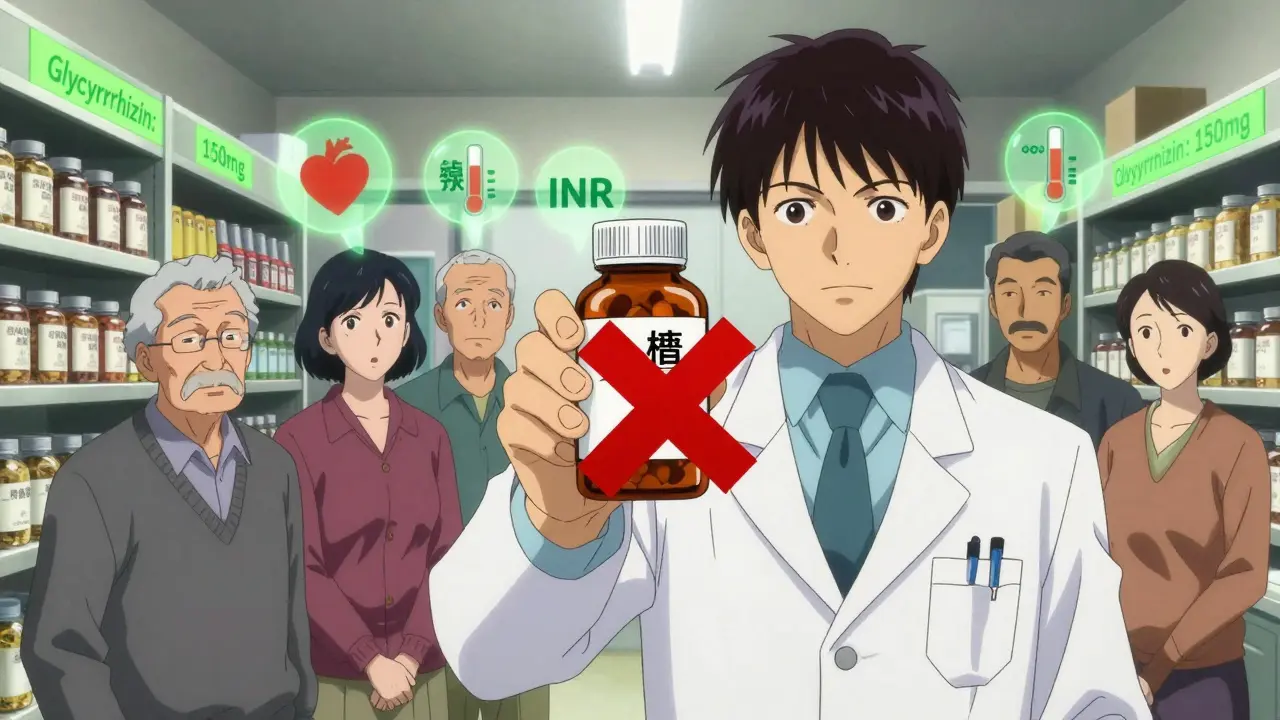
If you’re on any medication and you eat licorice, here’s what to do right now:- Stop eating black licorice candy or herbal supplements with licorice root until you talk to your doctor.
- Check your medicine cabinet. Look at every supplement. If it says “licorice root,” “Glycyrrhiza glabra,” or “licorice extract,” put it aside.
- Ask your pharmacist: “Does my medication interact with licorice?” Don’t assume they know. A 2021 study found only 37% of community pharmacists could list all major licorice-drug interactions.
- If you’ve been eating licorice regularly and feel weak, bloated, have headaches, or notice your heart racing, get your potassium and blood pressure checked immediately.
- If you’re on blood thinners, ask your doctor to check your INR within a week of stopping or starting licorice.
There’s no need to panic. But you do need to be aware. Licorice isn’t the villain-it’s the quiet one. It doesn’t scream. It doesn’t come with a warning label. It just sits there in the candy aisle, next to the gummy bears, waiting for someone to eat it without knowing what it’s doing inside their body.
The Bigger Picture
This isn’t just about candy. It’s about how we treat natural products. We assume “natural” means “safe.” But licorice is a plant with powerful chemistry. It’s used in traditional medicine for a reason-because it works. And that’s exactly why it can hurt you.The global licorice market is worth over $1.3 billion. Supplements make up a third of it. And nearly 78% of black licorice products don’t list glycyrrhizin content. The FDA doesn’t require it. The UK now demands warning labels on products with over 100 mg per serving, but most countries don’t. You’re on your own.
Future rules might change. The American Herbal Pharmacopoeia wants mandatory glycyrrhizin labeling by 2026. The European Commission is considering reclassifying high-glycyrrhizin licorice as a medicine, not food. But for now? It’s your responsibility to know what you’re eating.
Next time you reach for that black licorice stick, ask yourself: Is this worth the risk? Because your meds might be working fine-until they suddenly aren’t.
Can I eat licorice if I’m on blood pressure medication?
It’s not safe. Licorice can raise your blood pressure and counteract the effects of medications like lisinopril, losartan, or beta-blockers. Even small amounts over time can cause dangerous spikes. If you’re on blood pressure meds, avoid black licorice entirely unless your doctor says otherwise.
Is red licorice safe to eat with medications?
Yes, if it’s real red licorice. Most red licorice is flavored with anise or artificial flavors and contains no glycyrrhizin. But always check the ingredients. If it says “licorice extract” or “licorice root,” avoid it. Stick to products that list only sugar, corn syrup, and flavoring.
How much licorice is too much?
For most adults, more than 100 mg of glycyrrhizin per day for more than two weeks is risky. That’s about 50 grams of traditional black licorice candy. But some people react to even half that amount. If you’re on medication, even one piece a day could be too much.
Can licorice affect my potassium levels?
Yes. Glycyrrhizin causes your kidneys to flush out potassium, leading to hypokalemia. Symptoms include muscle weakness, cramps, fatigue, and irregular heartbeat. If you’re taking diuretics, steroids, or heart meds, this can become life-threatening. A potassium level below 3.0 mmol/L requires immediate medical attention.
What should I do if I’ve been eating licorice and feel unwell?
Stop eating it immediately. Contact your doctor or pharmacist. Ask for a blood test to check your potassium and blood pressure. If you’re on blood thinners, request an INR test. Don’t wait for symptoms to worsen. Many serious reactions happen slowly-by the time you feel bad, the damage is already done.
Are there any safe licorice alternatives for flavor?
Yes. Anise, fennel, and star anise provide similar flavor without glycyrrhizin. Look for “licorice-flavored” products that list anise or fennel as the main ingredient and avoid any that mention “licorice root” or “Glycyrrhiza.” DGL supplements are also safe if you need licorice for digestive health.
srishti Jain
December 31, 2025 AT 06:23Just ate a bag of black licorice last week. Now my legs feel like wet noodles. Thanks for the heads-up, I’m never touching that stuff again.
Colin L
January 1, 2026 AT 05:56Look, I get it, licorice is dangerous, but let’s not turn every candy into a biohazard. I’ve been eating traditional black licorice for 15 years, on lisinopril, and my BP’s never been better. I’m 62, active, and my doctor says I’m fine. You’re scaring people with cherry-picked case reports while ignoring the fact that most people metabolize glycyrrhizin just fine. The real issue is the FDA’s laziness, not the candy. Why not demand labeling instead of fearmongering? Also, I’ve seen people panic over turmeric and green tea-same nonsense. Chill out.
kelly tracy
January 1, 2026 AT 23:56Oh please. You think this is news? I’ve been warning people for years. People think ‘natural’ means ‘harmless’ like it’s some kind of moral virtue. It’s not. Plants evolved toxins to kill animals. Licorice is a pharmacologically active compound disguised as candy. And you’re telling me we shouldn’t regulate it because ‘it’s traditional’? That’s how we got lead paint and thalidomide. Wake up. The fact that you’re still eating it means you’re either ignorant or reckless. And no, your ‘I’ve been fine for 20 years’ argument doesn’t hold up when your potassium drops below 3.0 and you wake up in the ER.
Kunal Karakoti
January 2, 2026 AT 13:50It’s interesting how we assign moral weight to substances based on familiarity. Sugar is fine. Alcohol is tolerated. But licorice? Suddenly it’s a villain because it has a compound that interacts with meds. But isn’t that true of grapefruit, St. John’s wort, even vitamin K? We’re not bad people for eating things that interact with medicine-we’re just poorly informed. The system fails us by not labeling, not because we’re careless. Maybe the real question isn’t ‘should we avoid licorice?’ but ‘why do we let unregulated botanicals flood the market?’
Kelly Gerrard
January 3, 2026 AT 14:11Thank you for this critical public health alert. I have been prescribing antihypertensives for over 20 years and have seen multiple cases of licorice-induced hypokalemia. Patients rarely disclose candy consumption. This must be standardized in patient intake forms. I will be sharing this with my entire clinic. Knowledge saves lives.
Glendon Cone
January 4, 2026 AT 15:09Bro this is wild. I just checked my pantry and found a bag labeled ‘black licorice’-turned out to be anise-flavored. Phew. 🙌 Also, DGL is legit if you need it for your stomach. I take it for acid reflux and my doc said it’s safe. Just read labels like your life depends on it… because it kinda does. 🤓
Henry Ward
January 4, 2026 AT 18:56People like you are the reason we’re losing common sense. You write this long essay like you’re some medical prophet and then act like everyone who eats licorice is a dumbass. I’ve been eating it since I was 10. I have high blood pressure. I take meds. I’m alive. I’m healthy. Your fear is toxic. You don’t get to scare people into compliance. If you’re that scared, don’t eat it. Don’t tell the rest of us what to do.
Aayush Khandelwal
January 6, 2026 AT 09:23Let’s not conflate pharmacokinetic modulation with outright toxicity. Glycyrrhizin is a saponin that inhibits 11β-HSD2, leading to pseudohyperaldosteronism. It’s a well-documented CYP3A4 substrate interaction with ACE inhibitors and potassium-wasting diuretics. The dose-response curve is nonlinear, and genetic polymorphisms in UGT1A1 and CYP3A5 explain interindividual variability. The real issue? Regulatory arbitrage. The EU mandates labeling. The US doesn’t. The market is exploiting legal gray zones. We need a global pharmacovigilance framework for botanicals, not just panic posts.
Sandeep Mishra
January 7, 2026 AT 05:06Hey everyone-just want to say thank you to the OP for putting this out there. I’ve got a cousin on warfarin who was eating licorice tea every day. She didn’t know it was even a thing. After reading this, she stopped. Her INR went from 4.8 to 2.1 in two weeks. No hospital visits. Just awareness. That’s what matters. Keep sharing stuff like this. It saves lives, even if it’s just one person at a time.
Joseph Corry
January 7, 2026 AT 18:48How quaint. We’ve reduced complex pharmacological interactions to a candy aisle morality tale. The real tragedy isn’t licorice-it’s the epistemic laziness of the public who equate ‘natural’ with ‘safe’ and ‘pharmaceutical’ with ‘evil.’ This post is less science and more performative concern trolling. The fact that you think this will change behavior reveals your fundamental misunderstanding of human psychology. People don’t change because you warn them. They change because they’re forced to. Regulation, not blog posts, is the answer.
Hayley Ash
January 8, 2026 AT 08:15So let me get this straight - you’re telling me I can’t have my beloved black licorice because some guy in New Zealand had a panic attack? Wow. Next you’ll tell me water is dangerous if you’re on lithium. I mean, I get it. Fear sells. But I’m not giving up my candy for a case study. Also, red licorice is fine right? Cool. I’ll just switch to that. Because clearly the problem isn’t the licorice - it’s the people who can’t handle it.
Cheyenne Sims
January 10, 2026 AT 05:19Grammatically incorrect. You wrote ‘you’re flying blind’ as if it’s an idiom acceptable in formal discourse. It is not. Also, ‘licorice’ is spelled correctly, but your capitalization of ‘FDA’ and ‘CYP3A4’ is inconsistent. You say ‘DGL’ without defining it first. This is not a well-structured piece. It reads like a blog draft. The information is valuable, but the presentation lacks rigor. You should have cited the EFSA guidelines in APA format.
Shae Chapman
January 10, 2026 AT 20:40OMG I just realized I’ve been eating licorice root tea for my stress every night 😱 I’m on metformin and a beta blocker… I’m so glad I read this. I threw it all out. Thank you for saving me from myself. 🙏💛