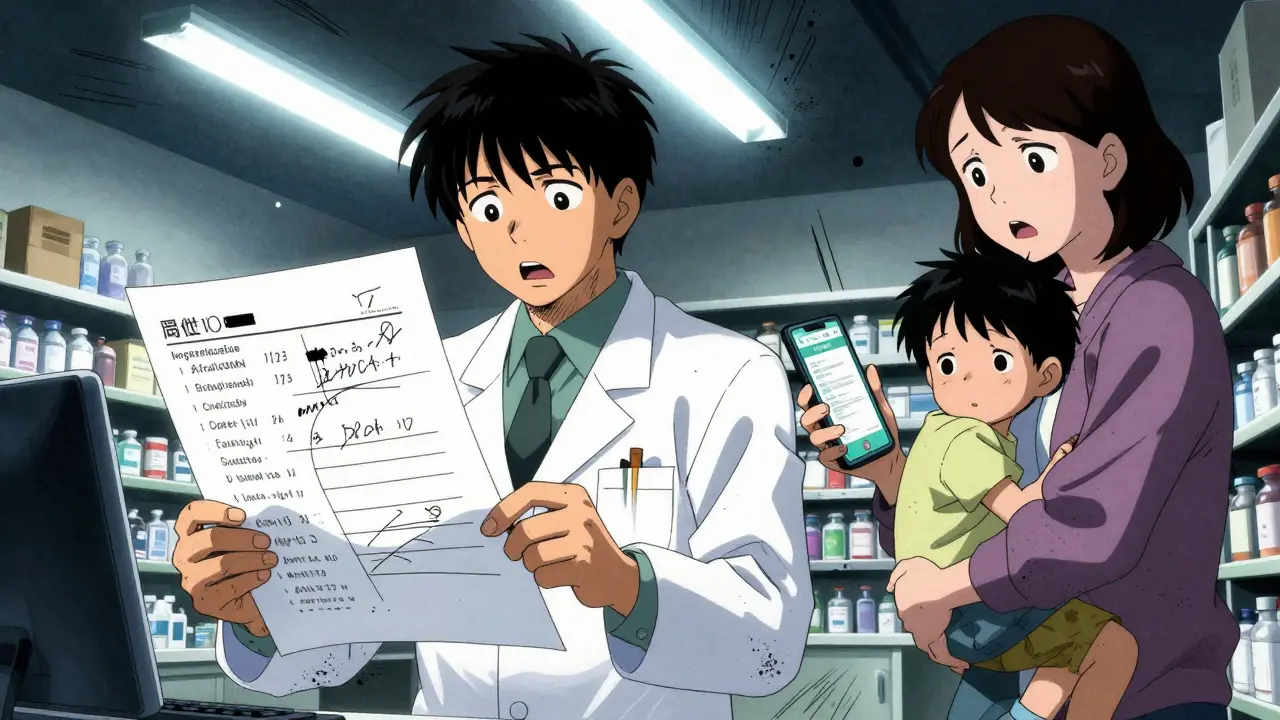
Imagine this: you pick up your child’s asthma inhaler prescription, and the pharmacist stares at it for a full minute. They call the doctor’s office. Then they call again. An hour later, you’re still sitting in the pharmacy waiting. Why? Because the handwriting on the paper prescription is unreadable. This isn’t rare. It’s happening 150 million times a year in the U.S. alone - all because a doctor scribbled a prescription too fast.
Illegible handwriting on prescriptions isn’t just annoying. It’s deadly. The Institute of Medicine found that poor handwriting alone contributes to about 7,000 preventable deaths each year in the United States. That’s more than the number of people who die in plane crashes annually. And it’s not just about bad penmanship. Missing initials, wrong dosages, unclear routes of administration - these tiny errors snowball into hospitalizations, allergic reactions, and sometimes, death.
Why Handwritten Prescriptions Are So Dangerous
Doctors are busy. They’re juggling patients, charts, insurance forms, and time limits. Writing a prescription by hand feels like the quickest way out. But speed comes at a cost. A 2022 study in the MMS Journal showed that 92% of medical students and doctors made at least one prescription error - averaging two per person. Many of those errors came from sloppy handwriting.
It’s not just doctors. Nurses and pharmacists are caught in the fallout. One study found that nurses spend an average of 12.7 minutes per illegible prescription trying to figure out what was meant. That’s over 12 minutes of time wasted - time that could’ve been spent helping another patient. And pharmacists? They make an estimated 150 million phone calls a year just to clarify prescriptions. That’s not customer service. That’s damage control.
Even the most experienced professionals struggle. A 2005 audit of 40 surgical notes in a British hospital found that only 24% were rated as "excellent" or "good" for legibility. Nearly 40% were called "poor." That’s not a one-off. It’s the norm.
And then there’s the human factor. About 22% of healthcare workers admitted they’d ignore an illegible prescription rather than take the time to clarify it. That’s not negligence - it’s exhaustion. But the risk? A patient gets the wrong drug. The wrong dose. The wrong route. All because a doctor didn’t take five extra seconds to write clearly.
The Silent Killer: Look-Alike, Sound-Alike Drug Names
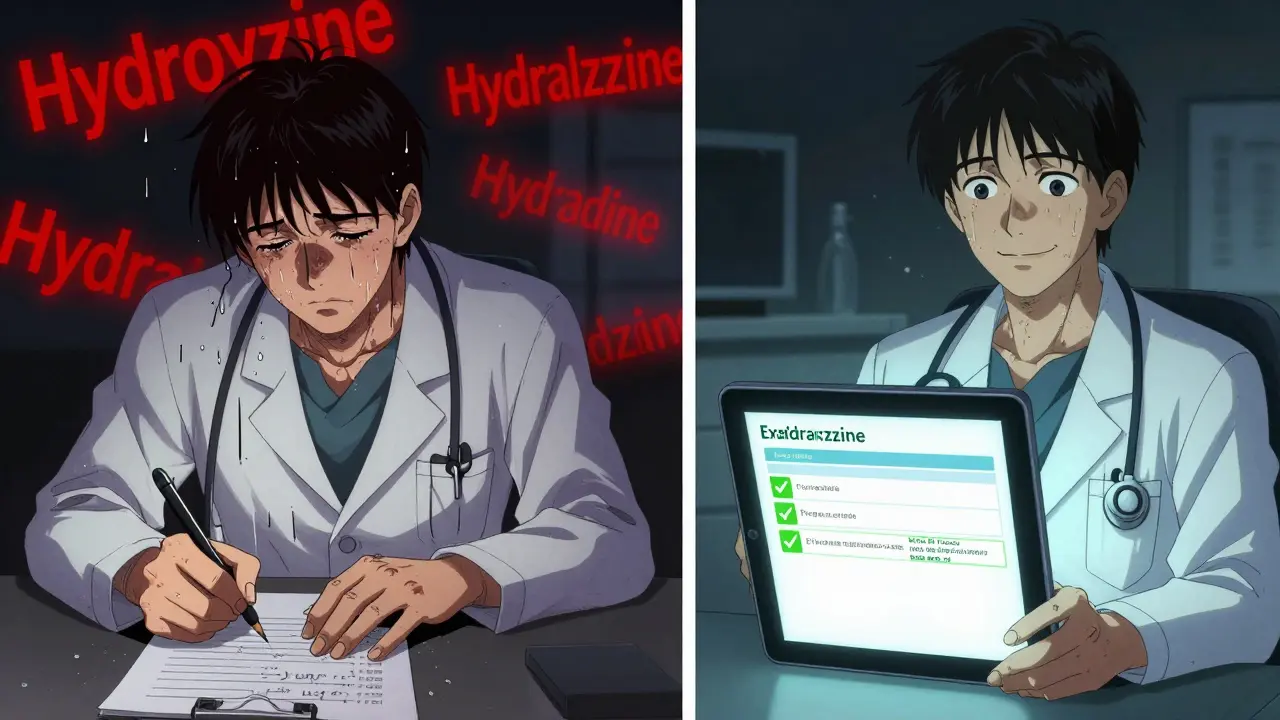
Illegible handwriting doesn’t just blur numbers and letters. It turns one drug into another. "Hydroxyzine" and "Hydralazine"? They sound almost identical. So do "Lanoxin" and "Lanoxin P." When written poorly, they become indistinguishable. The Institute for Safe Medication Practices lists these as top triggers for medication errors.
One case from a U.S. hospital: a patient was supposed to get hydralazine for high blood pressure. The handwritten script looked like "hydroxyzine," a drug used for allergies. The patient got the wrong medication. Within hours, their blood pressure spiked. They ended up in the ICU. The error was caught - but only because a pharmacist noticed the drug didn’t match the diagnosis.
These aren’t hypotheticals. They’re documented. And they happen because handwriting can’t reliably distinguish between similar-looking drug names. Printed text doesn’t have that problem. Neither does digital text.
E-Prescribing: The Proven Fix
There’s a solution - and it’s not asking doctors to write better. It’s eliminating handwritten prescriptions entirely. Enter e-prescribing.
Since 2003, electronic prescribing has been the gold standard for safety. By 2019, 80% of U.S. office-based providers were using it. And the results? Staggering.
A 2025 study in JMIR compared safety compliance between handwritten and e-prescriptions. Handwritten prescriptions scored just 8.5% on safety criteria. E-prescriptions? 80.8%. That’s a 9.5x improvement. Even manually typed e-prescriptions - without templates or auto-fill - hit 56% accuracy. That’s still more than six times safer than handwriting.
E-prescribing cuts errors from illegibility by 97%. That’s not a marketing claim. It’s data from Veradigm, a major health tech provider. No more guessing if a "5" is a "5" or a "S." No more wondering if "QD" means once daily or if it’s a typo for "QID." The system auto-fills the correct dosage, route, frequency, and alerts the prescriber if the dose is too high or conflicts with other meds.
And it’s not just safer - it’s faster. Pharmacists don’t have to call. Nurses don’t have to wait. Patients get their meds on time. Hospitals reduce readmissions. Everyone wins.
But E-Prescribing Isn’t Perfect
Here’s the catch: switching to digital doesn’t fix everything. It just changes the problems.
Some doctors say e-prescribing takes longer. Instead of scribbling one line, they now have to click through menus, select from dropdowns, and deal with pop-up alerts. And those alerts? They can become noise. Clinicians start ignoring them - a phenomenon called "alert fatigue." A 2025 study found that when systems flood doctors with too many warnings - even valid ones - they start clicking "OK" without reading. That’s dangerous.
There’s also cost. Setting up a full e-prescribing system can run $15,000 to $25,000 per provider. Training takes 8 to 12 hours. Integrating with electronic health records isn’t always smooth. Smaller clinics, rural hospitals, and clinics in low-income areas still struggle to afford it.
And let’s not forget: not everyone is tech-savvy. Older doctors who’ve been writing prescriptions for 30 years don’t always adapt easily. Some resist change. Some just don’t have the time to learn.
What If You Can’t Go Fully Digital?
Not every clinic can afford e-prescribing. Not every country has the infrastructure. So what do you do if you’re stuck with paper?
There are still ways to reduce risk:
- Print, don’t write in cursive. Block letters are easier to read than loops and swirls.
- Avoid dangerous abbreviations. The Joint Commission’s "Do Not Use" list bans terms like "U" for units, "QD" for daily, and "cc" for milliliters. Use "units," "daily," and "mL" instead.
- Write everything. Never skip the patient’s full name, drug name, exact dosage, frequency, route (oral, IV, etc.), and your signature with initials.
- Use specific numbers. Write "500 mg" instead of "500" or "half a tablet." Say "take by mouth twice daily" instead of "BID."
- Double-check. Before signing, pause for 10 seconds. Read it like a pharmacist would. Would you know what to give?
A 2019 study found that using a simple 15-item checklist - even just for self-review - reduced errors in handwritten prescriptions by 40%. It’s not perfect. But it’s better than nothing.
The Future Is Digital - And It’s Already Here
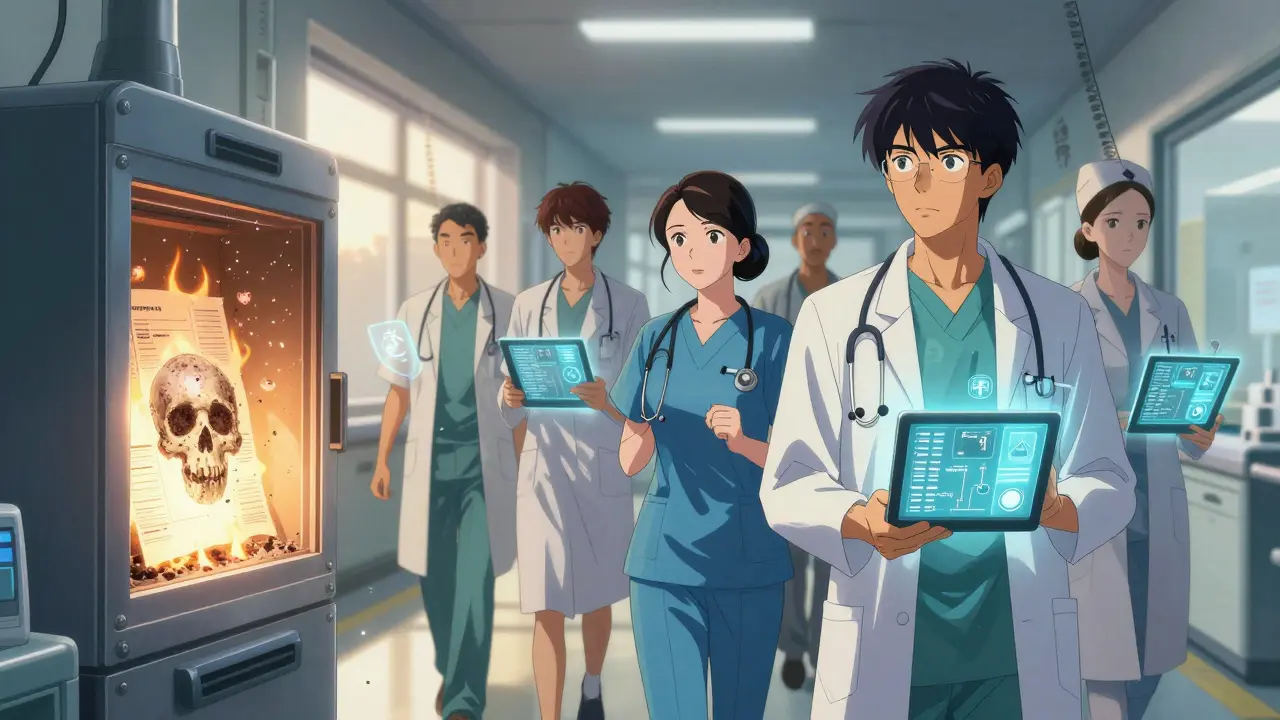
By 2030, handwritten prescriptions will be a relic - like fax machines or paper charts. The U.S. government has already pushed this change with laws like the Medicare Improvements for Patients and Providers Act (2008) and the 21st Century Cures Act (2016). These laws tied reimbursement to e-prescribing use. No more free passes.
The market is booming. The U.S. e-prescribing industry was worth $1.8 billion in 2022 and is projected to hit $4.2 billion by 2027. That’s not just tech companies chasing profit. It’s the healthcare system investing in safety.
Even AI is stepping in. Early tools can now scan handwritten prescriptions and interpret them with 85-92% accuracy. They flag unclear names, wrong dosages, and potential interactions. They’re not perfect - but they’re a bridge for clinics still using paper.
The bottom line? Illegible handwriting is a 20th-century problem in a 21st-century system. It’s not about being a good penman. It’s about protecting lives. And the data is clear: digital wins.
What You Can Do
If you’re a patient: Ask your doctor if they use e-prescribing. If they don’t, ask why. Your life might depend on it.
If you’re a provider: Start using e-prescribing. Even if it’s slow at first, the safety gains are worth the learning curve. Use templates. Turn on safety alerts. Don’t ignore them.
If you’re a pharmacist or nurse: Don’t guess. Always call back. Document every clarification. Your vigilance is the last line of defense.
Handwritten prescriptions aren’t just outdated. They’re a ticking time bomb. The fix isn’t harder work. It’s smarter systems. And those systems are already here.
Amy Ehinger
January 17, 2026 AT 10:13Wow, this post really hit home. I remember my mom once waiting two hours at the pharmacy because the doctor wrote '20 mg' like it was a doodle and the pharmacist thought it was '200 mg.' She ended up with a scary adrenaline rush just from a typo. It’s insane that we’re still letting people risk lives because they’re too tired to write clearly. I’m not even mad-I’m just exhausted on behalf of everyone involved.
Niki Van den Bossche
January 18, 2026 AT 11:38Ah, the romantic tragedy of the handwritten script-nature’s last bastion of chaotic human imperfection in an age of algorithmic purity. We fetishize efficiency while simultaneously glorifying the ‘human touch,’ yet when that touch translates into a child nearly dying because a lowercase ‘l’ looked like a ‘1,’ we suddenly remember we’re not living in a Dickens novel. The real horror isn’t the pen-it’s our collective refusal to evolve beyond the feudal system of medical bureaucracy. E-prescribing isn’t progress. It’s merely the first step toward a world where machines don’t let humans be lazy with life-or-death decisions.
Jan Hess
January 19, 2026 AT 02:50Gloria Montero Puertas
January 20, 2026 AT 01:52Tom Doan
January 20, 2026 AT 12:19It’s fascinating how the same professionals who demand precision in diagnostics, lab results, and surgical protocols are permitted-and even encouraged-to operate with the lowest standard of legibility when prescribing. One might argue that the healthcare system, in its structural inertia, has institutionalized incompetence. The real tragedy isn’t the handwriting-it’s that we’ve normalized the expectation that someone else will clean up the mess. The system rewards reaction over prevention, and that’s not a technical problem. It’s a philosophical one.
Sohan Jindal
January 20, 2026 AT 21:02Nishant Garg
January 22, 2026 AT 20:39In India, we still use handwritten scripts in most places, but we’ve developed our own workaround-standardized abbreviations passed down through generations of pharmacists. It’s not perfect, but we’ve built a culture of double-checking. One pharmacist I know can read a doctor’s scribble in under 10 seconds because he’s seen the same handwriting for 20 years. Maybe the solution isn’t just digital-it’s also community-based. Trust, experience, and shared knowledge still matter. That said, I’d still rather see e-prescribing. My cousin nearly got the wrong drug last year because ‘Metformin’ looked like ‘Metoprolol.’ That shouldn’t happen anywhere.
Annie Choi
January 24, 2026 AT 18:36Arjun Seth
January 25, 2026 AT 23:53Amy Vickberg
January 27, 2026 AT 01:39I know this is a heavy topic, but I just want to say thank you for writing this. It’s easy to feel powerless when you’re just a patient or a family member, but knowing that change is possible gives me hope. I’ve started asking my doctor about e-prescribing now, and honestly? He said he’s switching next month. Small steps, right? We all have a role to play-even if it’s just asking the question.
Crystel Ann
January 27, 2026 AT 06:58I work in a rural clinic and we’re still on paper. We don’t have the budget for e-prescribing. But we started using that 15-item checklist you mentioned-and our error rate dropped by half. It’s not glamorous. It’s not techy. But it’s something. And honestly? It’s made me more careful. I don’t just sign and go anymore. I read it out loud. I pause. I breathe. Maybe that’s the real lesson here: slowing down saves lives, even if you’re still using pen and paper.
Iona Jane
January 28, 2026 AT 11:54What if this is all a lie? What if the ‘7,000 deaths’ are inflated? What if the ‘97% reduction’ is just a marketing stat from Veradigm? Who funds these studies? Who benefits? I’ve seen doctors get fined for using e-prescribing because the system auto-filled the wrong drug. And now they’re being forced into it? This feels like a corporate takeover disguised as safety. They want to control the data. They want to track every pill. And they want you to be grateful for it.
Jaspreet Kaur Chana
January 28, 2026 AT 15:52In my village in Punjab, the local doctor still writes everything by hand-but he’s got this little notebook where he keeps his common prescriptions in block letters. Every new intern learns from it. We don’t have computers, but we have memory, routine, and respect. Still, I saw a kid get the wrong antibiotic last year because ‘Amoxicillin’ looked like ‘Azithromycin.’ That’s not tradition. That’s a waiting disaster. We need help. Not just tech-but real support. Training. Funding. Someone to actually care.
Haley Graves
January 29, 2026 AT 14:56If you’re a provider reading this and you’re still on paper-you’re not just behind the curve. You’re actively endangering people. I don’t care if your system is slow or your training was bad. The tools are out there. The data is clear. The cost of inaction is measured in lives. Stop making excuses. Start using the system. Your patients are not your guinea pigs. They’re people. And they deserve better than your handwriting.
Diane Hendriks
January 31, 2026 AT 09:51