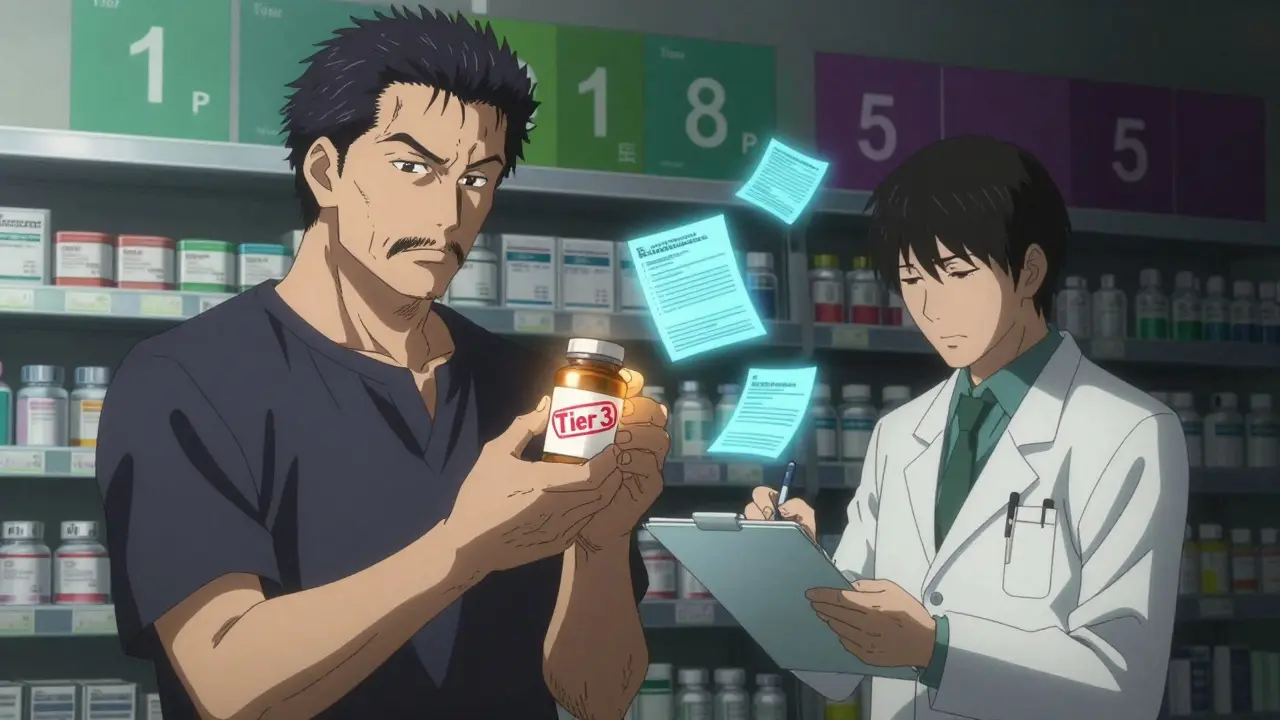
Every month, millions of Americans pay hundreds of dollars just to fill their prescriptions - not because the drug is expensive, but because their insurance plan puts it in the wrong tier. If your medication is on Tier 3 or higher, you might be paying $50, $100, or even more per month. But here’s the thing: you don’t have to. A tier exception can move that same drug to a lower tier - sometimes all the way to Tier 1 - cutting your copay to $0 or $10. And the best part? It’s legal, it’s allowed, and you’re already entitled to it.
What Is a Tier Exception?
A tier exception is a formal request to your Medicare Part D or private insurance plan to change the cost-sharing level of a drug you’re already taking. It’s not about getting a drug that’s not on your plan’s list - that’s a formulary exception. A tier exception is simpler: your drug is on the list, but it’s stuck in a high-cost tier. You’re asking to move it down. Medicare Part D plans use a tiered system to control costs. Here’s how it usually breaks down:- Tier 1: Generic drugs - $0 to $10 copay
- Tier 2: Preferred brand-name drugs - $10 to $20 copay
- Tier 3: Non-preferred brand-name drugs - $30 to $50 copay
- Tier 4: Preferred specialty drugs - 20% to 25% coinsurance (often $100+)
- Tier 5: Non-preferred specialty drugs - 30% to 40% coinsurance (can hit $1,000/month)
For example, if you’re taking Humira - a biologic used for rheumatoid arthritis - it’s often on Tier 4. That means you pay 30% of the drug’s list price. If the drug costs $5,000, your copay is $1,500. But if you get a tier exception and move it to Tier 2, your copay drops to $20. That’s a $1,480 monthly savings.
Insurance companies put drugs in higher tiers not because they’re less effective, but because they didn’t negotiate a good price with the manufacturer. A tier exception says: “This drug is medically necessary for my patient. Lower-tier alternatives won’t work.”
Who Can Request a Tier Exception?
You, your doctor, or someone acting on your behalf (like a family member or patient advocate) can start the process. But here’s the catch: your doctor has to sign off. Insurance companies don’t approve these based on your complaints about cost. They need clinical proof.The doctor’s statement must show one or more of these:
- The preferred drug on a lower tier won’t work as well for your condition
- You had serious side effects from the preferred drug
- You tried the lower-tier alternative and it failed
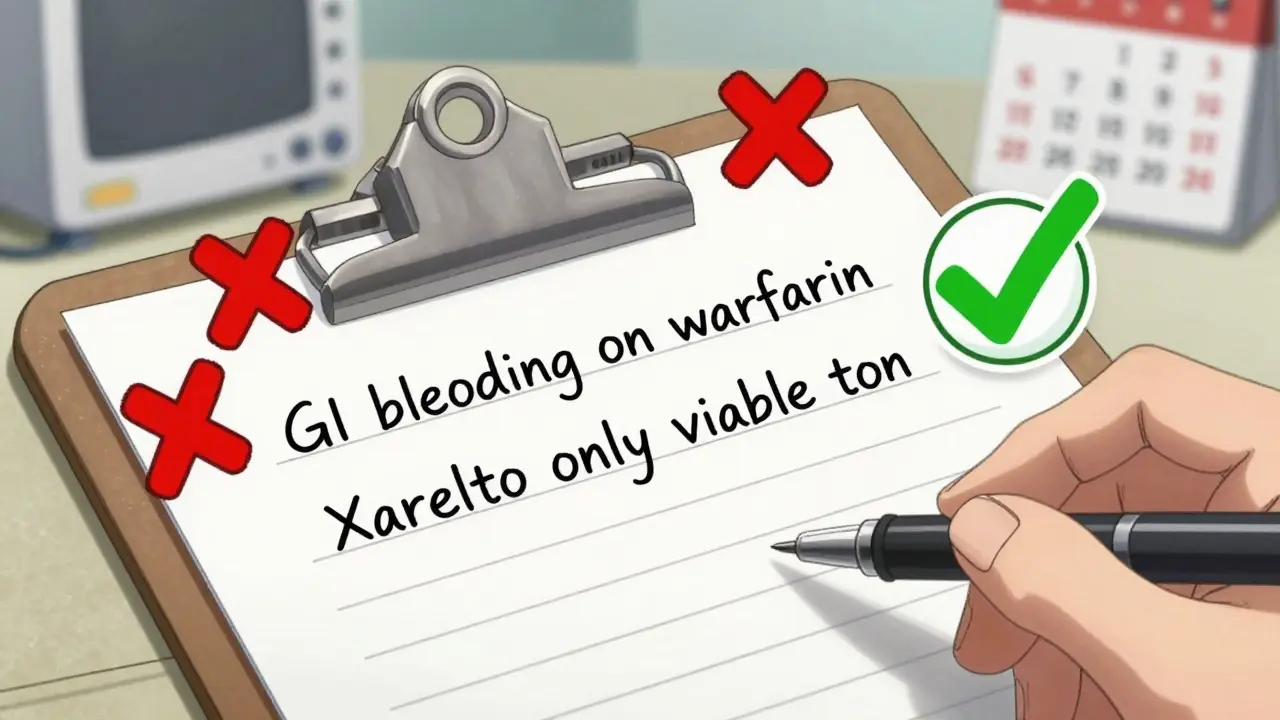
Generic statements like “I don’t like this drug” or “It’s too expensive” won’t cut it. You need specifics: “Patient developed GI bleeding on warfarin, required hospitalization. Switched to apixaban - now stable. Warfarin is contraindicated.” That’s the kind of language that gets approved.
How to Request a Tier Exception: 4 Simple Steps
Don’t wait until you’ve paid $100 for your first fill. Start this process before you even pick up your prescription.
- Check your copay - When your doctor writes the script, ask the pharmacy: “What’s the copay for this drug?” If it’s $40 or more, ask if a tier exception is possible.
- Ask your doctor to submit a request - Most doctors’ offices have the form. If they don’t, your insurance plan’s website has a downloadable version. Tell your doctor: “I need a tier exception for this drug. Can you write a note explaining why lower-tier options won’t work?”
- Provide clinical details - The stronger the medical rationale, the faster it gets approved. If you’ve tried other drugs, list them. If you had a bad reaction, mention it. Include dates, symptoms, lab results if relevant.
- Track the status - Plans must respond within 72 hours for urgent cases (if your health is at risk) or 14 days for standard requests. Call the number on your insurance card if you haven’t heard back in 10 days.
Pro tip: Some doctors now submit tier exceptions at the same time they write the prescription - called “proactive exceptions.” These get approved 89% of the time, compared to 67% for requests made after the fact.
What If Your Request Gets Denied?
Denials happen - often because the doctor’s note was too vague. But don’t give up. You have the right to appeal.Here’s what to do:
- Get a copy of the denial letter - it’ll say exactly why they rejected it.
- Ask your doctor to rewrite the note with more clinical detail.
- Submit the appeal within 60 days.
According to UnitedHealthcare’s internal data, 78% of denied requests are approved on appeal - if you fix the documentation. One patient in Sacramento tried twice for Xarelto. First denial: “Insufficient clinical justification.” Second time, the doctor added: “Patient has history of stroke and atrial fibrillation. Warfarin requires weekly INR monitoring - patient is homebound and cannot comply. Xarelto is the only viable option.” Approved - moved to Tier 2. Copay dropped from $40 to $15.
Who Benefits the Most?
Tier exceptions aren’t just for seniors. They’re especially powerful for people taking:- Biologics - like Humira, Enbrel, or Orencia for rheumatoid arthritis or psoriasis
- Multiple sclerosis drugs - such as Ocrevus or Tysabri
- Complex heart medications - like Entresto or Jardiance
- High-cost cancer drugs - especially those not yet generic
These drugs are often stuck in Tier 4 or 5. Moving them down even one tier can save $500-$1,000 a month. The Medicare Rights Center found that 58% of people who applied for tier exceptions succeeded - and saved an average of $37.50 per fill. Multiply that by 12 fills a year: $450 saved, just by asking.

Why So Few People Use This
Only 18% of eligible Medicare beneficiaries even try to get a tier exception. Why? Three reasons:- They don’t know it exists. Most people think their copay is fixed.
- They think it’s too complicated. But if your doctor fills out the form, it takes less than 10 minutes.
- They’re afraid of being denied. But with proper documentation, approval rates are over 60%.
The real barrier isn’t the system - it’s the lack of awareness. A 2023 Kaiser Family Foundation report found that patients who asked for tier exceptions saved an average of $300-$600 per year per drug. That’s money you can use for groceries, rent, or a dental visit.
What’s Changing in 2025?
Starting in 2025, the Inflation Reduction Act caps out-of-pocket drug costs for Medicare Part D beneficiaries at $2,000 per year. That sounds great - but it doesn’t eliminate tier exceptions. Why?Because the $2,000 cap kicks in only after you’ve spent that much. Until then, you’re still paying tier-based copays. If you’re on a $1,500/month drug, you’ll hit that cap in just over a month. But if you get a tier exception and lower your copay to $50, you’ll spend $600 a year instead of $18,000. You’ll never even come close to the cap - and you’ll save thousands.
Plus, the cap doesn’t apply to private insurance plans - only Medicare Part D. So if you’re under 65 and on a commercial plan, tier exceptions are still your best tool.
Final Tips to Get Approved
- Don’t wait - request the exception before your first fill.
- Be specific in the doctor’s note. Use medical terms, not opinions.
- Keep copies of everything: the request, the denial letter, the approval notice.
- If your plan denies it, appeal. You have a 78% chance of winning on appeal with better documentation.
- Ask your pharmacist if they can help. Many have patient advocates on staff.
Tier exceptions aren’t a loophole. They’re a safety valve built into the system to make sure people get the drugs they need - not just the cheapest ones. If your medication is costing you too much, you’re not stuck. You just haven’t asked yet.
Can I request a tier exception for any drug?
Yes - but only if the drug is already on your plan’s formulary. If it’s not covered at all, you need a formulary exception, not a tier exception. Tier exceptions are for drugs that are covered but in a higher-cost tier than you think they should be.
Do I need to be on Medicare to use tier exceptions?
No. While tier exceptions are most commonly discussed in Medicare Part D, most private insurance plans (including those from employers or the ACA marketplace) use the same tiered system. You can request a tier exception with any plan that has multiple drug tiers.
How long does a tier exception take to process?
Standard requests take up to 14 days. If your doctor says your health is at risk without the drug (e.g., you’re at risk of hospitalization or worsening symptoms), you can request an expedited review - the plan must respond within 72 hours.
What if my doctor won’t help me?
Ask your pharmacist or call your insurance plan’s member services. They can often send your doctor the exact form and wording needed. Many doctors are willing to help once they see how simple it is. If your doctor refuses, consider asking another provider - especially if you’re on a chronic condition where medication choice matters.
Can I get a tier exception for a new prescription?
Absolutely. In fact, it’s best to request it before you fill the prescription. Many doctors now submit tier exception requests at the same time they write the script. This avoids delays and lets you pay the lower copay from day one.
Lauren Wall
January 21, 2026 AT 12:05Wow, I had no idea this was even a thing. My mom’s been paying $90 a month for her blood pressure med-she’s gonna be so mad she didn’t know about this sooner.
Kenji Gaerlan
January 22, 2026 AT 14:12so like… u just ask? no paperwork? my doc just shrugs and says ‘sorry bro’
Akriti Jain
January 24, 2026 AT 00:48lol sure 😏 the pharma giants *totally* want you to save money… next you’ll tell me they give free vaccines to puppies 🐶💊 #BigPharmaLies
Mike P
January 24, 2026 AT 03:49Man, if you're not using tier exceptions, you're literally leaving thousands on the table. I'm not even mad-just disappointed. This isn't some secret hack, it's a RIGHT. If your doctor won't help, get a new one. This ain't rocket science, it's basic healthcare advocacy. Stop being lazy and start asking. America's not broke because of the poor-it's broke because people don't fight for what they're owed.
Jasmine Bryant
January 25, 2026 AT 04:40Just tried this for my insulin-submitted the form with my doctor’s note and got approved in 5 days. Copay dropped from $85 to $15. 😭 I didn’t even know what a tier was until last month. Also, typo: ‘formulary exception’ not ‘formulary expection’-but still, life-changing info!
Sarvesh CK
January 25, 2026 AT 07:17It is fascinating to consider the structural inequities embedded within pharmaceutical pricing models, wherein access to essential therapeutics becomes contingent upon bureaucratic navigation rather than medical necessity. The tier exception mechanism, while ostensibly a procedural safeguard, reveals a deeper truth: healthcare systems are designed to incentivize cost containment over patient autonomy. One cannot help but wonder how many individuals, particularly those with limited health literacy or social support, are systematically excluded from such remedies-not due to clinical irrelevance, but due to institutional inertia. The moral imperative here transcends policy; it demands a reimagining of care as a human right, not a transactional commodity.
Hilary Miller
January 27, 2026 AT 06:36This is huge. My cousin in Mexico just got her rheumatoid arthritis meds covered after we helped her file this. She cried. Seriously. You don’t need to be American to benefit-this works everywhere with tiered plans.
Margaret Khaemba
January 28, 2026 AT 21:26Wait, so if I’m on a private plan, I can still do this? I thought this was just for Medicare. My husband’s on his employer’s plan and he’s on Humira-gonna print this out and hand it to his doctor tomorrow.
Malik Ronquillo
January 29, 2026 AT 15:19My doctor flat out told me to suck it up. Said ‘the system’s broken’ and walked out. So I called my insurance myself. Got approved in 3 days. Copay’s $10 now. Don’t let them gaslight you. You’re not asking for a favor-you’re claiming what’s yours.