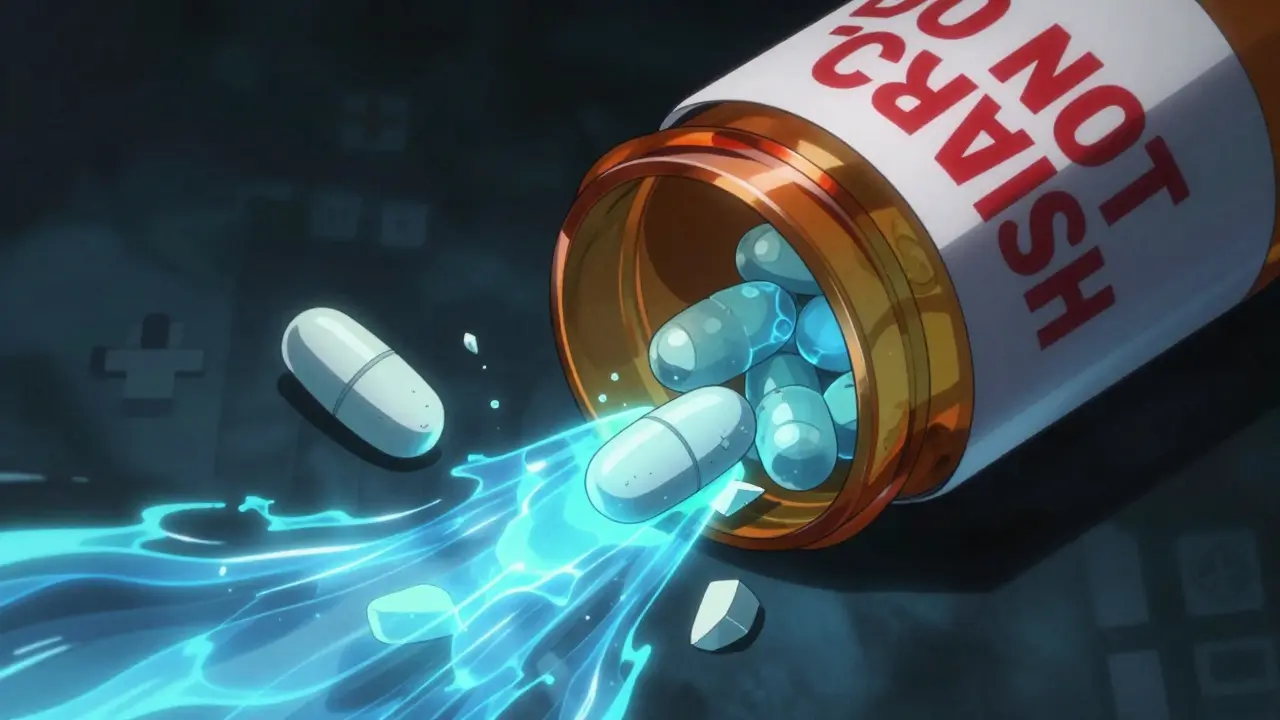
Every year, thousands of people end up in the emergency room because they didn’t understand what extended-release meant on their pill bottle. It’s not because they’re careless. It’s because the labels are confusing-even for people who read them carefully.
Imagine you take a pill labeled "Metoprolol ER 25 mg" and think, "This is just a regular pill, so I’ll crush it to make it easier to swallow." That single action could flood your system with the full day’s dose all at once. Your heart rate could drop dangerously low. You could pass out. In some cases, it’s fatal.
Extended-release medications aren’t just pills that last longer. They’re engineered systems designed to release medicine slowly, over hours or even days. And if you break them open, you break the system.
What "Extended Release" Actually Means
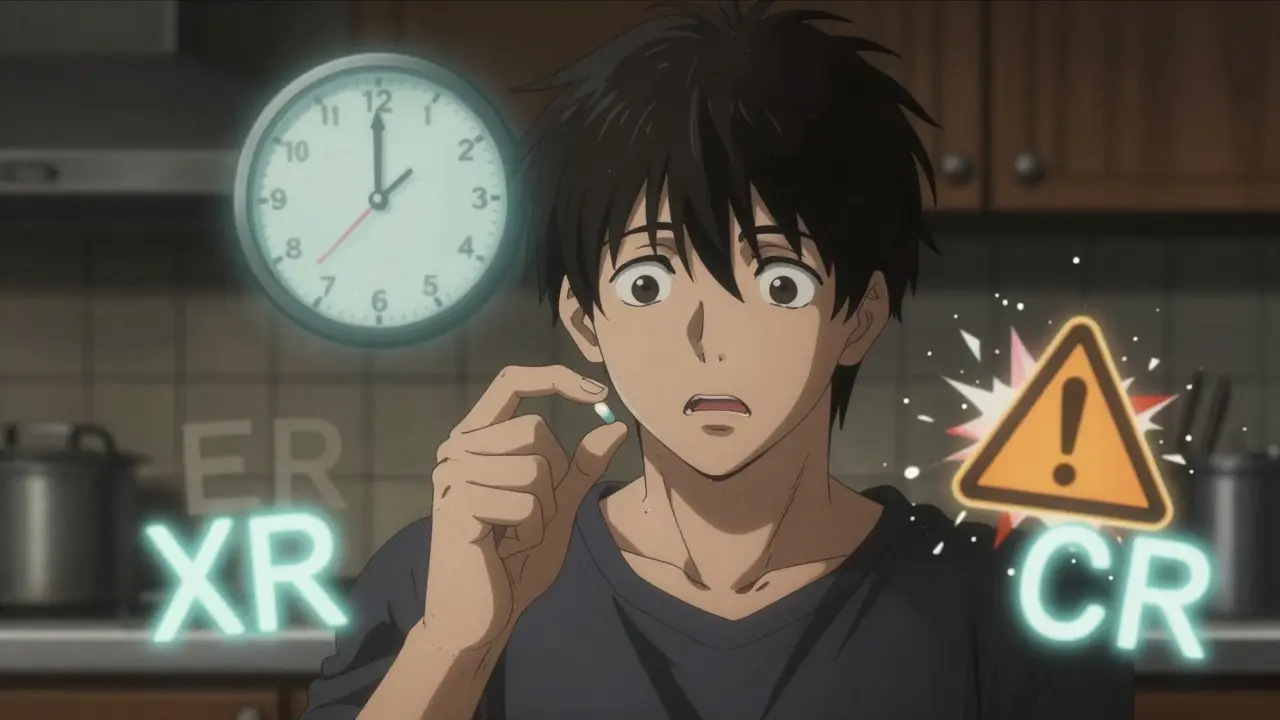
When you see "ER," "XR," "SR," "CR," or "CD" on a pill label, it’s not marketing fluff. It’s a technical term that tells you how the drug behaves inside your body.
Regular pills (called immediate-release) dissolve in your stomach within 30 to 60 minutes. All the medicine hits your bloodstream at once. That’s why you might need to take them three or four times a day.
Extended-release versions use special technology to control how fast the drug leaves the pill. Some use a wax-like coating that slowly wears away. Others have tiny beads inside a capsule, each with its own release timing. Some even use osmotic pumps-like a tiny water-powered timer-that push the medicine out steadily over 24 hours.
That’s why you see phrases like "24-hour extended release" or "12-hour sustained release" on the label. The number matters. A 12-hour version needs to be taken twice a day. A 24-hour version is meant for once daily. Mix them up, and you’re either underdosing or overdosing.
How to Spot Extended-Release Medications on the Label
Extended-release designations always appear right after the drug name. Here’s what to look for:
- ER = Extended Release
- XR = eXtended Release
- SR = Sustained Release
- CR = Controlled Release
- CD = Continuous Delivery
- XT = Extended Release (brand-specific, like Cartia XT)
- OROS = Osmotic Release Oral System (Concerta’s tech)
These abbreviations are not interchangeable. Two pills with "ER" in the name can work completely differently. For example, one generic extended-release diltiazem might release over 24 hours using a matrix system, while another uses a different coating and releases unevenly. They’re not interchangeable, even if they have the same dose.
Also, watch for the time frame. Look for "24-hour" or "12-hour" right next to "extended release." If it’s missing, ask your pharmacist. Some labels skip it, and that’s dangerous.
The One Rule You Must Never Break
Never crush, split, chew, or open an extended-release pill unless your doctor or pharmacist says it’s safe.
That warning isn’t a suggestion. It’s a life-or-death rule.
When you crush a 24-hour extended-release opioid like OxyContin, you’re not just getting the whole day’s dose in one go-you’re getting it all in seconds. The FDA has documented over 1,200 adverse events between 2018 and 2022 from people who did exactly that. Many ended up in the ER with respiratory failure.
The same goes for stimulants like Adderall XR. Crushing it turns a once-daily dose into a rapid, intense high. That’s why it’s commonly abused. But even if you’re not abusing it, you’re risking seizures, heart rhythm problems, or sudden death.
Some pills have a special coating or a built-in mechanism to prevent crushing. But you can’t tell just by looking. Always assume the pill is designed to stay whole.
When and How to Take Them
Timing isn’t optional with extended-release meds. It’s part of the design.
Some are meant to be taken in the morning. Niaspan (niacin extended-release), for example, causes flushing. Taking it at night helps you sleep through it.
Others, like certain blood pressure pills, work best when taken at night to control early-morning spikes in pressure.
Always check the "Directions" section on the label. It might say:
- "Take once daily in the morning"
- "Take with food"
- "Do not take with grapefruit juice"
Why does food matter? Some extended-release pills need food to trigger the right release pattern. Others are damaged by stomach acid and only work if taken on an empty stomach.
If the label says "take with food" and you take it on an empty stomach, the medicine might release too fast-or not at all.
What’s in the Inactive Ingredients?
Most people skip the "Inactive Ingredients" list. Big mistake.
These are the non-medicine parts of the pill-the fillers, coatings, and polymers that control how the drug is released. Some people are allergic to these. For example, lactose, gelatin, or certain dyes can trigger reactions.
Also, some extended-release formulations use proprietary polymers that are unique to that brand. Generic versions might use different ones, which can change how the drug behaves-even if the active ingredient is the same.
That’s why two "extended-release metoprolol" pills from different manufacturers might not work the same way. The FDA doesn’t require them to be "AB-rated" (interchangeable) unless they’ve passed strict bioequivalence tests. Always ask your pharmacist if your generic is interchangeable with your brand.
What to Do If You’re Confused
Don’t guess. Don’t assume. Don’t rely on memory.
Here’s what to do instead:
- Check the Medication Guide. By law, pharmacies must give you a printed guide for high-risk extended-release drugs-especially opioids, stimulants, and heart meds. Read it.
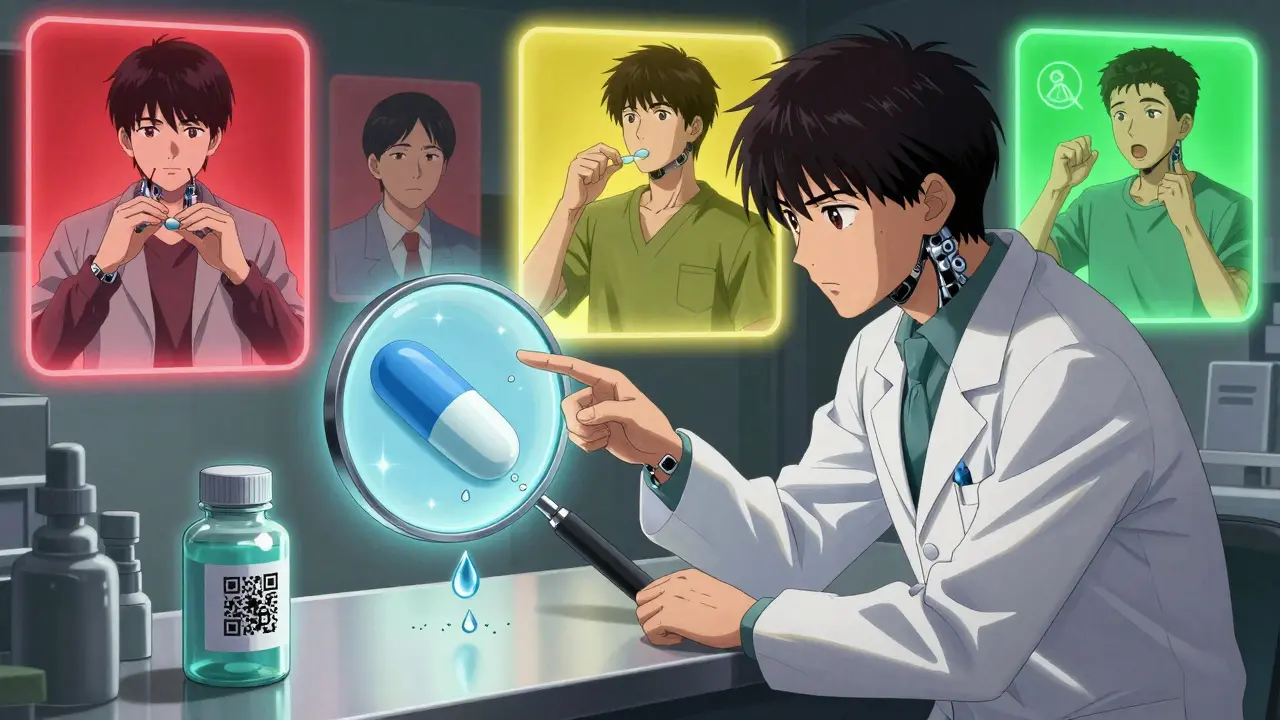
- Ask the pharmacist to explain it in plain language. Say: "Can you show me how this pill works?"
- Use the "teach-back" method. After they explain, say: "So, I take this once a day in the morning, don’t crush it, and never skip a dose?" If they nod, you got it right.
- Look for QR codes on newer labels. Many now link to short videos showing how to take the pill correctly.
- If you’re over 65, ask for a medication review. Seniors are 42% more likely to misunderstand extended-release labels, according to FDA studies.
Why This Matters More Than You Think
Extended-release medications make up over 35% of all prescriptions in the U.S. That’s one in three pills you or someone you care about is taking.
They’re popular because they reduce dosing frequency. One pill a day instead of four. That’s a big help for people with chronic conditions like high blood pressure, diabetes, or depression.
But they’re also more expensive-20% to 35% more than immediate-release versions. And they’re harder to adjust if your condition changes. If you need a higher dose, you can’t just take half an extra pill. You have to switch to a different strength.
That’s why understanding the label isn’t just about safety. It’s about getting the most value from your medication.
What’s Changing in 2025
The FDA is cracking down on confusing labels. Starting in January 2024, all new extended-release medications must have a bold, high-contrast "DO NOT CRUSH" warning on the front of the bottle.
Electronic health records now require prescribers to write "24-hour extended release" instead of just "ER." That’s because "ER" can be misread as "every day" or "emergency."
And new technologies are coming. Some pills in development use GI-retention systems that can keep medicine flowing for up to 72 hours. That means you might only need to take a pill every three days.
But until then, the rules are simple: Read the label. Know the suffix. Never break the pill. And if you’re unsure-ask.
What does ER mean on a prescription label?
ER stands for Extended Release. It means the medication is designed to release its active ingredient slowly over time-usually 12 or 24 hours-instead of all at once. This allows for fewer daily doses and more stable blood levels. Never crush, split, or chew an ER pill.
Can I split an extended-release pill in half?
No, unless the pill is specifically designed to be split (like some scored tablets with a special coating). Most extended-release pills have a protective layer or internal structure that ensures slow release. Splitting it destroys that system and can cause a dangerous overdose. Always check with your pharmacist before splitting any pill.
Why do some extended-release pills have different names like XR, SR, and CR?
These are different terms for similar but not identical technologies. ER and XR usually mean the same thing. SR (Sustained Release) often refers to slower release over a longer period. CR (Controlled Release) implies precise timing, often using a mechanical system. CD (Continuous Delivery) is a brand-specific term. The key is: even if two pills say "ER," they might release medicine differently. Never assume they’re interchangeable.
What happens if I take an extended-release pill at the wrong time?
Taking it at the wrong time can reduce its effectiveness or increase side effects. For example, taking a blood pressure pill meant for morning at night might cause your pressure to spike in the early hours. Some medications, like Niaspan, cause flushing-so taking them at night helps you sleep through it. Always follow the timing instructions on the label.
Are generic extended-release medications the same as brand-name ones?
Not always. While generics must have the same active ingredient and dose, the release mechanism can differ. Some are "AB-rated" (interchangeable), but others aren’t. For example, there are three different 24-hour diltiazem products on the market that are not interchangeable. Always ask your pharmacist if your generic is approved as interchangeable with your brand.
What should I do if I accidentally crushed an extended-release pill?
Call your pharmacist or poison control immediately (1-800-222-1222). Do not wait for symptoms. Crushing an extended-release opioid, stimulant, or heart medication can cause a life-threatening overdose. Even if you feel fine now, the full dose may still be entering your system over the next few hours.
Can I take extended-release medication with alcohol?
Generally, no. Alcohol can interfere with the release mechanism of extended-release medications, causing the drug to be released too quickly. This is especially dangerous with opioids, sedatives, and blood pressure medications. Even one drink can increase the risk of overdose or side effects. Always check the label or ask your pharmacist.
Final Tip: When in Doubt, Ask
You don’t need to be a pharmacist to understand your meds. But you do need to ask questions.
When you pick up your prescription, pause. Look at the label. Read the directions. Ask: "Is this extended-release? What happens if I crush it? When should I take it?"
That five-minute conversation could save your life-or someone else’s.
Nicola George
December 27, 2025 AT 20:46So let me get this straight - we’re now treating adults like they can’t read a damn label, and the solution is to print bigger warnings? I’ve been taking ER pills since 2012. I didn’t need a video tutorial. I just read the damn thing. This is infantilizing.
Raushan Richardson
December 29, 2025 AT 19:13YES. This is so important. I had a friend crush her XR Adderall because she thought it was ‘just a pill’ - turned out she was in the ER for 36 hours. The system is broken when people have to be told not to chew their medicine like a gummy bear. Please share this with someone who needs to see it.
Robyn Hays
December 31, 2025 AT 12:04I love how you broke down the abbreviations - I used to think ER and XR were just marketing buzzwords. Turns out, OROS is basically a tiny water-powered clock inside a pill? That’s wild. I always assumed it was just slow-dissolving, but the engineering behind this stuff is next-level. Also, the part about generics not being interchangeable? Mind blown. I’m going to ask my pharmacist to show me the difference next time I refill.
Liz Tanner
December 31, 2025 AT 16:57Thank you for including the teach-back method. That’s the single most effective tool in patient education. I work in a clinic, and when patients repeat back instructions in their own words, we catch misunderstandings 87% of the time. It’s not about dumbing things down - it’s about making sure the message lands. Please, everyone: say it back. Don’t just nod.
Babe Addict
January 2, 2026 AT 08:28Actually, most of these ‘extended-release’ systems are just placebo engineering. The FDA doesn’t require bioequivalence testing for release kinetics - only for plasma concentration. So technically, two ‘ER’ pills can have wildly different pharmacokinetics and still be approved. The whole ‘never crush’ thing? Mostly legal liability padding. If you’re not taking opioids or stimulants, the risk is overstated. I’ve split my metoprolol ER for years. Still alive.
Satyakki Bhattacharjee
January 3, 2026 AT 10:03Human beings are lazy. They want everything easy. They crush pills because they don’t want to wait. They want fast results. But life is not fast. Medicine is not fast. Nature is slow. The body is a temple. To break the pill is to break the sacred rhythm. This is not science - this is rebellion against nature. And rebellion always ends in pain.
Liz MENDOZA
January 4, 2026 AT 22:31I’m so glad you mentioned the QR codes - my grandma just started using them. She watches the 90-second video every time she picks up a new med. She says it helps her feel less scared. We need more of this. Not just warnings - education that meets people where they are. Also, thank you for including seniors. Too many forget we’re not all tech-savvy.
Kishor Raibole
January 4, 2026 AT 22:52It is an undeniable truth that the pharmaceutical industry, in its infinite wisdom, has constructed a labyrinth of nomenclature - ER, XR, SR, CR, CD, OROS - each a subtle incantation meant to confuse the layperson, while simultaneously enriching the corporate coffers. The very language of medicine has been weaponized into a barrier of obscurity, and the patient, bewildered and weary, is left to navigate this semantic minefield alone. Is it any wonder that mortality rates rise? When knowledge is hoarded behind jargon, death becomes a statistical inevitability - not of disease, but of systemic neglect.
Miriam Piro
January 5, 2026 AT 03:04Okay but what if the FDA is actually hiding something? 🤔 I read somewhere that the ‘slow-release’ tech was originally developed by the military to keep soldiers alert during long missions - and now it’s in our blood pressure pills? Who’s really controlling the release? Are they monitoring us? And why do all the QR codes lead to the same corporate website? 🤨 I’ve been taking my ER meds for 10 years… and I swear, sometimes I feel like someone’s adjusting the dose remotely. 👁️🗨️ #DeepStatePills
Monika Naumann
January 5, 2026 AT 18:42It is not merely a matter of reading labels; it is a moral imperative. In a nation where the sacred duty of self-preservation is entrusted to the individual, the failure to comprehend the most basic pharmaceutical instruction constitutes a dereliction of civic responsibility. One does not crush a pill as one would crush a flower - one respects the integrity of the mechanism designed by science and sanctioned by law. To do otherwise is to invite chaos into the sanctum of the body. Let this be a lesson to all: humility before medicine, and reverence for the pill.