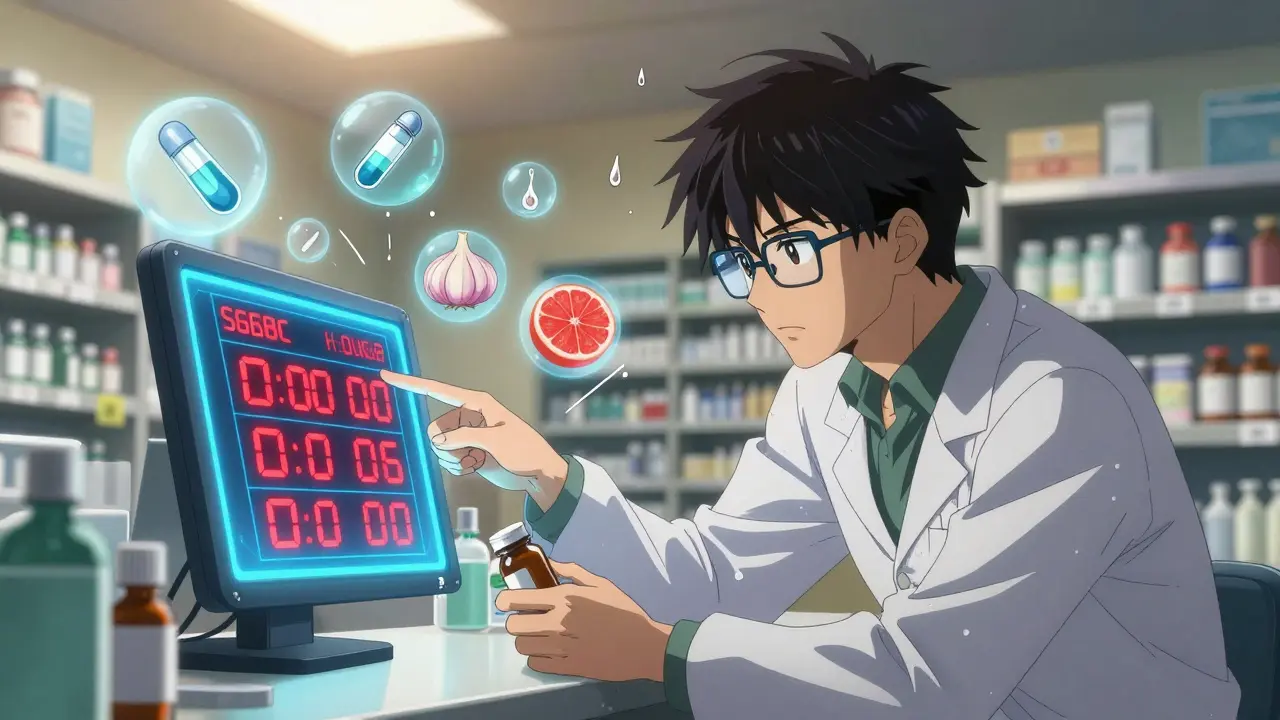
When you pick up your prescription, you might think the hard part is over. But there’s one final step that could save your life: confirming allergies and interactions right at the counter. This isn’t just a formality-it’s a critical safety check that happens in the last 90 seconds before you walk out with your meds. And if it’s done wrong, it can lead to hospital visits, dangerous reactions, or even worse.
Every year, around 6.7% of hospital admissions are caused by adverse drug events. That’s not some distant statistic-it’s real people, often older adults or those on multiple medications, who got sick because a simple check was missed. The good news? Pharmacists now have powerful tools to catch these errors. The bad news? Many systems still flood them with false alarms, and patients often don’t know what to say when asked, "Do you have any allergies?"
What Happens at the Pickup Counter?
It starts the moment the prescription hits the pharmacy system. The software automatically scans your profile for allergies and current medications. It pulls data from your electronic health record (EHR), cross-references it with databases like Lexicomp or Micromedex, and flags anything that looks risky. But here’s the catch: not all flags are created equal.
Some systems check every ingredient-even the inactive ones. That means if you’re allergic to food dyes, and your pill contains Red 40, you’ll get an alert. But if you’re allergic to penicillin and your doctor prescribes amoxicillin? That’s a real threat. The problem? Too many false alerts. A 2024 BMJ study found pharmacists override 68.4% of allergy warnings, and 12.7% of those overrides are dangerous. That’s not just noise-it’s a system on the brink of burnout.
How Systems Get It Wrong (and Right)
There are three main ways pharmacies screen for allergies:
- NDC-based screening: Uses National Drug Codes to match exact pill formulations. It’s precise, but outdated. NDC codes get removed from databases within 18 months of a drug being discontinued. If your allergy record says you reacted to a version of a drug that’s no longer sold, the system won’t catch a similar one.
- Drug name concept screening: Checks the active ingredient. This catches more real risks. For example, if you’re allergic to amoxicillin, it flags all penicillin-based antibiotics-even ones with different brand names. But it also triggers 3.2 times more alerts than NDC systems, many of them about dyes or fillers.
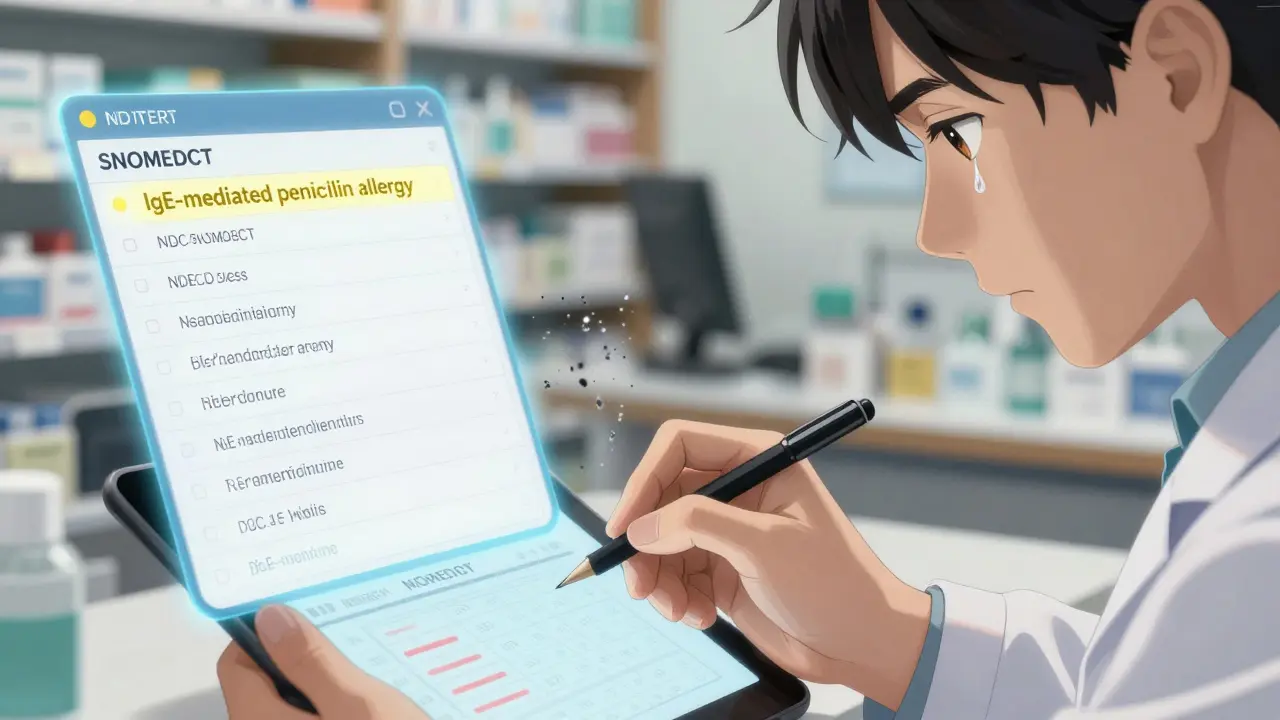
- Structured picklists (SNOMED CT): Uses standardized medical terms. This is the gold standard. Instead of "allergic to penicillin," it records "IgE-mediated penicillin allergy." That precision helps systems ignore irrelevant alerts and focus on real dangers.
Most U.S. pharmacies use Epic or Cerner EHRs, and 87.3% of community pharmacies run automated checks. But only 63.2% of them have fine-tuned their systems to filter out junk alerts. That’s why some pharmacists still see 10+ alerts per prescription-even for simple meds like ibuprofen.
What You Need to Say at Pickup
Pharmacists don’t just read your chart. They ask you questions. And your answer matters. Too often, patients say, "I’m allergic to penicillin," without knowing what that actually means. Here’s what you should be prepared to share:
- What reaction did you have? (Rash? Swelling? Trouble breathing?)
- When did it happen? (Years ago? As a child?)
- Was it confirmed by a doctor or allergist?
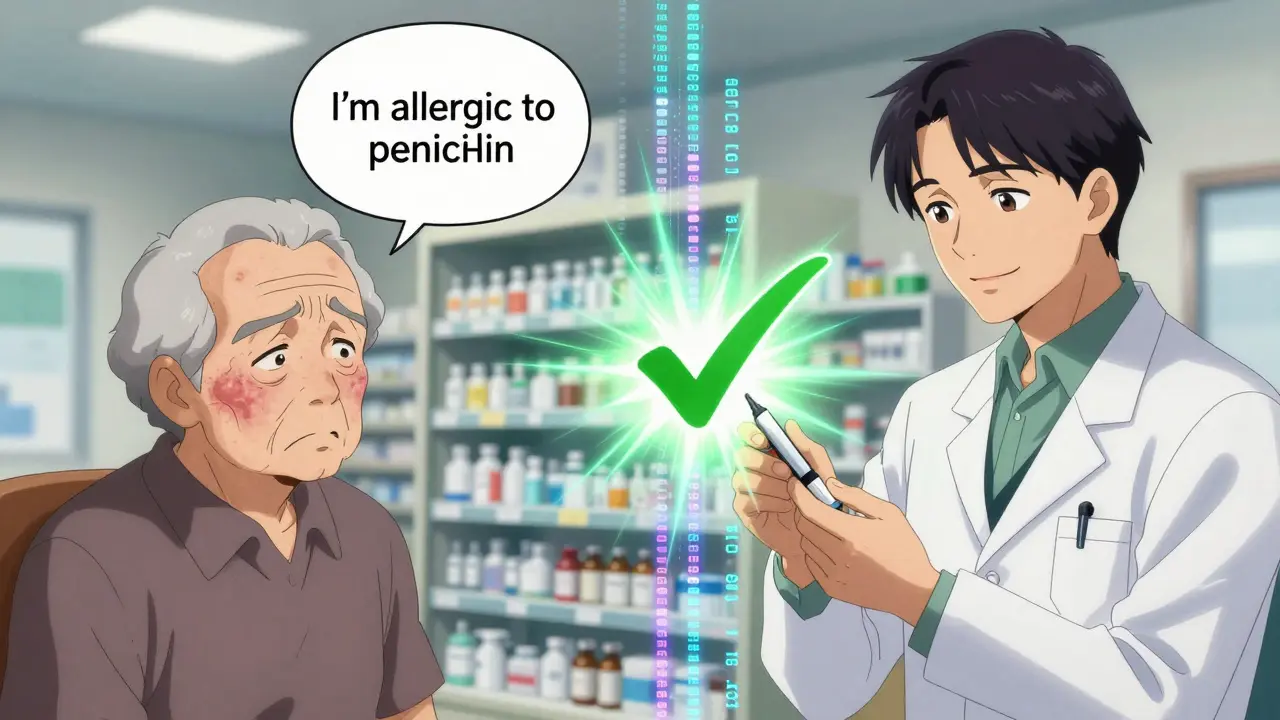
Here’s the kicker: 90% of people who say they’re allergic to penicillin aren’t. A 2023 JACI study found that only 10-20% of those labels are accurate. Skin testing can clear 93% of them. If you’ve been avoiding penicillin for decades because of a childhood rash, you might be missing out on the best antibiotic for your infection. Tell your pharmacist. They can help you get tested.
Same goes for other common labels: "I’m allergic to sulfa." But sulfa drugs include antibiotics, diuretics, and diabetes meds. Are you allergic to all of them? Probably not. Don’t assume. Say what happened.
How Pharmacists Are Fixing This
Leading pharmacies have started changing their workflows. Mayo Clinic introduced "allergy timeouts"-a 30-second pause before dispensing for patients with complex histories. They also train pharmacists to ask one simple question: "Has your allergy been confirmed by a specialist?" That alone cut unnecessary antibiotic substitutions by 37%.
Walgreens now requires pharmacists to enter a reason when they override an alert. That reason gets shared with the prescriber and next pharmacist who sees your file. No more guessing why a warning was ignored. It’s now part of your medical record.
And it’s not just big chains. Smaller pharmacies are using cloud-based tools like DRONIS Pharmacy Software, which integrates with WebMD’s interaction checker. That tool flags 1,058 drug-drug interactions, 327 drug-food interactions, and over 2,000 drug-condition interactions. If you have diabetes and take a new blood pressure med? It’ll warn you. If you’re on warfarin and start taking garlic supplements? It’ll catch that too.
What You Can Do Right Now
You don’t have to wait for the system to improve. Here’s how to protect yourself:
- Update your allergy list every time you see a doctor. Write it down. Keep a copy in your wallet.
- Don’t just say "allergic to penicillin." Say: "I had a rash after taking amoxicillin at age 8. I’ve never been tested." That gives the pharmacist context.
- Ask if your meds interact with supplements. Many people don’t realize that St. John’s Wort can cancel out birth control. Or that grapefruit can make your cholesterol drug dangerous.
- Request an allergy review if you’ve been told you’re allergic to a common antibiotic. Ask if skin testing is an option.
- Bring your pill bottles to pickup. If the label says "amoxicillin 500mg" but the prescription says "amoxicillin-clavulanate," the pharmacist needs to know.
Why This Matters More Than Ever
The medication safety market is growing fast-projected to hit $4.89 billion by 2029. Why? Because regulators are cracking down. CMS will start penalizing pharmacies with more than a 15% override rate on allergy alerts starting October 2024. That means pharmacies are under pressure to get this right.
And it’s not just about drugs. New biologics-like monoclonal antibodies used for arthritis or cancer-are tricky. Current systems only catch 62.3% of cross-reactivities. That’s why pharmacists now consult specialized databases and sometimes call the prescribing doctor directly.
AI is coming, too. Google Health’s 2024 pilot analyzed clinical notes and found 31.7% more undocumented allergies. That’s huge. But until then, you’re still the most important part of the system.
Final Thought: You’re Not Just a Patient. You’re a Partner.
Pharmacists aren’t robots. They’re people who want to keep you safe. But they can’t read your mind. If you’ve had a reaction, even if it was years ago, tell them. If you’re unsure, say so. If you’ve been avoiding a medication because of a label you never verified-ask if it’s still true.
That five-minute conversation at pickup? It could mean the difference between a healthy recovery and a trip to the ER.
What should I do if I think my allergy is outdated?
Ask your pharmacist to review your allergy history. Many pharmacies now offer free allergy screenings or can refer you to an allergist. Skin testing for penicillin allergies is safe, quick, and can clear you to use life-saving antibiotics. If you’ve been told you’re allergic to penicillin but never had a confirmed reaction, you might be safe to use it.
Can supplements cause dangerous interactions?
Yes. Common supplements like St. John’s Wort, garlic, ginkgo, and vitamin E can interfere with blood thinners, antidepressants, and blood pressure meds. Always list supplements when you pick up prescriptions. WebMD’s interaction checker includes over 300 food and supplement interactions. Your pharmacist can warn you before you take a new pill.
Why do I keep getting alerts for dyes or fillers?
Some pharmacy systems flag inactive ingredients like dyes, lactose, or aspartame-even if you’ve never reacted to them. This creates "alert fatigue," where pharmacists start ignoring warnings. Ask if your pharmacy uses SNOMED CT picklists, which help filter out these false alarms. If they don’t, request a manual review.
What if I’m allergic to multiple drugs?
Complex allergy histories require extra care. Ask the pharmacist to pause the process and call your doctor. Some pharmacies use "allergy timeout" protocols for patients with five or more allergies. They’ll verify each interaction one by one and may contact the prescriber to find a safe alternative.
Do pharmacies update allergy records automatically?
No. Your allergy info stays in the system until you update it. A 2023 study found 32.7% of patient records have allergies documented over five years ago. Even if you outgrew an allergy, it may still trigger alerts. Always confirm your list at every visit-especially after a hospital stay or new diagnosis.
Jazminn Jones
March 8, 2026 AT 16:42The structural inefficiencies in current pharmacy alert systems are a textbook case of misaligned incentive structures. The reliance on NDC-based screening-outdated, brittle, and statistically indefensible-is not a technical oversight; it’s a systemic failure of governance. Pharmacists are not merely overworked; they’re being set up to fail by legacy EHR architectures that prioritize regulatory compliance over clinical utility. The 68.4% override rate isn’t negligence-it’s rational adaptation to noise pollution in clinical decision support.
Moreover, the continued use of unstructured free-text allergy entries (e.g., 'allergic to penicillin') without SNOMED CT codification is a profound breach of interoperability standards. If your EMR cannot map 'amoxicillin' to its ATC code and cross-reference with IgE-mediated reaction ontologies, then your entire safety infrastructure is built on sand.
And yet, institutions like Mayo Clinic and Walgreens are pioneering corrective measures: audit trails for override rationales, mandatory specialist confirmation prompts, and dynamic reconciliation protocols. These aren’t 'best practices'-they’re baseline requirements for any healthcare entity that claims to value patient safety.
Until CMS enforces penalties for non-compliance with SNOMED CT-compliant allergy documentation, we’re merely rearranging deck chairs on the Titanic. The $4.89B market projection? That’s not growth-it’s damage control capitalism.
Stop romanticizing pharmacists. They’re triage operators in a broken system. The solution isn’t more training-it’s architectural overhaul.
Stephen Rudd
March 10, 2026 AT 10:42Nicholas Gama
March 11, 2026 AT 01:46Mary Beth Brook
March 12, 2026 AT 07:44Neeti Rustagi
March 14, 2026 AT 06:01It is truly commendable that the article highlights the critical role of patient-pharmacist communication in medication safety. In many developing nations, such structured dialogue remains a luxury, and patients often receive medications without any verbal confirmation of allergies or interactions.
However, the underlying infrastructure-SNOMED CT, EHR integration, and standardized picklists-is not universally accessible. While U.S. pharmacies may have advanced tools, millions globally still rely on handwritten scripts and manual cross-checks.
Perhaps the real innovation lies not in more alerts, but in scalable, low-cost training modules for community pharmacists worldwide. A simple checklist, translated into local languages, could prevent more harm than a thousand algorithmic overrides.
Let us not forget: technology serves humanity-not the reverse.
Dan Mayer
March 14, 2026 AT 08:08Janelle Pearl
March 14, 2026 AT 15:58I’ve been on five different meds for years, and I always bring my list to the pharmacy. Last month, they caught that my new blood pressure med and my fish oil were interacting-my doctor never mentioned it.
I just said, ‘I take this stuff every day, I don’t know if it’s safe.’ They paused, called my doctor, and switched my prescription.
It wasn’t complicated. I didn’t have to be an expert. I just showed up, spoke up, and trusted them to listen.
That’s all it takes. You don’t need to be perfect. You just need to be present.
Robert Bliss
March 15, 2026 AT 00:59Peter Kovac
March 15, 2026 AT 18:47The data presented is methodologically sound but lacks contextual granularity. The 68.4% override rate is not indicative of pharmacist incompetence; rather, it reflects the inherent limitations of rule-based clinical decision support systems when deployed in high-volume, low-signal environments.
Furthermore, the assertion that '90% of penicillin allergy labels are inaccurate' is drawn from cross-sectional studies with selection bias. Retrospective self-reporting is notoriously unreliable, and the 93% clearance rate via skin testing applies only to IgE-mediated reactions-not delayed hypersensitivity, which constitutes 37% of reported 'allergies.'
The systemic failure lies not in alert fatigue, but in the absence of longitudinal allergy re-evaluation protocols embedded within primary care workflows. Until this is addressed, pharmacy-level interventions remain palliative, not curative.
APRIL HARRINGTON
March 16, 2026 AT 14:50Leon Hallal
March 16, 2026 AT 23:15Judith Manzano
March 17, 2026 AT 04:12rafeq khlo
March 17, 2026 AT 08:40Morgan Dodgen
March 18, 2026 AT 14:39