The FDA Orange Book is the single most important tool for anyone trying to figure out when a brand-name drug will lose its patent protection and allow generics to hit the market. If you're a pharmacist, a generic drug manufacturer, a patient waiting for a cheaper version of your medication, or even a researcher tracking drug pricing trends, knowing where to find accurate patent expiration dates can save time, money, and even lives.
What Is the FDA Orange Book?
The FDA Orange Book, officially called Approved Drug Products with Therapeutic Equivalence Evaluations, isn’t just a dusty reference book anymore. It’s a live, daily-updated database that lists every approved small-molecule drug in the U.S. and the patents tied to them. Created under the Hatch-Waxman Act in 1984, it was designed to balance innovation with access - giving brand-name companies time to recoup R&D costs while setting clear rules for when generics can enter.It doesn’t just list patents. It also tracks regulatory exclusivities - extra protections that aren’t patents but still block generics. These can include data exclusivity, orphan drug exclusivity, or pediatric exclusivity. The key is this: a drug can have patents, exclusivity, both, or neither. And they don’t always expire at the same time.
Where to Find Patent Expiration Dates
The easiest way to find patent expiration dates is through the Electronic Orange Book on the FDA’s website. Here’s how to do it step by step:- Go to the Electronic Orange Book.
- Search by the drug’s brand name (like Brilinta), active ingredient (like ticagrelor), or application number.
- Click on the application number (e.g., NDA 022154) for the drug you’re looking up.
- Scroll to the bottom of the page and click View next to "Patents and Exclusivity."
- You’ll see a list of all patents listed for that drug, each with a patent number, expiration date, and a "Use Code" (like U-123).
For example, if you look up Brilinta (ticagrelor), you’ll see multiple patent expiration dates - some from 2018, others as late as 2021. That’s because different patents cover different things: the active ingredient, the pill formulation, or how it’s used to treat heart conditions.
What the Patent Expiration Date Really Means
The date you see in the Orange Book isn’t just the original patent expiry. It’s the date after any Patent Term Extension (PTE) has been added. PTEs are granted by the USPTO to make up for time lost during FDA review. If a drug took five years to get approved, the patent might be extended by five years.But here’s the catch: the FDA doesn’t update the Orange Book if a patent expires early because the owner didn’t pay maintenance fees. A 2023 study from the National Bureau of Economic Research found that 46% of patents listed in the Orange Book expire early - and the FDA doesn’t remove them retroactively. That means the date you see might be outdated.
That’s why savvy generic manufacturers cross-check with the USPTO Patent Center. The Orange Book is a great starting point, but it’s not gospel.
Pediatric Exclusivity: The Hidden Extension
If a drug maker runs pediatric studies requested by the FDA, they get an extra six months of market protection. This doesn’t create a new patent. Instead, it’s tacked onto existing patents and exclusivities.In the Orange Book, you’ll see the same patent listed twice:
- Once with the original expiration date
- Once with the same patent number but a date six months later
This trips up a lot of people. They think there are two patents when there’s really just one - with an extra six months of protection. If you’re trying to predict when a generic will launch, you need to look at the later date.
Patent Use Codes: What They Actually Tell You
Each patent in the Orange Book has a Use Code - a string like U-123. These codes describe what the patent covers: the drug’s use for treating high blood pressure, or its method of delivery, or how it’s combined with another drug.Here’s the key: a patent might cover a use that’s no longer the main one. For example, a drug might originally have been approved for heart failure, but now it’s mostly used for preventing strokes. If the patent only covers the old use, a generic company might be able to launch a version that only markets the new use - without infringing.
The FDA has a Patent Use Code search tool to decode these. But it’s clunky. Many users report it doesn’t load properly. If you’re serious about this, keep a printed list of common codes handy.
Download the Data for Bulk Analysis
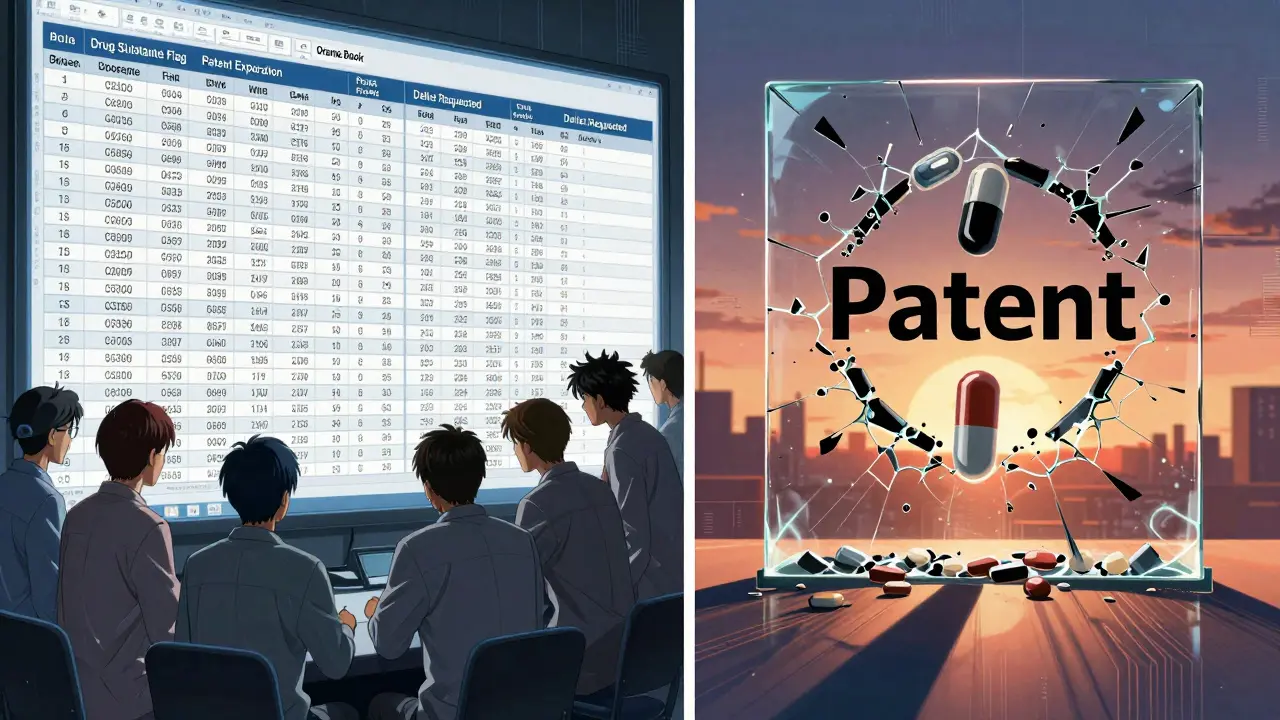
If you’re tracking dozens of drugs or building a market forecast, the web interface won’t cut it. The FDA provides daily downloadable data files at Orange Book Data Files.The CSV files include columns like:
- Product No - the unique identifier for each drug product
- Patent No - the actual U.S. patent number
- Patent Expiration - in MM/DD/YYYY format
- Drug Substance Flag - "Y" means the patent covers the active ingredient
- Drug Product Flag - "Y" means the patent covers the pill, capsule, or formulation
- Patent Use Code
- Delist Requested Flag - "Y" means the patent owner asked to remove it
Companies like CVS Health and Express Scripts use these files to predict which drugs will go generic next quarter. If you’re in pharma, finance, or policy, this is the gold standard.
Red Flags to Watch For
Not everything in the Orange Book is reliable. Here’s what to watch for:- Delist Requested = Y - If a patent owner asks to remove a patent, it often means they’ve lost the patent in court, or they no longer believe it’s enforceable. This can be a signal that a generic launch is coming soon.
- Multiple patents with close expiration dates - This is common with "evergreening," where companies file new patents on minor changes to delay generics. But if one patent expires and others are still active, the drug may still be protected.
- No patent listed at all - Some drugs have no patents. That doesn’t mean generics can’t come - it just means they’ve always been allowed to.
Why This Matters Right Now
In 2025, an estimated 78% of brand-name drug revenue will face generic competition. That’s up from 65% just five years ago. As more drugs lose patent protection, the Orange Book becomes more critical than ever.For patients, it means cheaper drugs are coming. For insurers, it means lower costs. For generic makers, it’s a race to file. And for the FDA, it’s a balancing act - ensuring patents are respected but not abused.
Remember: the Orange Book doesn’t tell you when a generic will launch. It tells you when the legal barriers fall. The actual launch depends on whether a generic company files a Paragraph IV certification, wins a lawsuit, or waits for exclusivity to expire.
What to Do Next
If you’re looking for patent expiration dates:- Start with the Electronic Orange Book for quick checks.
- For serious research, download the daily data files.
- Always cross-check with USPTO Patent Center for early expirations.
- Look for "Delist Requested = Y" - it’s a strong hint a patent is dead.
- Don’t ignore exclusivity dates - they can block generics even if patents have expired.
The system isn’t perfect. But if you know how to read it, the Orange Book gives you a clear window into the future of drug pricing - and who gets to sell what, and when.
Is the FDA Orange Book free to use?
Yes, the Electronic Orange Book and all downloadable data files are completely free and publicly accessible through the FDA’s website. No subscription or login is required.
Can I trust the patent expiration dates in the Orange Book?
The dates are usually accurate for patents with extensions, but the FDA doesn’t update the Orange Book if a patent expires early due to missed maintenance fees. About 46% of listed patents expire early, so always verify with the USPTO Patent Center for critical decisions.
What’s the difference between a patent and exclusivity in the Orange Book?
A patent is a legal right granted by the USPTO to protect an invention, like a drug’s chemical structure or method of use. Exclusivity is a regulatory protection granted by the FDA that blocks generics for a set time, even without a patent. Exclusivity can be for new chemical entities, orphan drugs, or pediatric studies. A drug can have both, one, or neither.
Why does the same patent appear twice in the Orange Book?
That’s usually pediatric exclusivity. When a drug maker completes FDA-requested pediatric studies, they get six months of additional market protection. The Orange Book lists the original patent date and then the same patent again with the six-month extension added. It’s not two patents - it’s one patent with a longer protection period.
How often is the Orange Book updated?
The Electronic Orange Book is updated daily. The downloadable data files are also refreshed every day, usually by 7 a.m. Eastern Time. This means patent listings, exclusivity dates, and delistings are current within 24 hours.
Do biologics appear in the Orange Book?
No. The Orange Book only covers small-molecule drugs. Biologics - like insulin, monoclonal antibodies, and vaccines - are listed in a separate database called the Purple Book, managed by the FDA’s Center for Biologics Evaluation and Research.
What does "Drug Substance Flag = Y" mean?
It means the patent covers the active ingredient - the actual chemical compound in the drug. These are the most valuable patents because they prevent any generic version of that ingredient from being made, regardless of formulation. If you’re looking for when a generic can enter the market, focus on patents with this flag.
Kelly McRainey Moore
January 20, 2026 AT 19:35Just used the Orange Book to check my dad's meds last week. Found out his brand-name pill was gonna go generic in 3 months. Saved him $200 a month. Seriously, if you're on any chronic med, this is a game-changer.
Don't overthink it. Just search the name and click 'Patents and Exclusivity'.
Yuri Hyuga
January 21, 2026 AT 20:30🌟 This is the kind of public infrastructure that makes me proud to live in a country that still invests in transparency. 🌟
The Orange Book isn’t just data-it’s democracy in action. Patients, pharmacists, startups-they all get equal access to the same truth.
And yet, so many still treat it like a secret club. Spread the word. Share this with someone who pays for prescriptions. Knowledge is the cheapest medicine we have.
Also, props to the FDA for keeping it daily updated. Rare in this age of digital neglect. 👏
Coral Bosley
January 22, 2026 AT 10:41Every time I see this stuff I get so angry. Big Pharma spends billions on lawyers to stretch patents by 6 months here, 18 months there, all while people skip doses because they can’t afford the $800 pill.
And now you’re telling me the government’s own database is full of outdated info? Of course it is. They don’t care. They’re not fixing it. They’re just letting us scramble in the dark while the CEOs buy yachts.
It’s not a tool. It’s a trap.
MAHENDRA MEGHWAL
January 23, 2026 AT 01:03Thank you for this comprehensive overview. The distinction between patent expiration and regulatory exclusivity is often misunderstood, even among healthcare professionals.
It is imperative to cross-reference the United States Patent and Trademark Office records, as the FDA's database does not reflect administrative lapses such as non-payment of maintenance fees.
This practice underscores the necessity of due diligence in pharmaceutical market analysis.
I shall share this resource with my colleagues in the Department of Pharmaceutical Economics.
Sangeeta Isaac
January 24, 2026 AT 22:51so like… i was literally just trying to figure out why my insulin was still $500 when the patent was ‘expired’ in 2022 and then i realized-oh. the orange book lists a patent that says ‘delivery system’ and it’s not expired until 2028. so they just repackaged the same damn chemical and called it a ‘new invention.’
also, pediatric exclusivity?? bro, you did a study on kids to get 6 extra months?? that’s not innovation, that’s a loophole.
and why does the uspto site crash every time i try to check? someone fix this. i need to know if i can afford my meds next year.
Alex Carletti Gouvea
January 25, 2026 AT 20:18Why are we even talking about this? The government shouldn’t be helping foreign generic makers steal American innovation. These patents protect jobs. Real American jobs.
If you want cheap drugs, go to Canada. Don’t let China and India profit off our R&D.
This isn’t about access-it’s about betrayal.
Philip Williams
January 27, 2026 AT 13:37While the Electronic Orange Book is an indispensable resource, its limitations must be acknowledged. The absence of real-time updates regarding patent revocations or early terminations due to non-payment of maintenance fees introduces significant risk for market entry planning.
Moreover, the reliance on Use Codes without a standardized, machine-readable taxonomy impedes automated analysis. A more robust API and structured data schema are urgently needed.
For academic and commercial applications, I recommend supplementing with USPTO’s Patent Full-Text and Image Database (PatFT) and the FDA’s Drug Registration and Listing System (DRLS) for comprehensive verification.
Ben McKibbin
January 28, 2026 AT 00:36Let’s be real-the Orange Book is the closest thing we have to a fair fight between innovators and generics. It’s not perfect, but it’s the rulebook.
That said, the ‘delist requested = Y’ flag is the real red flag. Companies don’t ask to remove patents unless they’re already losing in court. I’ve seen generics launch within weeks of that change.
And yeah, pediatric exclusivity? It’s a loophole, but it’s one Congress wrote. If you want to fix it, lobby Congress-not the FDA.
Also, biologics are in the Purple Book. Don’t confuse the two. I’ve seen analysts waste months on that mistake.
Uju Megafu
January 28, 2026 AT 06:51OF COURSE the FDA doesn’t update the database properly. Who do you think owns the FDA? Big Pharma. They pay the salaries. They write the rules.
And now you’re acting like this is some neutral tool? HA. It’s a weapon. They list patents they know are dead. They drag out exclusivity. They let people suffer so they can keep charging $1000 for a pill that costs $2 to make.
And you call this transparency? This is manipulation with a government seal.
Stop praising the system. Burn it down.
Stephen Rock
January 29, 2026 AT 14:30Amber Lane
January 29, 2026 AT 22:10My aunt in Nigeria gets her HIV meds through a generic program. She doesn’t know what the Orange Book is. But she knows the pill works and it’s affordable.
This system matters. Not because it’s perfect-but because it’s the only one that lets people like her live.
Don’t hate the tool. Use it. Then fight to make it better.