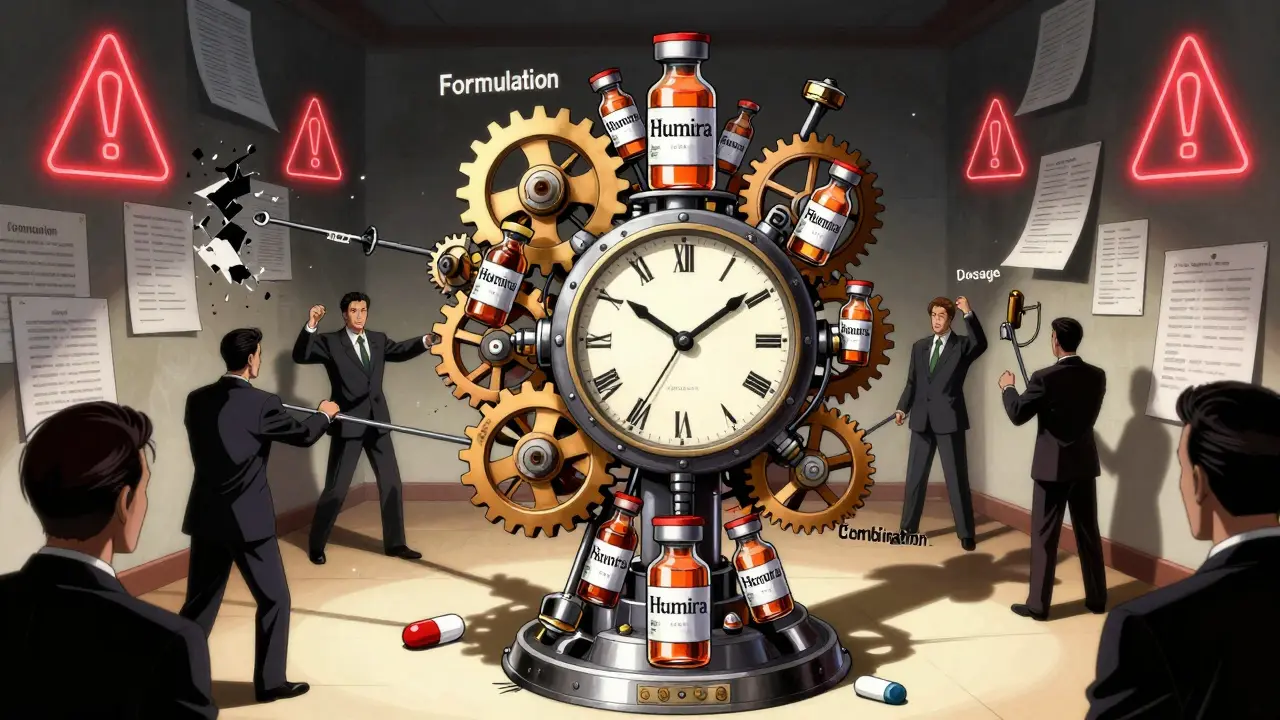
When a drug company invents a new medicine, it gets 20 years of patent protection. That’s the rule. But in reality, many blockbuster drugs stay off-limits to generics for decades longer-sometimes over 30 years. How? Through a practice called evergreening. It’s not about inventing better drugs. It’s about inventing tiny changes to old ones-just enough to reset the patent clock.
What Evergreening Really Means
Evergreening isn’t a loophole. It’s a legal strategy, built into the system. After the 1984 Hatch-Waxman Act, the U.S. created a path for generic drugs to enter the market faster. But it also gave drug makers tools to delay them. Instead of letting a patent expire and letting cheaper versions take over, companies file new patents on minor tweaks: a slightly different pill coating, a new dosage form, a changed release schedule, or a combo with another drug already on the market.
These aren’t breakthroughs. They’re tweaks. A pill that releases medicine slower? That’s not a new cure. It’s a tweak. A pill that comes in a capsule instead of a tablet? Still the same active ingredient. But under patent law, these changes can qualify for a new 20-year clock. And sometimes, they get extra exclusivity too-like five years for a new use, or six months for pediatric studies.
The result? A single drug can have dozens of patents stacked on top of each other. AbbVie’s Humira, used to treat rheumatoid arthritis and Crohn’s disease, had 247 patent applications filed around it. Over 100 were granted. That’s not innovation. That’s a patent thicket-a wall of legal barriers designed to scare off generic makers who can’t afford to fight 100 lawsuits.
How It Works: The Playbook
Drug companies don’t wait until the last minute. They start planning five to seven years before the original patent expires. Teams of chemists, lawyers, and regulatory experts work together to find every possible angle to extend exclusivity.
- New formulation: Switching from a tablet to a liquid, or adding a time-release coating. AstraZeneca did this with Prilosec, turning it into Nexium-same active ingredient, but a new patent.
- New combination: Pairing an old drug with another drug that’s already off-patent. Suddenly, it’s a "new" product.
- Product hopping: Pulling the old version off the market and pushing patients to the new version. Patients are told the old one is "less safe" or "less effective," even when the difference is negligible.
- Authorized generics: The brand company itself launches a generic version at a lower price-just enough to keep real generics out. It looks like competition, but it’s still their product.
- Patenting genetic tests: If a drug works better for people with a certain gene, patent the test to identify them. Now, generics can’t even test patients without permission.
Each of these moves adds months or years. And when you stack them? You get decades. AstraZeneca extended market control on six drugs by over 90 years combined. That’s not a fluke. It’s standard business.
The Cost to Patients and the System
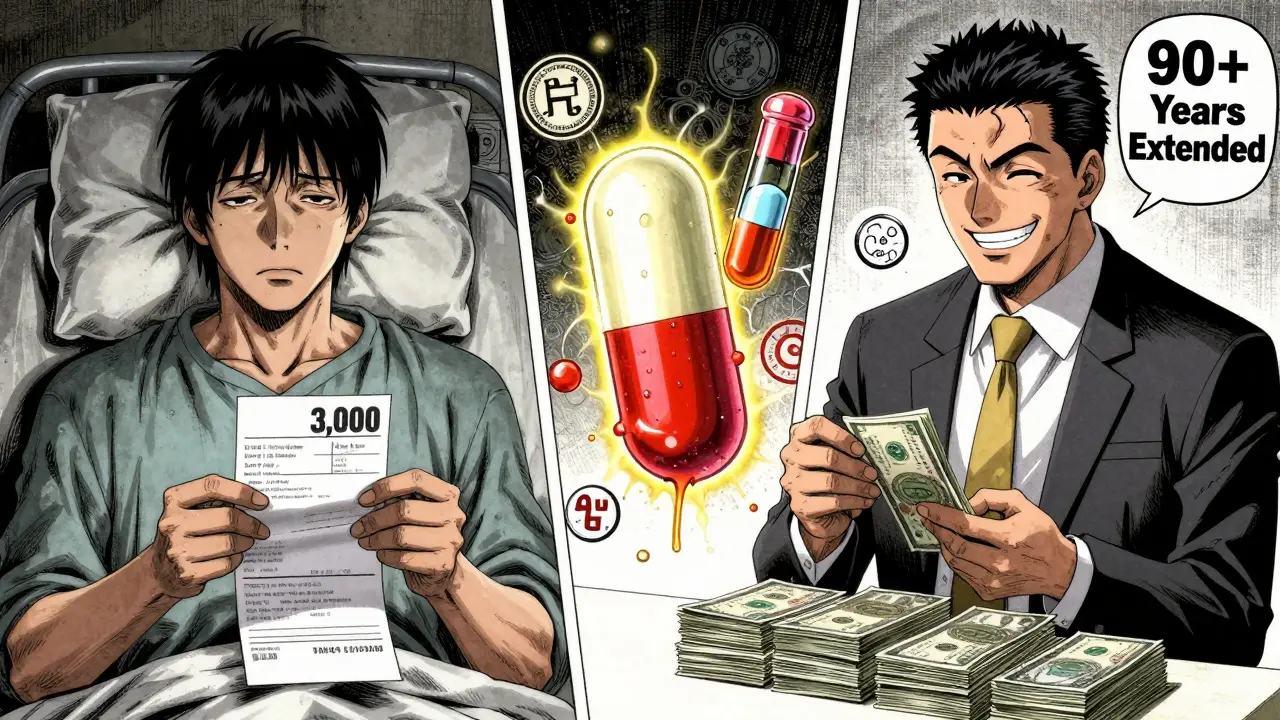
When a drug goes generic, prices drop by 80% to 85% within a year. That’s the power of competition. But evergreening blocks that. Patients keep paying $500, $1,000, or even $3,000 a month for drugs that could cost $50.
Humira alone brings in $40 million a day in revenue for AbbVie. That’s because, for over a decade, no generic could enter. Millions of Americans with autoimmune diseases had no choice. Many skipped doses. Some went without. The system was designed to reward innovation-not to lock in profits on old drugs.
And it’s not just Humira. Drugs for diabetes, acid reflux, high cholesterol-all have been through this. The same active ingredients. The same effects. But patients pay premium prices because the brand companies won’t let go.
It’s not just about money. It’s about access. In low- and middle-income countries, evergreening keeps life-saving drugs out of reach entirely. The World Health Organization has called it a barrier to global health equity.
Why It’s Not Innovation
Developing a truly new drug costs $2.6 billion and takes 10 to 15 years. It’s risky. Most fail. But evergreening? It costs a fraction of that. A chemist tweaks a molecule. A lawyer files a patent. A marketing team rebrands it. Done.
Harvard researchers found that 78% of new patents for prescription drugs are for existing drugs-not new ones. That means the system is being used to protect old money, not fund new science.
Real innovation should be rewarded. But when companies spend more on legal teams than on R&D, you’re not getting better medicine-you’re getting more expensive medicine.
Regulators Are Fighting Back
The system isn’t completely broken. There are signs of pushback.
In 2022, the U.S. Federal Trade Commission sued AbbVie over Humira’s patent strategy, calling it anticompetitive. The FTC argued that the 247 patents were a sham-a way to block competition without real innovation.
The Inflation Reduction Act of 2022 let Medicare negotiate prices for some of the most expensive drugs. That cuts the profit motive behind evergreening. If the government can cap prices, companies lose the incentive to stretch patents just to keep high prices.
The European Medicines Agency now requires proof of "significant clinical benefit" before granting extra exclusivity. That’s a big shift. It means you can’t just tweak a drug-you have to prove it’s better for patients.
And the U.S. Patent Office is getting stricter on "obvious" patents. If a change is too simple, too predictable, it’s being rejected.
What’s Next?
Drug companies aren’t giving up. They’re evolving.
Now, they’re moving into biologics-complex drugs made from living cells. These are harder to copy. Even if a patent expires, making an exact copy is nearly impossible. So companies are patenting delivery systems, storage methods, and even the way the drug is administered.
They’re also using pharmacogenomics-patenting genetic tests that determine who responds to the drug. That creates a new layer of control.
But the tide is turning. Public pressure is rising. More lawmakers are asking: Why should a company get 30 years of monopoly on a drug that’s been around for 15?
Patients aren’t asking for free medicine. They’re asking for fair competition. If a drug’s active ingredient is old, why shouldn’t it be cheap?
Final Thought: The System Was Designed to Balance Two Things
Patents exist to reward innovation. Generics exist to make medicine affordable. Evergreening breaks that balance. It turns a temporary monopoly into a permanent one.
The real question isn’t whether companies should protect their inventions. It’s whether they should be allowed to game the system to keep old drugs off the market. The answer, for many, is no.
Is evergreening illegal?
No, evergreening isn’t illegal-but it’s heavily contested. It operates within patent law, using legal mechanisms like new patents, exclusivity periods, and regulatory loopholes. However, regulators and courts are increasingly challenging it when modifications are deemed non-inventive or when the strategy is used to block competition without real clinical benefit. Lawsuits like the FTC’s case against AbbVie show that legal systems are starting to treat some evergreening tactics as anticompetitive.
How long can a drug stay protected through evergreening?
A drug can be protected for 30 years or more. The original patent lasts 20 years from filing. But with additional exclusivity periods-like five years for a new use, three years for new clinical data, six months for pediatric studies, and new patents on formulations-companies can stack protections. AstraZeneca extended protection on six drugs by over 90 years total. Humira’s protections were extended to 2034, more than 20 years beyond its original patent.
Do evergreened drugs work better than generics?
Almost always, no. The active ingredient is identical. Changes like a time-release coating or a different pill shape don’t improve how well the drug treats the disease. In most cases, generics are just as effective. The FDA requires generics to meet the same standards for safety and effectiveness. The difference is price-generics cost 80-85% less.
What’s the difference between evergreening and patent extension?
Patent extension is a legal adjustment granted by the U.S. Patent Office to make up for delays caused by regulatory review. It’s limited and based on real delays in approval. Evergreening is a strategic filing of multiple new patents on minor changes to the same drug. It’s not about fixing delays-it’s about restarting the clock. Evergreening is proactive; patent extension is reactive.
Can generic companies fight back?
Yes, but it’s expensive. Generic manufacturers can challenge patents in court, but a company with 100+ patents forces them into a legal marathon. Many can’t afford it. Some settle by paying royalties to the brand company. Others wait until the last patent expires. The FTC and Congress are now supporting reforms to make it easier for generics to enter the market faster, especially when patents are clearly weak.
Amina Aminkhuslen
March 7, 2026 AT 17:33Let me get this straight-pharma execs are out here filing 247 patents on one drug like it’s a fucking LEGO set? And we call this innovation? Nah. This is corporate kleptocracy with a white coat and a law degree. Humira’s not a miracle drug-it’s a money printer with a side of suffering. Millions skipping doses because they can’t afford the $500 pill when the active ingredient costs $2 to make? That’s not capitalism. That’s feudalism with better PR.
I’ve seen people cry in pharmacy lines. I’ve held the hands of folks who chose between insulin and rent. This isn’t about R&D. It’s about greed dressed up as science. The system isn’t broken-it was designed this way. And we’re still surprised when the machine eats the poor?
They patent genetic tests now? Like, if your DNA doesn’t match their proprietary algorithm, you’re not allowed to take the damn drug? That’s not medicine. That’s sci-fi horror written by a patent lawyer who got high on caffeine and corporate bonuses.
And don’t even get me started on authorized generics. ‘Oh, we’re lowering prices!’ No, you’re just sucking the oxygen out of real competition so you can keep your yacht fueled. You’re not a company-you’re a rent-seeking vampire with a marketing team.
The FTC finally sued? Took them long enough. But lawsuits won’t fix this. We need to burn the whole patent thicket down and rebuild it with one rule: if it’s the same damn molecule, it should be cheap. Period.
Every time I hear someone say ‘patents incentivize innovation,’ I want to scream into a pillow. Innovation? You’re not inventing cures-you’re inventing loopholes. And we’re all paying the price.
They’re moving to biologics now? Great. More complexity. More barriers. More patients left behind. This isn’t progress. It’s evolution of exploitation.
Someone needs to start a movement: #SameMoleculeSamePrice. No more games. No more patents on coatings. No more pediatric extensions. Just the drug. The dose. The cost. Let the market do what it’s supposed to do-drive prices down. Not up.
And if you’re still defending this? You’re not pro-business. You’re pro-bank account.
Andrew Poulin
March 8, 2026 AT 01:56Same molecule. Same effect. Different price. That’s the whole scam.
Joe Prism
March 9, 2026 AT 09:16Patents were meant to reward creation, not manipulation. What we’re seeing isn’t capitalism-it’s legal fiction. A drug company isn’t innovating; it’s playing chess with the law while patients starve for access.
The real tragedy? We all know this is wrong. But no one’s willing to cut the cord. Too many lobbyists. Too much money. Too many politicians on retainer.
It’s not about whether companies should profit. It’s whether they should profit from something that’s been around for 15 years. That’s not a business model. That’s a moral failure.
Imagine if we treated vaccines this way. ‘Sorry, you can’t get the flu shot-it’s still under patent.’ We’d riot. So why do we accept it for chronic disease drugs?
Maybe the answer isn’t more lawsuits. Maybe it’s a public patent reset. Let old molecules go free. Let generics win. Let the system breathe.
amber carrillo
March 11, 2026 AT 03:28I’ve worked in healthcare for over 20 years, and I’ve seen firsthand how patients suffer when affordable alternatives are blocked. This isn’t just about economics-it’s about dignity. People shouldn’t have to choose between their health and their housing. The fact that this practice is legal is a reflection of how far we’ve drifted from our ethical foundations.
I’m not anti-business. I believe in innovation. But innovation should mean new cures, not new ways to keep old ones expensive. The system needs recalibration, not just litigation.
There’s hope in the FTC’s actions and the Inflation Reduction Act. Change is slow, but it’s happening. We must keep pushing-not with anger, but with clarity and compassion.
Vikas Verma
March 12, 2026 AT 00:55From a pharmaceutical economics standpoint, evergreening represents a suboptimal allocation of R&D capital. The marginal utility of incremental patent extensions is negative when weighed against societal health outcomes and systemic cost burdens.
Regulatory capture is evident in the disproportionate influence of industry lobbying on FDA and USPTO decision-making frameworks. The 5-year new use exclusivity and 6-month pediatric exclusivity mechanisms were originally designed to incentivize pediatric trials and novel indications-not to enable perpetual market exclusivity via trivial formulation changes.
Empirical data from the Journal of Health Economics shows that 78% of pharmaceutical patents post-2000 are for secondary innovations. This indicates a structural shift from therapeutic advancement to financial engineering.
Biologics and pharmacogenomic barriers represent the next frontier of rent extraction. The complexity of biosimilars is being weaponized as a non-technical barrier to entry. This requires policy intervention-not just litigation.
Global health equity is not a moral imperative-it’s an economic inevitability. As LMICs build domestic manufacturing capacity, the current U.S.-centric patent regime will collapse under its own weight.
Bridget Verwey
March 12, 2026 AT 15:33Oh wow, so the same drug that costs $50 in India costs $3,000 here? And we’re supposed to clap because the company ‘invented’ a capsule instead of a tablet? Sweet. Can I get a gold-plated pill with a 30-year warranty? I’ll take two.
Let’s be real: if this were a taco, you’d be charged $20 for the same beans because you put them in a different tortilla. We’d call you a scammer. But because it’s Big Pharma? Congrats, you’re a visionary.
I’m not mad-I’m just disappointed. We’ve been lied to for decades. And now we’re supposed to be grateful when a regulator finally says, ‘Hey, maybe that’s not a real innovation.’
Next time someone says ‘patents protect innovation,’ hand them a Humira receipt and ask them to explain why their ‘breakthrough’ tastes like a bank statement.
Adebayo Muhammad
March 14, 2026 AT 03:07Let’s not pretend this is about drugs. This is about the death of meritocracy. The system was engineered to transfer wealth upward-disguised as intellectual property. The patent office is not a court of law-it’s a casino where lawyers roll dice with human lives.
Every patent extension is a vote of no confidence in the public’s right to health. Every authorized generic is a psychological trick to make you think you’re getting choice when you’re getting manipulation.
And the biologics? That’s the next stage of corporate feudalism. You won’t just pay more-you’ll pay to be *allowed* to be treated. Genetic tests? That’s not medicine. That’s biometric surveillance with a prescription pad.
They’ve turned healthcare into a subscription service. And we’re the unpaid subscribers.
There’s no solution in law. The law is the weapon. The only solution? Revolution. Not protest. Not petition. A full systemic collapse. Then rebuild.
And don’t tell me ‘it’s complicated.’ It’s not. It’s theft. With a flowchart.
Sean Callahan
March 15, 2026 AT 05:32i just read this and i dont even know what to say anymore like i get that drugs are expensive but like… why does it feel like we’re being played by robots? like who even designed this system? some guy in a suit with a calculator and no soul? i just took my mom’s diabetes med and i was like… this thing costs what? and i cried? i dont even know why. its not even about the money. its like… we’re supposed to trust this system? and it just… breaks you? i dont know. i just feel so tired. like why do we have to fight just to breathe? i dont even know what i’m saying anymore
Pranay Roy
March 17, 2026 AT 00:10Evergreening is just the tip of the iceberg. Did you know the FDA and USPTO are secretly funded by Big Pharma through revolving door appointments? The same people who approve patents used to work for Pfizer. The same regulators who say ‘no’ to generics used to be paid by the same companies they now regulate. This isn’t corruption. It’s institutionalized treason.
And the WHO? They’re just a PR front. They don’t have the power to act. They’re funded by Gates and Rockefeller foundations who have their own pharma investments. You think they’re going to condemn a system that profits their donors?
There’s a global cabal. They’re not just extending patents-they’re controlling access to oxygen. Literally. Because if you can control medicine, you control survival. And they’ve been doing it for decades. The pandemic proved it. They held back vaccines. Now they’re holding back generics. Same playbook.
It’s not a coincidence that every time a country tries to make generics, they get trade sanctions. China? Sanctioned. India? Sanctioned. Brazil? Sanctioned. It’s not about health. It’s about control.
You think this is about drugs? No. It’s about power. And we’re just livestock.