Esketamine Blood Pressure Risk Calculator
Blood Pressure Assessment
This calculator helps you understand if your current blood pressure puts you at risk for serious side effects when considering esketamine treatment for depression.
When you’ve tried multiple antidepressants and still feel stuck in deep depression, the idea of a treatment that works in hours instead of weeks can feel like a lifeline. Esketamine nasal spray - sold under the brand name Spravato - is one of the first antidepressants in decades that doesn’t work on serotonin or norepinephrine. Instead, it targets the brain’s glutamate system, offering rapid relief for people with treatment-resistant depression. But it’s not a simple pill you pick up at the pharmacy. It comes with intense side effects, strict monitoring rules, and a level of oversight you won’t find with any other depression medication.
How Esketamine Works - And Why It’s Different
Most antidepressants, like SSRIs or SNRIs, take weeks to kick in. They slowly adjust brain chemicals tied to mood. Esketamine works differently. It blocks NMDA receptors, which are part of the glutamate system - the brain’s main excitatory signaling pathway. This isn’t just a tweak. It’s a reset. Within hours, some patients report feeling less numb, more connected, even hopeful. That’s why it’s used only when other treatments have failed - typically after at least two antidepressants didn’t help. The drug is delivered as a nasal spray, not an injection or pill. You self-administer it under the watch of a healthcare provider in a certified clinic. It’s absorbed quickly: peak levels hit your bloodstream in 20 to 40 minutes. That’s when the effects - both good and bad - start to show.Dissociation: The Most Common Side Effect
If you’ve never heard of dissociation, you’re not alone. But if you’ve taken esketamine, you probably have now. Dissociation means feeling detached from yourself or your surroundings. It’s not hallucinating, but it can feel like it: time slows down, your body feels unreal, sounds seem muffled, or you feel like you’re floating. In clinical trials, over half of patients (56%) reported dissociation after their first dose. That’s compared to just 14% in the placebo group. It’s not the same as being high on ketamine - though they’re chemically related. The experience is usually milder and more predictable. Most people describe it as “dreamlike” or “out of body.” It peaks around 40 minutes after spraying and fades within two hours. By the fourth or fifth treatment, many say it’s much less intense - sometimes barely noticeable. Clinics use a tool called the CADSS (Clinician-Administered Dissociative States Scale) to measure how strong it is. If your score hits 3 or higher, it’s considered severe. That happened in about 6% of patients during trials. But even then, most people don’t panic. They’re in a calm, quiet room with trained staff nearby. Soft lighting, no phones, no distractions. That’s part of the protocol.Blood Pressure Spikes - And Why They Matter
Esketamine doesn’t just change how you feel mentally. It changes your body too. Blood pressure rises - sometimes sharply. In trials, 33% of patients saw their systolic pressure jump above 140 mmHg. For someone with high blood pressure, that’s dangerous. Diastolic pressure (the bottom number) can climb 7 to 16 points. These spikes start within 5 minutes, peak at 40 minutes, and drop back down by the end of the 2-hour monitoring window. That’s why you can’t just take this at home. You need to be monitored. Your blood pressure is checked before the spray, then every 5 to 10 minutes for the first half hour, then every 15 to 30 minutes after that. If your pressure goes above 180/110, treatment stops. You’re not allowed to get esketamine if you have uncontrolled high blood pressure, a history of stroke, aneurysm, or recent heart attack. Most people don’t feel anything during the spike. No headache, no dizziness. But the risk is real. One patient on PatientsLikeMe stopped treatment after two sessions because his systolic pressure hit 170 - even though he was already on blood pressure meds. That’s why screening is so strict.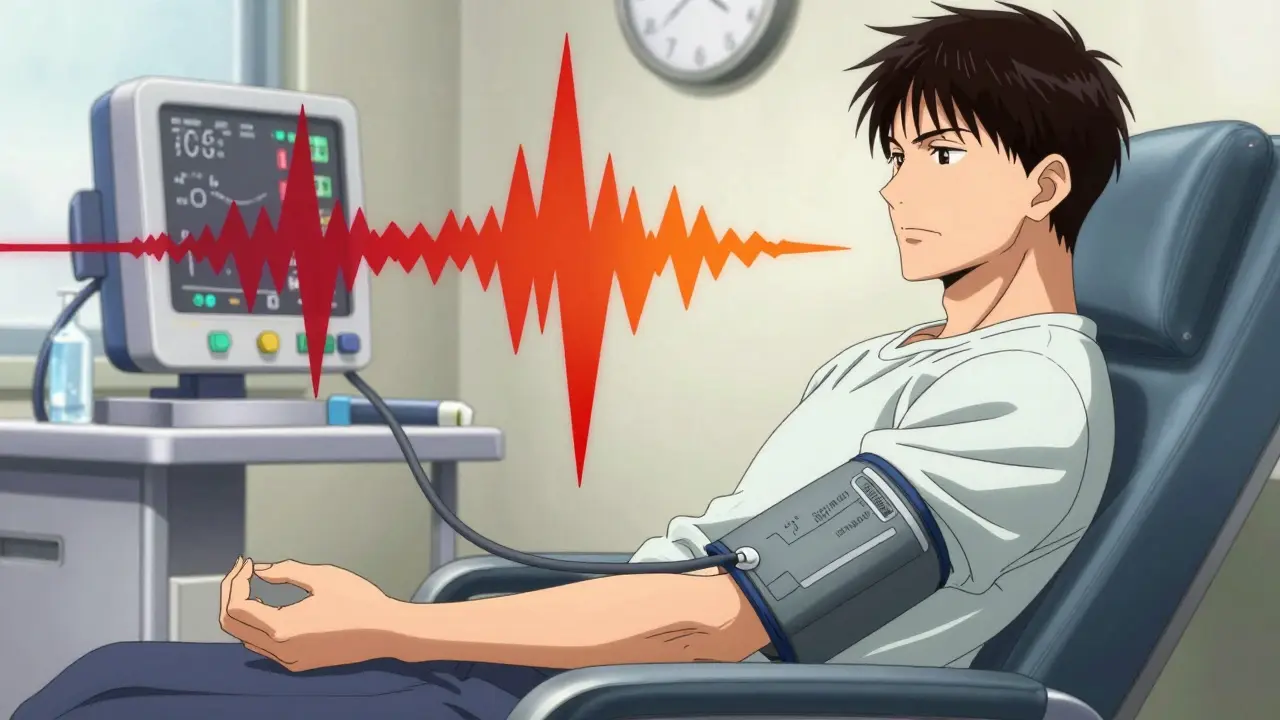
The 2-Hour Monitoring Rule - And Why It Exists
You don’t leave the clinic until at least two hours after your spray. That’s not optional. It’s part of the FDA’s Risk Evaluation and Mitigation Strategy (REMS), a safety program designed to prevent misuse and manage acute side effects. The clinic must be certified, staff must be trained, and they need emergency equipment on hand - oxygen, benzodiazepines for severe reactions, and tools to monitor your vitals. The 2-hour window isn’t arbitrary. It’s based on when side effects peak and fade. Dissociation and blood pressure changes usually resolve by then. But some clinics are starting to test shorter times. A 2023 trial found that 63% of patients were stable after just one hour. Based on that, the FDA approved a new option: if you’ve had several treatments and your side effects stay mild, you might be able to leave after 60 minutes. It’s not universal yet - but it’s a step toward making access easier.What the Clinics Are Doing Right (and Where They Struggle)
There are now over 2,800 certified Spravato clinics in the U.S. That’s up from just 350 in 2019. But setting one up isn’t cheap. The average cost to equip a room - with private space, monitoring gear, staff training, and emergency supplies - is around $18,500. Staff spend about 2 hours and 15 minutes per patient: 15 minutes for prep, 5 minutes to spray, and two full hours of monitoring. The biggest challenges? Patient anxiety, scheduling conflicts, and insurance delays. Many people are scared of dissociation before they even try it. Clinics that spend time explaining what to expect see 32% less anxiety. Others use calming techniques: dim lights, headphones with soothing music, no talking unless needed. Only 1.2% of treatments need emergency drugs like benzodiazepines. Most patients just sit quietly, breathe, and wait it out. And that’s where the system works: trained staff know exactly what to do. In fact, 91% of positive reviews on Drugs.com mention that the staff made them feel safe.
Real People, Real Experiences
On Reddit’s r/Spravato, users share stories that mirror the data. One person wrote: “My first treatment felt like I was watching myself from the ceiling. I was terrified. By my fourth, I just felt a little spaced out - and then I cried for the first time in months.” Another said: “I have hypertension. My doctor said no. But I begged for a trial. My pressure went to 165. They watched me for two hours. It came down. I did two more sessions and stopped. It helped my depression - but not worth the risk.” On Healthgrades, the average rating is 3.7 out of 5. People who benefit most are those who’ve tried everything else. Those who respond well often say it’s life-changing. Those who don’t tolerate it say the side effects outweigh the relief.Is It Worth It?
Esketamine isn’t for everyone. It’s not a first-line treatment. It’s not a magic cure. But for people with treatment-resistant depression - those who’ve lost hope after years of failed meds - it offers something rare: a chance to feel human again, quickly. The dissociation and blood pressure spikes are real. They’re not minor. But they’re predictable. And they’re managed. The monitoring system isn’t perfect - it’s expensive, time-consuming, and hard to access in rural areas. But it’s designed to keep you safe while giving you a shot at recovery. The future might bring easier versions: oral pills, fewer clinic visits, digital monitoring tools. But for now, esketamine works because it’s controlled. The side effects are part of the treatment. And the monitoring? That’s what makes it possible.Can I take esketamine at home?
No. Esketamine nasal spray (Spravato) can only be administered in certified healthcare settings under direct supervision. This is required by the FDA’s REMS program due to risks of dissociation and blood pressure spikes. You must stay for at least 2 hours after each dose. Home use is not permitted.
How long do dissociation and high blood pressure last after a dose?
Both dissociation and blood pressure increases typically begin within 5 to 10 minutes, peak around 40 minutes, and resolve within 1.5 to 2 hours. Most patients return to baseline before leaving the clinic. In rare cases, mild dizziness or detachment may linger for up to 4 hours, but serious symptoms are uncommon after the 2-hour monitoring window.
Is esketamine addictive?
Esketamine is chemically related to ketamine, which has abuse potential. But in clinical use, addiction is rare. The controlled setting, low dosing schedule (twice weekly at first, then once weekly or biweekly), and strict monitoring reduce misuse risk. The FDA has not classified it as a controlled substance, but long-term data is still being collected. Patients are screened for substance use disorders before starting treatment.
Who should not use esketamine nasal spray?
You should not use esketamine if you have uncontrolled high blood pressure (systolic >160 or diastolic >100), a history of aneurysm, arteriovenous malformation, recent heart attack, or active substance use disorder. It’s also not approved for people under 18 or for depression without a current moderate-to-severe episode. Always discuss your full medical history with your provider.
How soon will I feel better?
Many patients report improvements in mood, energy, or suicidal thoughts within 24 to 48 hours after the first dose. In clinical trials, significant symptom reduction was seen as early as day 4. This is much faster than traditional antidepressants, which often take 4 to 6 weeks. Full benefit usually builds over 4 to 6 weeks of treatment, with maintenance doses given weekly or every other week.
Do I still need my regular antidepressant?
Yes. Esketamine is approved only for use with an oral antidepressant. It’s not meant to replace your current medication. The combination works better than either alone. Stopping your oral antidepressant can reduce the effectiveness of esketamine and increase the risk of relapse. Always follow your doctor’s guidance on medication changes.
Alvin Bregman
January 14, 2026 AT 06:25ive been on every ssri known to man and this sounds like a miracle but also like a trap
Jason Yan
January 15, 2026 AT 21:00the real breakthrough here isnt the drug its the structure around it. most mental health care treats you like a problem to be solved not a person to be held. esketamine forces you into a space where someone is literally watching you breathe for two hours. thats radical compassion disguised as protocol. its not just medicine its a ritual of safety.
Sarah -Jane Vincent
January 17, 2026 AT 17:52they say its not addictive but dont you think the fda just says that because theyre scared of backlash if they classify it as controlled? ketamine is a party drug and this is basically the same thing with a white coat. theyre hiding the truth behind clinical jargon and monitoring rules. next thing you know its being sold on the dark web as "spravato lite"
Vicky Zhang
January 18, 2026 AT 00:05i had my first session last week and i swear i felt my soul come back into my body. the dissociation was wild at first like i was floating above my own life but the staff held space for me so gently. i cried for 20 minutes after and it was the first real release i’d had in five years. this isnt magic its medicine with heart.
Andrew Freeman
January 19, 2026 AT 21:20they charge 800 a dose and you gotta go twice a week for a month and then once a week forever and insurance takes 6 months to approve it. so basically its a luxury treatment for rich people who can afford to wait. meanwhile people in flyover states are still waiting for their first antidepressant to kick in
says haze
January 21, 2026 AT 03:54the entire framework of esketamine treatment reveals the pathological failure of modern psychiatry. weve reduced human suffering to biochemical equations while ignoring the existential rot beneath. the dissociation isnt a side effect its a revelation. the body is screaming what the mind has been trained to silence. and the clinic? its not a treatment center its a cathedral of forced presence in a world that has forgotten how to be still.
shiv singh
January 22, 2026 AT 16:03you people are so naive. this is just another way for big pharma to make billions while pretending they care. they know people are desperate so they sell them a dream wrapped in a monitoring room. and dont get me started on how they make you keep your regular antidepressant like you’re some kind of broken machine that needs two different kinds of fuel
Sarah Triphahn
January 23, 2026 AT 22:37if you’re getting dissociation you’re doing it wrong. this isn’t a spiritual experience its a medical procedure. people who romanticize it are just looking for an excuse to feel special. if you’re crying after a session you probably just needed a hug not a nasal spray
Dylan Livingston
January 23, 2026 AT 23:54oh wow so now we’re giving people hallucinogens in a room with dim lights and calling it therapy? how progressive. next they’ll hand out ayahuasca in a cubicle with a clipboard and a wellness pamphlet. the only thing more absurd than this is that people are grateful for it. you’re not healing you’re being sedated with a side of performative safety
Anna Hunger
January 24, 2026 AT 11:32the clinical data supporting esketamine is robust and methodologically sound. the risk mitigation strategy is not excessive but rather proportionate to the pharmacological profile of the compound. given the mortality rate associated with treatment-resistant depression, the current protocol represents a responsible and ethically defensible standard of care.
Henry Sy
January 24, 2026 AT 22:13the blood pressure thing is wild. i had mine spike to 170 and i felt nothing. no headache no sweat just this weird calm like my body was doing its own thing while my mind was on mars. the nurse just kept checking the monitor like it was a weather report and said "yep still climbing" like it was normal. and honestly? it kinda was
Robert Way
January 25, 2026 AT 23:45why do they make you wait 2 hours? cant they just give you a ride home? i had to miss work and my kid had a recital and i was so dizzy i couldnt even text my wife. this whole system is broken
Allison Deming
January 25, 2026 AT 23:55while the efficacy of esketamine is empirically supported, the structural inequities in access cannot be ignored. the requirement for certified clinics, trained personnel, and continuous monitoring creates a tiered system of mental healthcare where socioeconomic status determines not just access but dignity. this is not innovation-it is medical apartheid dressed in white coats.